Clear Sky Science · en
Wideband circularly polarized dielectric resonator antenna with high gain for microwave wireless power transfer
Power Through the Air
Imagine your home full of tiny sensors, wearables, or even small drones that never need to be plugged in or have their batteries changed. Wireless power transmission aims to make that vision real by sending energy through the air, much like Wi‑Fi sends data. This paper presents a new kind of compact antenna that can beam microwave power farther, more efficiently, and with less concern about how the receiving gadget is oriented in space.
Why Beaming Power Is Hard
Sending useful amounts of power over a distance is trickier than sending a data signal. The energy quickly spreads out, so the transmitting antenna must concentrate it into a tight beam with high “gain.” At the same time, phones, sensors, and flying devices rarely stay neatly aligned with a transmitter. If the electric field of the wave points in one fixed direction (linear polarization), any tilt or rotation of the receiver can drastically cut the captured power. Circular polarization, where the field effectively spins as the wave travels, solves this by delivering more stable power regardless of device orientation, but making antennas that are both strongly circular and wideband—working well across a broad range of frequencies—has been a persistent engineering challenge.
A New Shape for Better Beams
To tackle this, the authors design a new three‑dimensional radiator made from a low‑cost plastic commonly used in 3D printing. Instead of a simple block, the antenna core resembles a cup‑shaped cone sitting on a flattened ring. By carefully adjusting the cone height and the ring size, the structure supports several resonant patterns of the electromagnetic field that merge into a single, continuous operating band. This means the antenna can stay efficient across a wide range of frequencies centered on 5.8 gigahertz, a standard industrial, scientific, and medical band often used for wireless power experiments. Simulations show that increasing the height of this structure activates higher‑order field patterns that significantly boost the beam strength without sacrificing bandwidth.

Smart Feeding from Below
An antenna’s performance depends as much on how it is “fed” with energy as on its visible shape. Here, the researchers carve two overlapping elliptical openings and small circular notches into the metal layer beneath the 3D‑printed cone and ring. These openings act like carefully tuned valves that split and delay the currents in just the right way for the fields to spin, creating circular polarization over a broad frequency range rather than at a single narrow point. The feed line that brings power to these slots is also sculpted into a key‑like profile of rectangles and circles so that the incoming energy matches the antenna’s natural impedance, reducing reflections that would otherwise waste power. Two small angled holes inside the plastic cone further fine‑tune how the fields swirl, broadening the range of frequencies where the circular motion remains strong.
Cleaning Up the Beam
Early versions of the design produced unwanted side and back lobes—stray directions where energy leaks instead of going toward the intended receiver. To fix this, the team added two connected circular cuts in the ground plane to reshape the current flow beneath the antenna, largely wiping out the side lobes. They then placed a simple metal plate, acting as a reflector, behind the whole structure at a specific distance. This reflector cancels most of the backward radiation and nudges more energy into the forward beam. The result is a compact single‑element antenna with a strong, well‑directed main lobe, a front‑to‑back ratio over 15 decibels, and peak gain around 11.1 decibels relative to a standard circularly polarized source—values that rival or beat many multi‑antenna arrays.
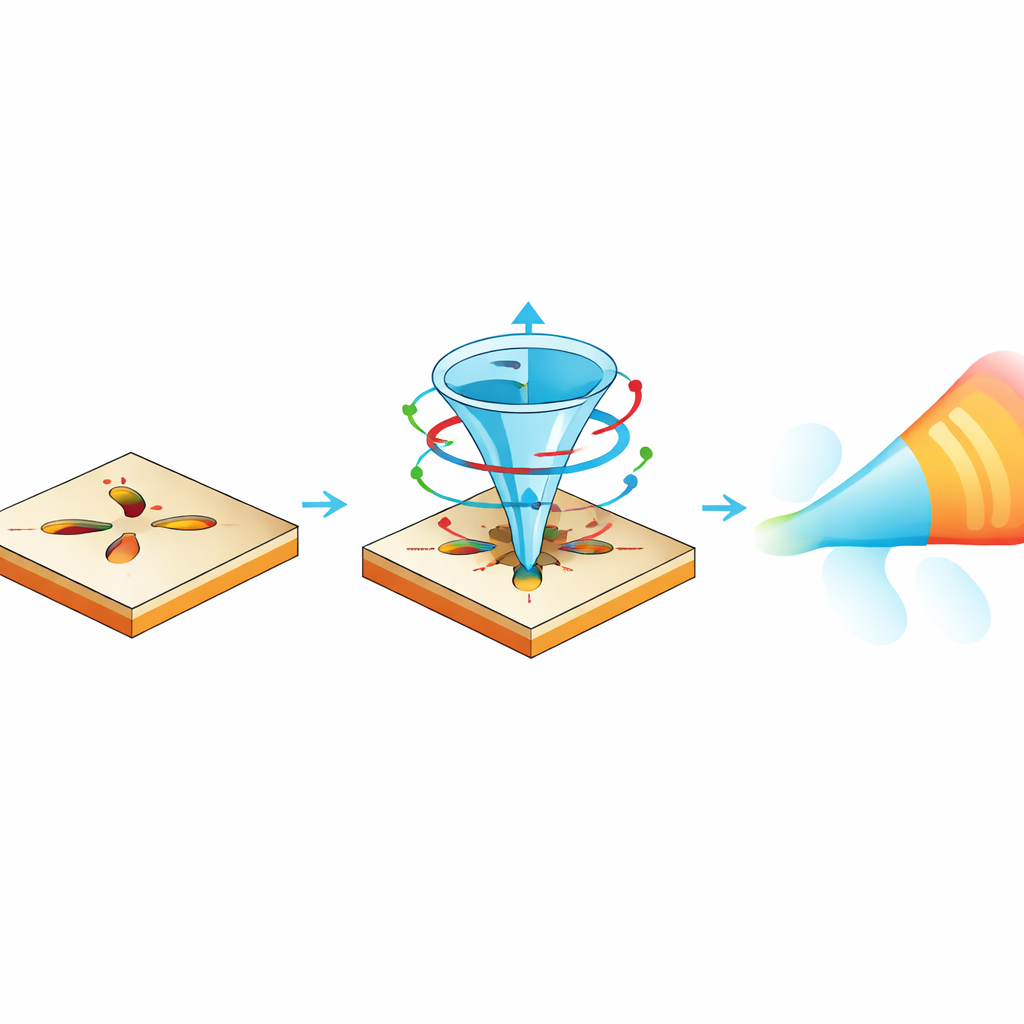
Proving It Works in the Real World
The team fabricated the design using ordinary 3D printing for the plastic core and standard circuit‑board technology for the metal layers and feed line, keeping cost and complexity low. Measurements in an anechoic chamber showed that the antenna operates from about 3.3 to 6.4 gigahertz, with a broad region where the polarization remains effectively circular. The measured gain closely matches simulations, reaching about 9.5 decibels without the reflector and higher with it. A simple link‑budget analysis suggests that, within a few meters, the antenna can deliver enough received power for typical energy‑harvesting circuits to operate at efficiencies above 50 percent, allowing small sensors to recharge in minutes rather than hours.
What This Means for Everyday Devices
In plain terms, the authors have built a low‑cost “power spotlight” that works over a wide band of microwave frequencies and keeps sending energy efficiently even as devices move and rotate. By combining an unusual 3D‑printed shape with a cleverly carved feed structure and reflector, they overcome the usual trade‑off between strong beams and wide operating range. This makes the antenna a promising building block for future wireless‑power networks that could quietly top up battery‑free sensors in homes, factories, and cities, bringing the idea of maintenance‑free connected devices a step closer to everyday reality.
Citation: Abdalmalak, K.A., Abdelmoneim, L.H., Alsirhani, K.F. et al. Wideband circularly polarized dielectric resonator antenna with high gain for microwave wireless power transfer. Sci Rep 16, 8833 (2026). https://doi.org/10.1038/s41598-026-39831-7
Keywords: wireless power transfer, circularly polarized antenna, dielectric resonator, 3D-printed electronics, microwave energy harvesting