Clear Sky Science · en
Hydro-mechanical coupling and microstructural evolution mechanism of expansive soil under full suction range
Why Cracking Hillsides Matter
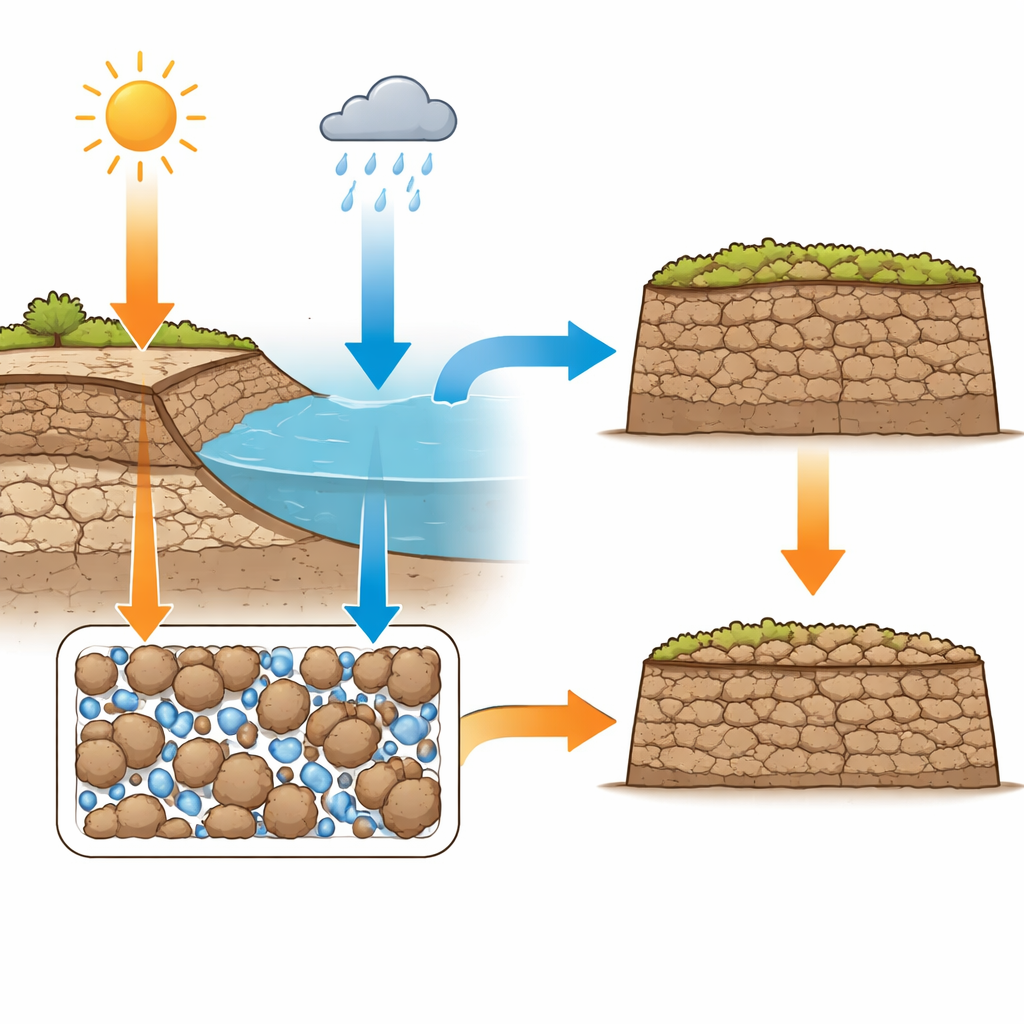
Across the world, stretches of canals, roads, and building foundations rest on a tricky kind of ground called expansive soil. This soil swells when it gets wet and shrinks when it dries, which can crack canal banks, tilt pavements, and damage structures. China’s South-to-North Water Diversion Project, for example, runs for hundreds of kilometres over such soils. This study explores, in detail, how water moving in and out of expansive soil reshapes its internal pore network and, in turn, controls how much the ground swells or shrinks. Understanding this hidden behaviour can help engineers design safer embankments and reduce costly damage.
Soil That Breathes with the Weather
Expansive soil is not a solid block; it is a framework of tiny mineral particles with pores in between and inside clusters of grains. When rainfall, canal water levels, and seasonal changes drive cycles of drying and wetting, water flows in and out of these pores. The researchers focused on a weak expansive soil used to build a canal embankment in central China. They recreated field-like conditions in the lab by preparing compacted soil samples that matched the natural density and moisture of the embankment. Then they subjected these samples to repeated drying–wetting cycles across an exceptionally wide range of “suction” – a measure of how strongly the soil holds on to water, from near-saturated states to extremely dry conditions.
Tracing How Water Comes and Goes
To map how much water the soil retains at each suction level, the team combined three laboratory methods that together cover the full range from very wet to extremely dry. Pressure plate tests handled low suctions, special salt solutions controlled the humidity for very high suctions, and a dew-point device filled in the gaps. From these they built a soil–water characteristic curve, a kind of fingerprint showing how water content, pore space, and saturation evolve as the soil dries and rewets. They found strong “hysteresis”: the path the soil follows while drying does not retrace itself when the soil wets again. At the same suction, dried soil tends to be denser and holds more water than soil that has been rewetted, because air bubbles get trapped, pore shapes differ, and the angles at which water advances or recedes on particle surfaces are not the same.
Hidden Two-Level Pore Network
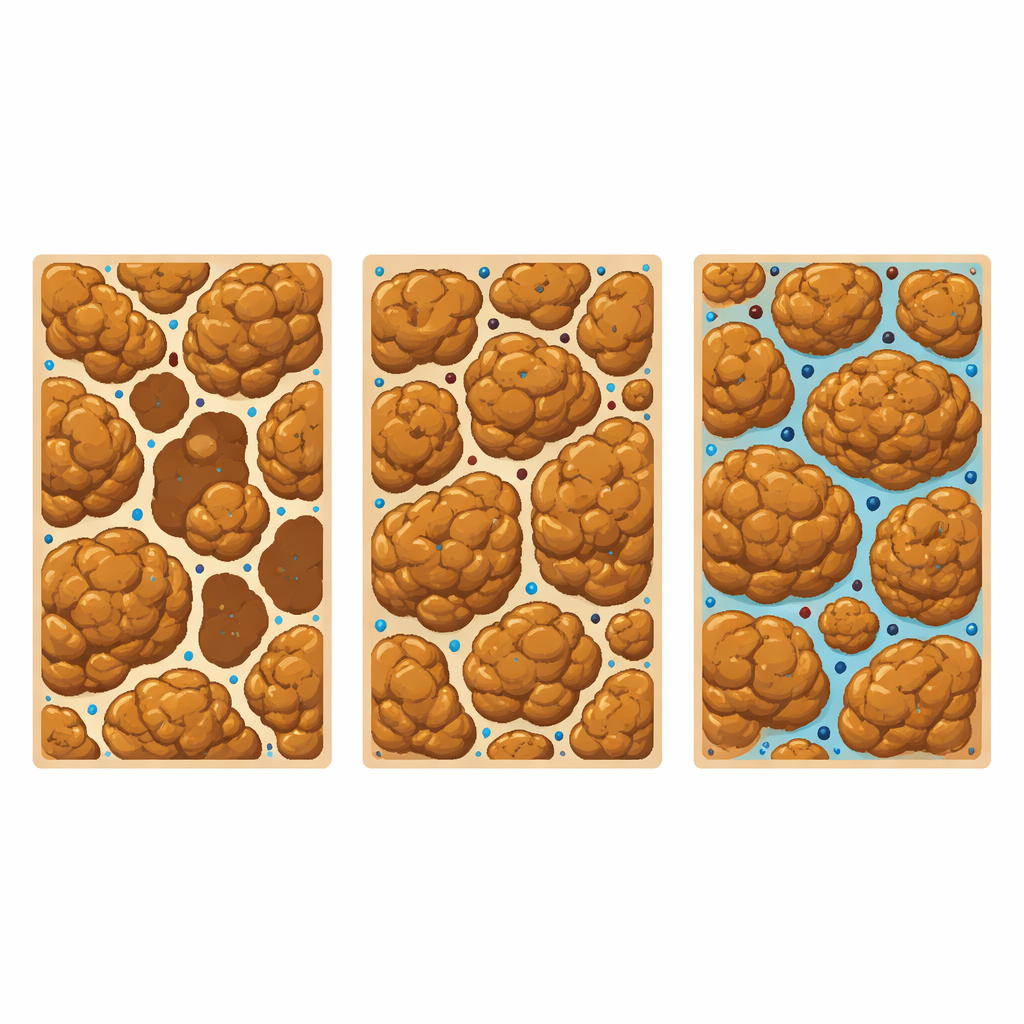
To see what happens inside, the researchers used mercury intrusion tests and scanning electron microscopy to view and measure pores across many scales. The soil’s internal structure turned out to be clearly dual: large pores lie between particle aggregates, while much smaller pores sit within each aggregate. The dividing line between these two pore families is around 0.2 micrometres. Across all suction levels, the tiny internal pores keep a remarkably stable volume distribution, while the larger pores change dramatically. As suction increases and the soil dries, the largest pores shrink or close, total pore volume drops, and the soil contracts. When the soil is rewetted, the process unfolds in three stages: initially, big pores close and the dominant pore size becomes smaller; in an intermediate stage, the overall distribution stays relatively steady; finally, as the soil becomes wetter, aggregates swell, macropores partly refill and rearrange, and the whole sample experiences noticeable expansion.
Microscopic Shifts, Macroscopic Damage
Electron microscope images show this transformation as a shift from smooth, plate-like structures with wide, connected gaps at low suction to tighter, more granular patterns with many small pores and microcracks at high suction. As water is removed, the forces between particles strengthen, plates break into smaller pieces, and large pores collapse into finer ones. During wetting, the aggregates push outward, partly filling former voids. Because the balance between water and air in large and small pores changes at different rates, the same overall void ratio can correspond to different levels of saturation depending on whether the soil is drying or wetting. This tight coupling between water state and pore geometry means that the mechanical stress carried by the soil skeleton evolves differently on each path, leaving behind irreversible deformation after each cycle.
What This Means for Real-World Structures
For non-specialists, the key message is that expansive soil behaves like a breathing sponge with two distinct pore systems: stable tiny pores locked inside aggregates and highly responsive larger pores between them. The study shows that the way these larger pores open, close, and redistribute during drying–wetting cycles explains both the strong hysteresis in water retention and the large volume changes seen in the field. Recognizing the controlling role of this dual-pore microstructure allows engineers to build better models of how embankments will move over time, improve designs for canal linings and reinforcements, and anticipate where shrink–swell damage is most likely to occur.
Citation: Wang, D., Li, M. & Wang, Z. Hydro-mechanical coupling and microstructural evolution mechanism of expansive soil under full suction range. Sci Rep 16, 8347 (2026). https://doi.org/10.1038/s41598-026-39828-2
Keywords: expansive soil, soil microstructure, unsaturated soils, suction and swelling, canal embankment stability