Clear Sky Science · en
Computational assessment of flow dynamics and turbulence generation in hydrofoil-crested weirs
Why shaping a simple barrier in a river really matters
When engineers build dams, spillways, or irrigation canals, they often rely on low walls called weirs to measure and control how much water is flowing. A newer style, the hydrofoil‑crested weir, has a smooth, wing‑like crest that helps water glide over it. This study asks a deceptively simple question with big practical consequences: how much does the thickness of that smooth crest change the speed, pressure, and churning of the water that passes over it—and what does that mean for energy loss, structural safety, and accurate flow measurement?
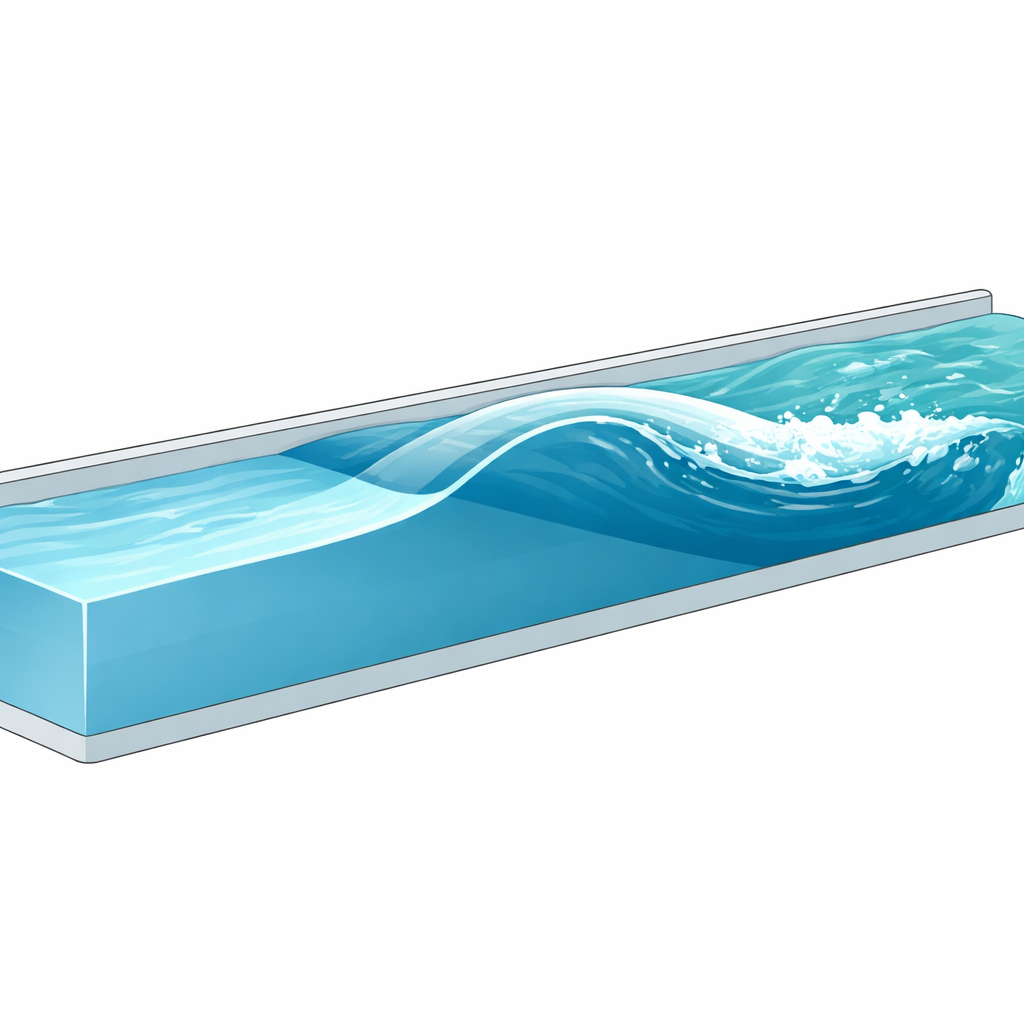
Shaped like a wing, working like a valve
Hydrofoil‑crested weirs are designed a bit like airplane wings laid across the bottom of a channel. Instead of a sharp step, water meets a curved surface, slides up and over it, and forms a fast jet near the surface downstream. Compared with older weirs, these shapes can pass more water smoothly and with less wasted energy. Yet engineers lacked a clear, quantitative picture of how different crest thicknesses—thinner versus thicker “wings”—change the flow, especially when it comes to turbulence, the swirling motion that both dissipates energy and can stress structures. This work tackles that gap by comparing several hydrofoil shapes under different flow rates.
Simulating flowing water in fine detail
Because carefully measuring every swirl in a laboratory flume is difficult, the authors turned to high‑resolution computer simulations. They modeled water flowing through a long, narrow channel and over three hydrofoil‑shaped crests of the same length but different thicknesses. The virtual water obeys the same physics as in reality, using a standard set of equations that average out the smallest eddies while still capturing the overall structure of the flow and the free water surface. Before exploring new shapes, the team checked their approach against earlier laboratory experiments and found that the simulated velocities matched measured values to within a few percent, giving confidence that the model could reliably explore how crest thickness changes flow behavior.
How thickness reshapes speed and pressure
The simulations revealed that crest thickness strongly influences the water’s speed just upstream and just downstream of the hydrofoil, but that these differences fade with distance. Thicker crests produced a faster, earlier‑forming surface jet, with near‑surface speeds up to about 20% higher than those over thinner crests and a broader high‑velocity zone in the upper part of the flow. Farther downstream, however, velocities over all shapes converged to similar values. Pressure patterns told a similar story. Thicker crests created stronger local pressure peaks upstream and sharper drops immediately beyond the crest—differences of up to roughly 15% under the same flow. Yet within a few tenths of a meter downstream, pressure returned to a near‑hydrostatic state, much like what would be found in calm water, indicating that the strongest shape effects are confined to the immediate crest region.
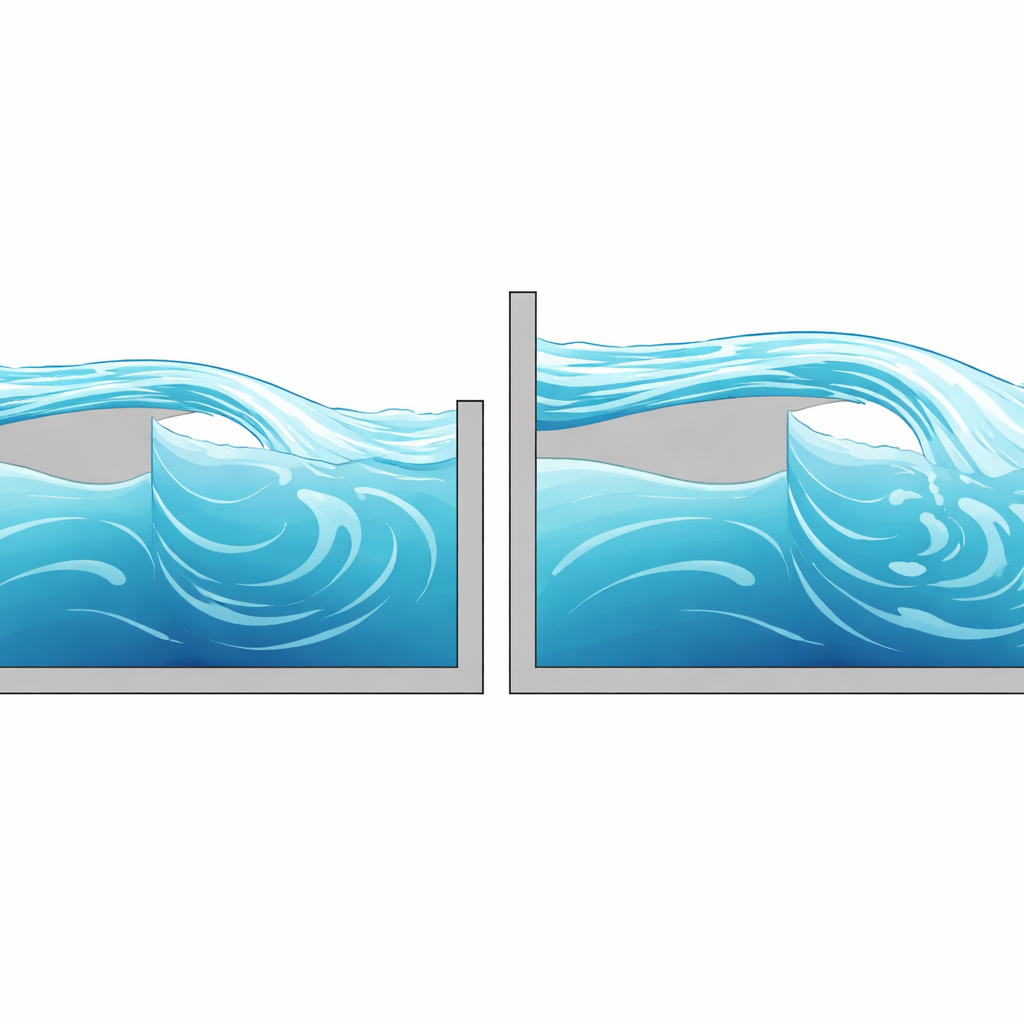
When extra churning helps, and when it hurts
The most striking differences appeared in the flow’s turbulence. The thickest crest generated significantly higher levels of turbulent kinetic energy, intensity, and dissipation, especially near the surface and mid‑depth. In practical terms, this means more vigorous vertical mixing and more efficient loss of the water’s excess kinetic energy—differences that reached on the order of 30–40% compared with the thinnest crest. That can be a major advantage when the goal is to safely bleed off energy, as in spillways below dams. On the other hand, greater turbulence also means stronger fluctuating forces on concrete and steel, more potential for surface instability, and a higher risk of issues like cavitation, where very low pressures can damage surfaces. Thinner crests, by contrast, produced smoother velocity and pressure fields and allowed turbulence to die out more quickly downstream, favoring stable conditions and more reliable flow measurements.
Balancing calm control and safe energy loss
Put simply, the study shows that the “thickness of the wing” in a hydrofoil‑crested weir acts like a dial between calm control and aggressive energy dissipation. Thicker crests turn more of the water’s orderly motion into swirling turbulence right after the crest, helping to sap energy quickly but increasing local loads and potential wear. Thinner crests keep the flow more orderly, with gentler pressure changes and less churning, which is better for precise gauging and structural comfort but less effective at removing energy. By mapping these trade‑offs in detail, the work offers designers a clearer guide for choosing and tuning hydrofoil weirs to fit their purpose—whether that is to quietly measure flow in a canal or to safely tame the powerful jets pouring over a dam.
Citation: Ghaderi, A., Rezaei, A.H., Mohammadnezhadaghdam, A.H. et al. Computational assessment of flow dynamics and turbulence generation in hydrofoil-crested weirs. Sci Rep 16, 8394 (2026). https://doi.org/10.1038/s41598-026-39825-5
Keywords: hydrofoil-crested weir, turbulence, energy dissipation, computational fluid dynamics, open-channel flow