Clear Sky Science · en
Tailoring electron bunch quality in laser-plasma acceleration: a comparative study of Bessel-Gaussian and Gaussian laser profiles under variable plasma density geometries
Why Tiny Plasma Accelerators Matter
Today’s most powerful particle accelerators stretch for kilometers and cost billions of dollars, yet many scientific, medical, and industrial applications would benefit from compact, affordable sources of high‑energy electron beams. Laser‑plasma accelerators promise to shrink this technology to tabletop scales by using intense laser pulses to surf electrons on waves in a thin gas. This paper explores how to fine‑tune these miniature machines so that the electron bunches they produce are not only energetic, but also well controlled and useful for real‑world applications.
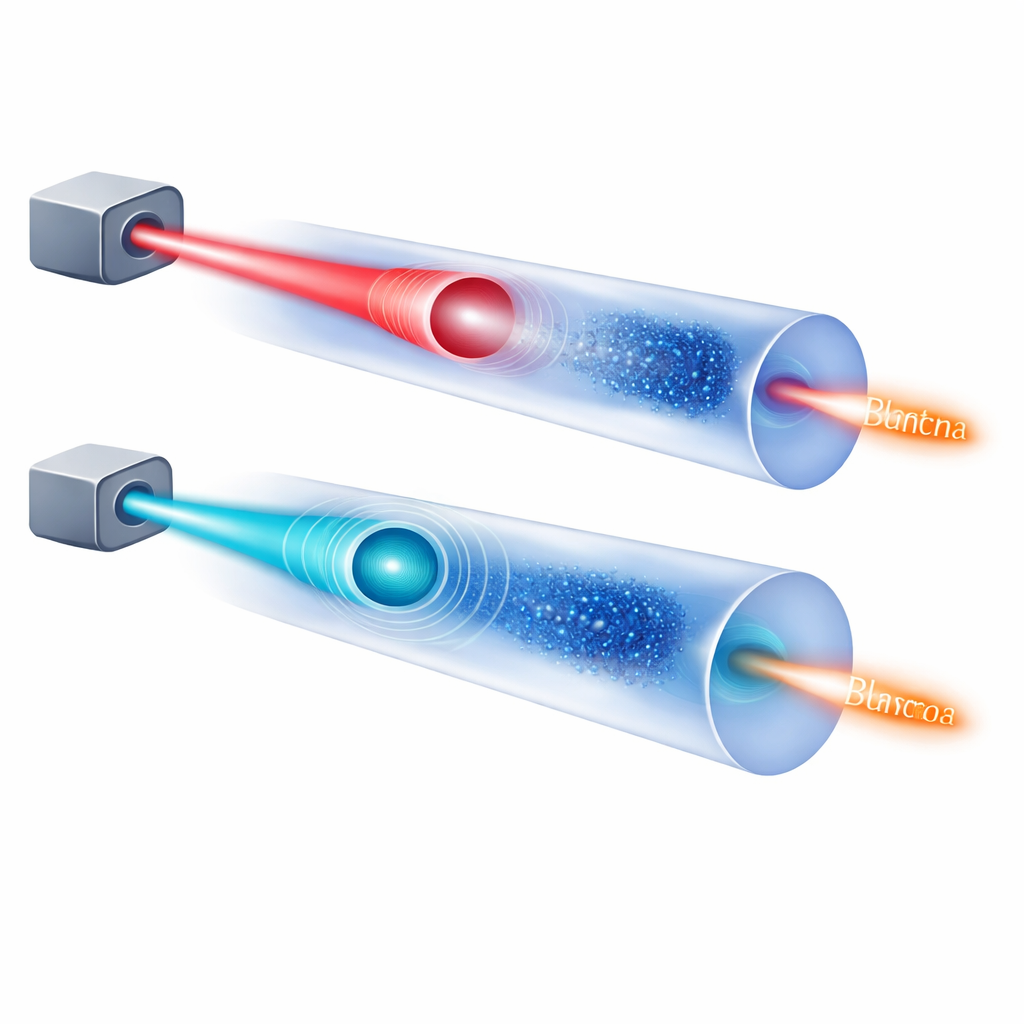
Riding Waves in a Sea of Charged Gas
In a laser‑plasma accelerator, a short, powerful laser pulse travels through a plasma—a gas whose atoms have been stripped of their electrons. As the laser plows forward, it pushes electrons aside and leaves behind a positively charged “bubble.” The strong electric fields in and around this bubble can accelerate trailing electrons to near light speed over just a few millimeters. The challenge is to inject the right number of electrons into the right part of this moving bubble at the right time. Too few electrons and the beam is weak; too many and they spoil the very fields that accelerate them, broadening the energy spread and degrading beam quality.
Two Ways to Shape a Laser Beam
The authors compare two different laser beam shapes: the familiar Gaussian beam, which is brightest at its center and fades smoothly outward, and a Bessel‑Gaussian beam, whose brightness has a bright core surrounded by a ring. Both beams are given the same total energy so that any differences in performance come from their shapes, not their power. Using detailed computer simulations, the team studies how each beam drives waves in the plasma and how that affects the amount and quality of injected electrons. They also vary how the plasma density changes along the path of the laser, especially the length of a high‑density “plateau” region, to see how the plasma itself can be used as a control knob.
Shaping the Plasma Like a Gentle Slope
The plasma density profile is designed with three main sections: an initial rise, a flat high‑density region, and then a gradual drop to a lower density. As the laser enters the falling‑density region, the bubble behind it swells, and some background electrons fall into the right position to be trapped and accelerated. By changing the length of the high‑density plateau, the researchers can make injection start earlier or later and last longer or shorter. Their simulations show that longer high‑density sections encourage earlier and stronger injection, filling the bubble with more charge. Shorter or absent plateaus lead to more modest injection, but also to cleaner, more uniform acceleration.
Trading Charge for Beam Purity
For every plasma shape they test, the Bessel‑Gaussian beam tends to pull in more electrons than the Gaussian beam, thanks to its stronger and more extended wake. This higher charge is attractive if one wants intense beams, but it comes at a cost: the accumulated electrons “load” the wakefield, weakening the accelerating forces and limiting the maximum energy the bunch can reach. In contrast, the Gaussian beam injects fewer electrons in more localized bursts, which leaves the accelerating field less disturbed. Under some conditions—especially when the high‑density plateau is removed altogether—the Gaussian beam produces electron bunches with higher average energies and very narrow energy spreads, meaning the electrons emerge with nearly the same energy.
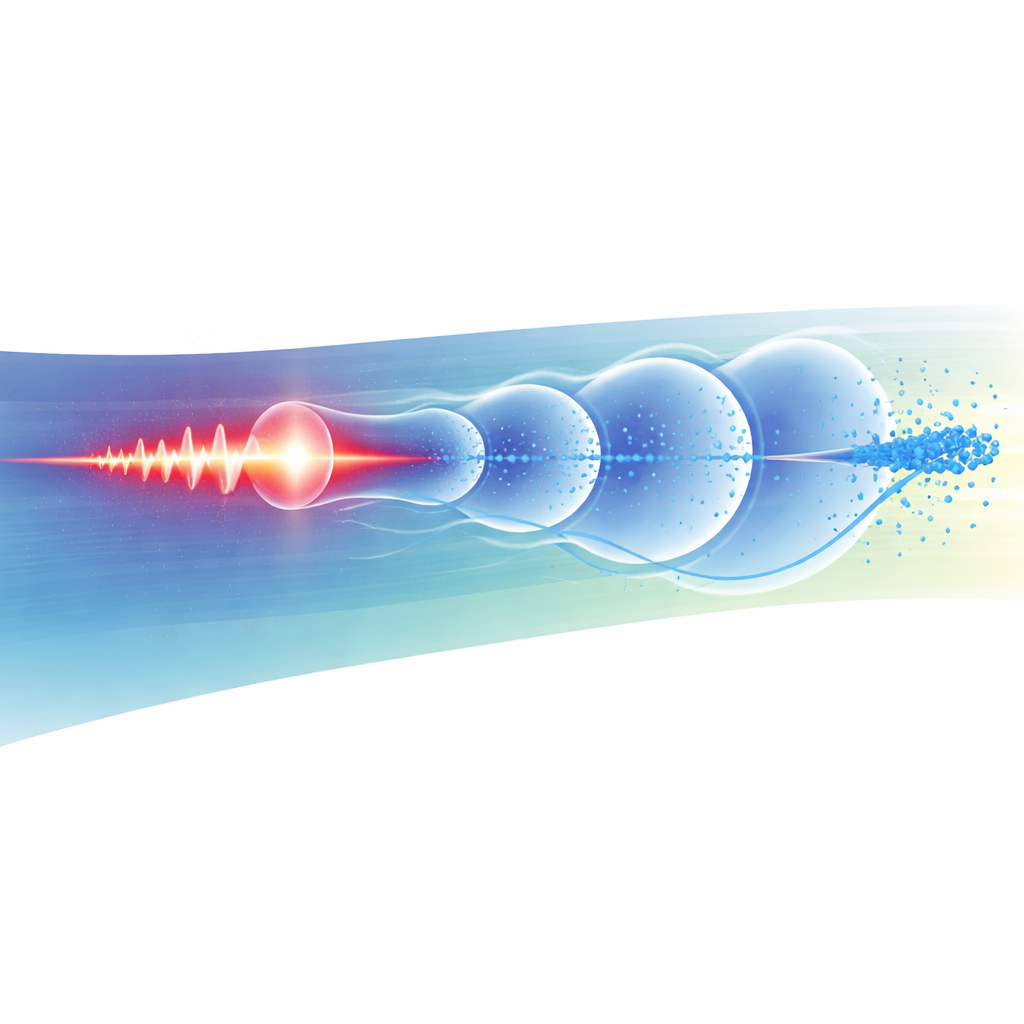
Keeping the Beam Narrow and Steady
Beyond how many electrons are captured and how energetic they become, their sideways motion also matters. If electrons wiggle too much as they are accelerated, the beam’s cross‑section widens and its “sharpness” declines. The study finds that the sideways squeezing forces inside the plasma bubble remain similar for both laser shapes; what really matters is when and where electrons are injected. Longer high‑density regions tend to trap electrons closer to the center and over a shorter time, which keeps their sideways oscillations small and preserves a narrow beam. Shorter plateaus or a simple down‑ramp let electrons join from farther out and at later times, giving them larger sideways swings and a gradual growth in beam width.
Design Rules for Compact Future Accelerators
Overall, the work shows that neither laser shape is universally better. Bessel‑Gaussian beams are well suited when a large amount of charge is needed, while Gaussian beams excel when the goal is a tightly defined, high‑energy bunch with a small spread in energy. The key lesson for non‑specialists is that both the laser beam pattern and the way the plasma density changes along the accelerator can be engineered to balance charge, energy, and beam sharpness. This provides practical design guidelines for next‑generation compact accelerators that could power advanced X‑ray sources, medical therapies, and high‑energy physics experiments without the need for giant facilities.
Citation: Khooniki, R., Fallah, R., Khorashadizadeh, S.M. et al. Tailoring electron bunch quality in laser-plasma acceleration: a comparative study of Bessel-Gaussian and Gaussian laser profiles under variable plasma density geometries. Sci Rep 16, 8592 (2026). https://doi.org/10.1038/s41598-026-39821-9
Keywords: laser wakefield acceleration, plasma accelerator, electron beam quality, Bessel-Gaussian laser, density tailoring