Clear Sky Science · en
DEM study of fines content effects on shear strength of binary mixtures under low confining pressure
Why tiny grains matter for big structures
From train tracks to sea walls and even lunar landers, many engineering projects rest on masses of sand and gravel. These granular materials may look simple, but their strength depends not only on the size of the main grains, but also on how many tiny "fines" are mixed in and how strongly the whole mass is squeezed by surrounding pressure. This study uses advanced computer simulations to show how small changes in fine particles and pressure can dramatically alter the way grains lock together, and proposes a new way to predict when such materials will hold firm or give way. 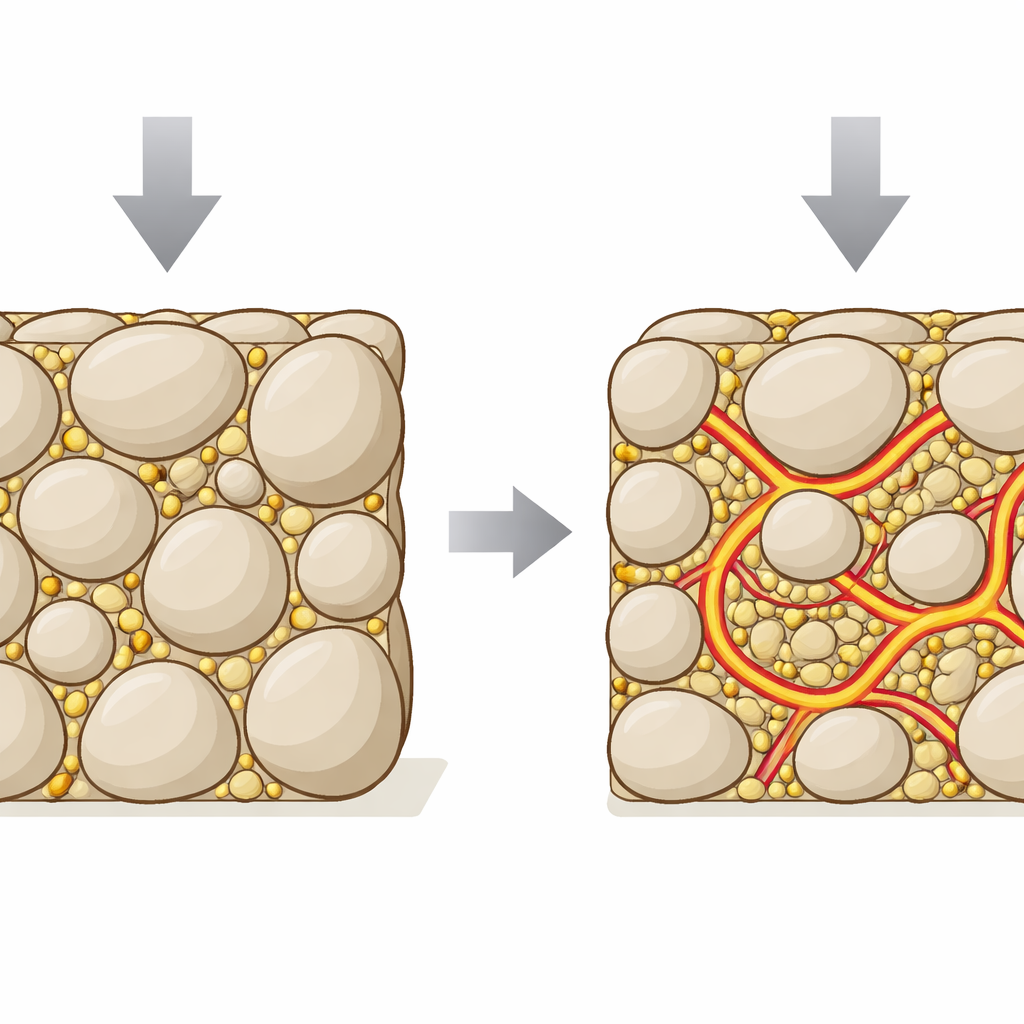
How engineers usually think about sandy ground
Designers of slopes, embankments, and foundations rely on parameters that describe how soil resists sliding when it is squeezed. At relatively high pressures, standard lab tests and simple formulas work reasonably well, so engineers often extrapolate those results down to low pressures. But real-world problems such as shallow landslides, liquefaction during earthquakes, or settlement beneath light structures frequently occur in this low-pressure range. Experiments there are technically difficult and easily distorted by friction in the testing devices, and measurements show that soil strength changes in a curved, not straight-line, fashion as pressure drops. On top of that, natural soils almost always contain fines produced by weathering and transport, and earlier studies have disagreed on whether these small grains strengthen or weaken the soil.
Peeking inside the grain skeleton with virtual tests
To untangle this puzzle, the authors turned to the discrete element method, a numerical approach that models thousands of individual grains and the forces between them. They built three-dimensional virtual samples made of large and small spherical particles with different proportions of fines, and subjected them to simulated triaxial compression tests that mimic standard lab procedures: prepare the sample, squeeze it evenly from all sides to a chosen pressure, then compress it vertically to make it shear. By carefully calibrating the contact properties of the particles using real glass-bead data, they ensured that the virtual tests reproduced laboratory results under higher pressures, and then systematically explored pressures from 10 to 1000 kilopascals and fines contents up to 30 percent. 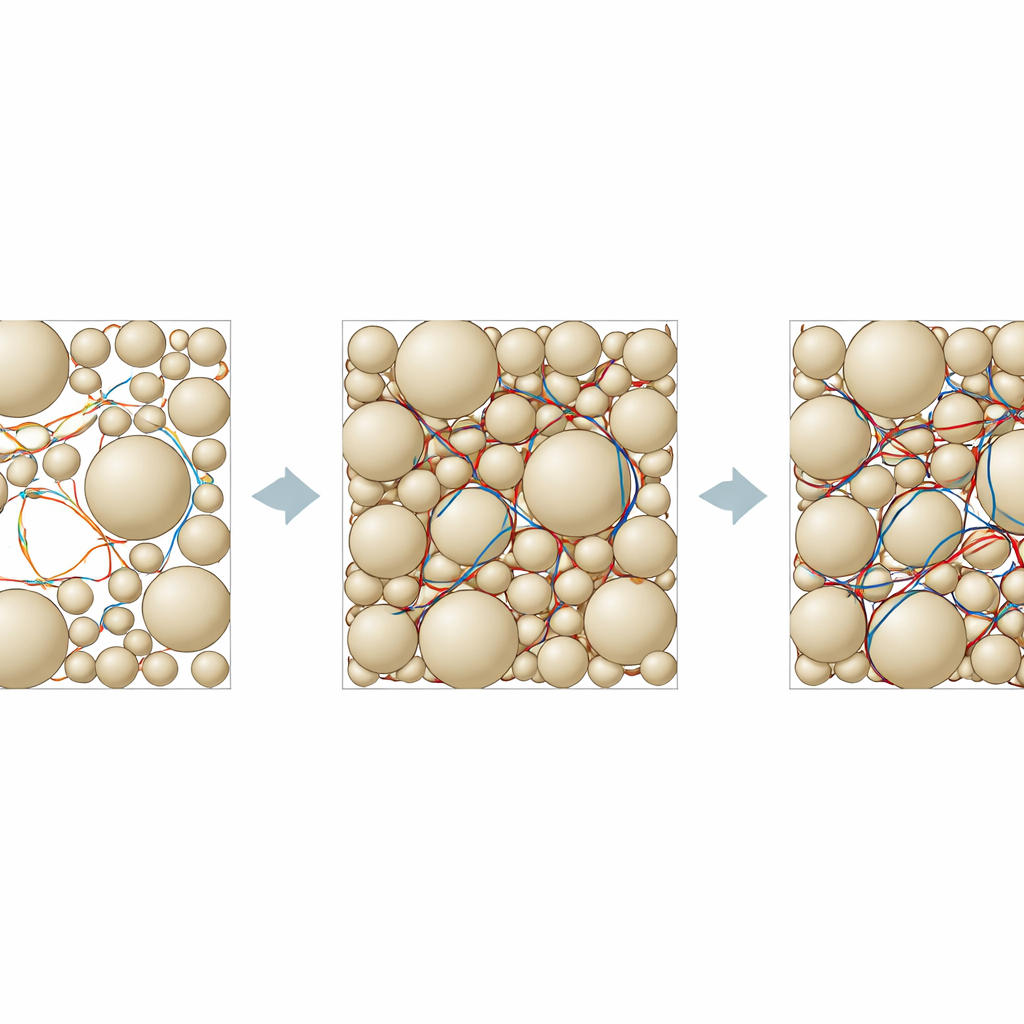
Rattlers, hidden pores, and shifting force paths
The simulations reveal that not all grains share the load. Many fine particles exist as "rattlers"—they sit in the pores between larger grains without enough contacts to carry significant force. When the amount of fines is low, or when pressure is very small, most fines remain rattlers and the main load-bearing skeleton is made of large grains alone. As more fines are added, the overall packing first becomes denser and then looser, with the tightest arrangement around 25 percent fines. A more telling measure is the so-called skeleton void ratio, which counts rattlers as part of the empty space. This quantity steadily decreases as fines are added, signaling a gradual shift from a framework dominated by large grains to one where large and small grains jointly carry forces along chains of contact.
How strength grows with pressure and fines
When the virtually consolidated samples were sheared, their peak strength showed a consistent pattern: at very low pressure the resistance to shearing increased sharply with pressure, and then leveled off once a certain critical pressure was reached. Adding more fines raised the overall peak strength and, crucially, caused this leveling-off to occur at lower pressures. Detailed tracking of the contact forces showed why. Fine–fine contacts contributed almost nothing to strength. Instead, once pressure increased enough to press rattling fines into the surrounding framework, new contacts between large and small grains formed, creating additional load paths that reinforced the existing large–large chains. For mixtures with around 20 percent fines, this activation of fine particles happened quickly over a modest pressure range, explaining both the rapid rise in strength at low pressure and the earlier stabilization.
A new guide for safer designs at low pressure
Building on these insights, the authors proposed an improved strength formula that directly ties peak strength to both confining pressure and fines content. The equation captures the observed rapid rise and plateau in strength with pressure, while also embedding how added fines both boost strength and shift the critical pressure downward. Fitted to all of the simulation data, it matches the results with high accuracy. For non-specialists, the key takeaway is that the tiny grains in a soil, and the modest pressures that may seem negligible, can strongly influence whether the ground behaves weakly or robustly. Accounting explicitly for fines and low-pressure effects should therefore lead to safer, more reliable designs for infrastructure built on or in sandy and silty ground.
Citation: Tiantian, H., Zhicheng, G., Chaojie, Z. et al. DEM study of fines content effects on shear strength of binary mixtures under low confining pressure. Sci Rep 16, 8356 (2026). https://doi.org/10.1038/s41598-026-39817-5
Keywords: granular soil strength, fine particles in sand, low confining pressure, discrete element simulation, geotechnical stability