Clear Sky Science · en
SA-ConSinGAN and reservoir computing fusion for accurate bearing fault classification and severity identification using GAF-based techniques
Why machine failures matter to all of us
From factory floors to wind farms and trains, countless machines rely on small metal components called bearings to keep things spinning smoothly. When these parts start to wear out, the first hints are often tiny vibrations that humans cannot sense—but if they go unnoticed, the result can be sudden breakdowns, costly shutdowns, and even dangerous accidents. This paper explores a smarter way to "listen" to those hidden warning signs using advanced data-driven methods, with the goal of spotting both the type of bearing fault and how severe it is before anything fails.
From vibrations to pictures of hidden damage
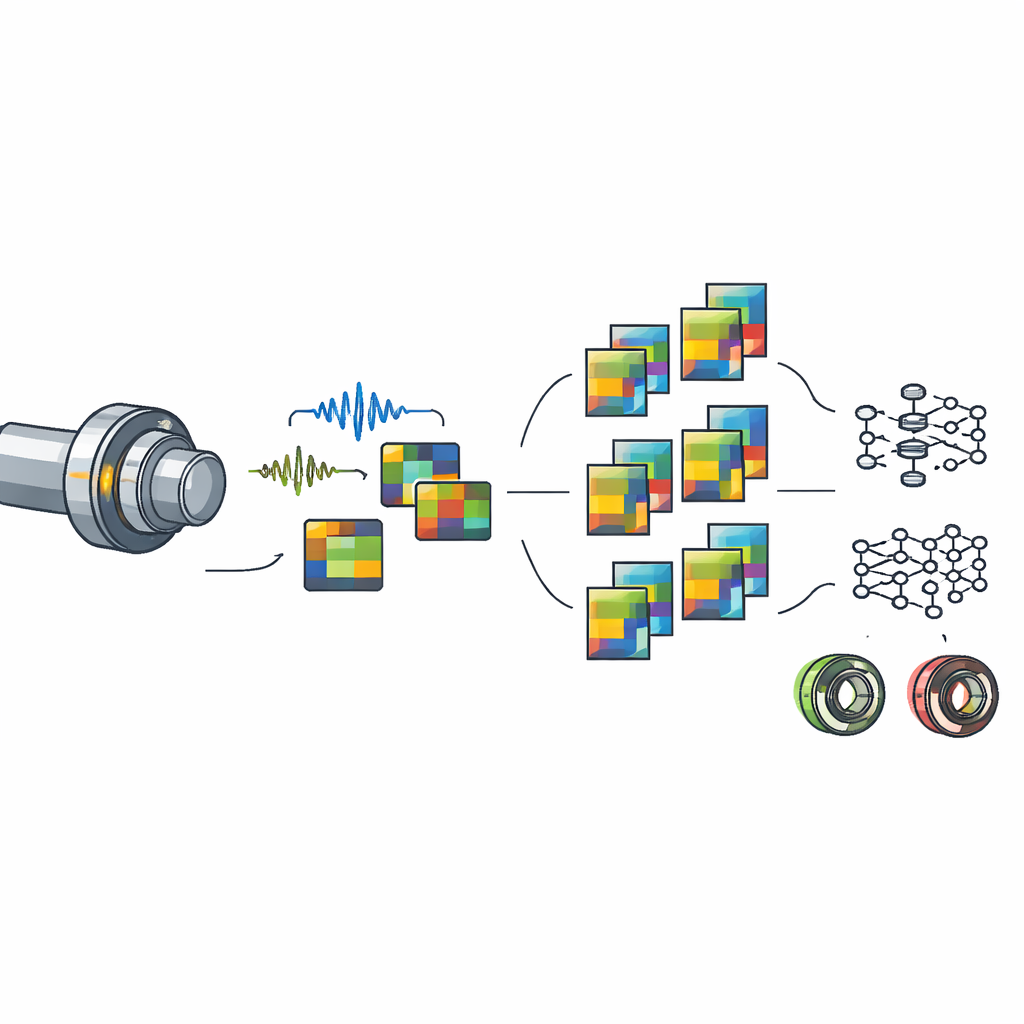
Instead of treating vibration data as squiggly lines over time, the authors turn these signals into colorful images that reveal patterns more clearly. They use a family of techniques called Gramian Angular Fields (GAF) to convert one-dimensional vibration signals into two-dimensional textures, where repeating impacts, irregularities, and subtle changes in motion appear as distinct visual patterns. Three related versions—summation-based, difference-based, and a more noise-robust variant—offer slightly different views of the same underlying behavior. This image-based view preserves the timing and strength of events in the bearing while making it easier for modern algorithms, originally designed for pictures, to recognize what kind of fault is present.
Creating more examples when real data are scarce
In real industry, one major challenge is that serious faults are rare, and it is expensive or risky to deliberately damage equipment just to collect data. To get around this, the study uses a generative model called SA-ConSinGAN, which can create many realistic variations of a fault image from only a few originals. A built-in "self-attention" mechanism helps the generator keep global structure and texture consistent, so the synthetic images still look and behave like true fault patterns rather than random noise. By expanding the dataset in this controlled way, the authors balance rare and common fault types and give their classifiers a much richer training set, without violating the physical logic of how bearings fail.
Lightweight brain-inspired models as fault judges
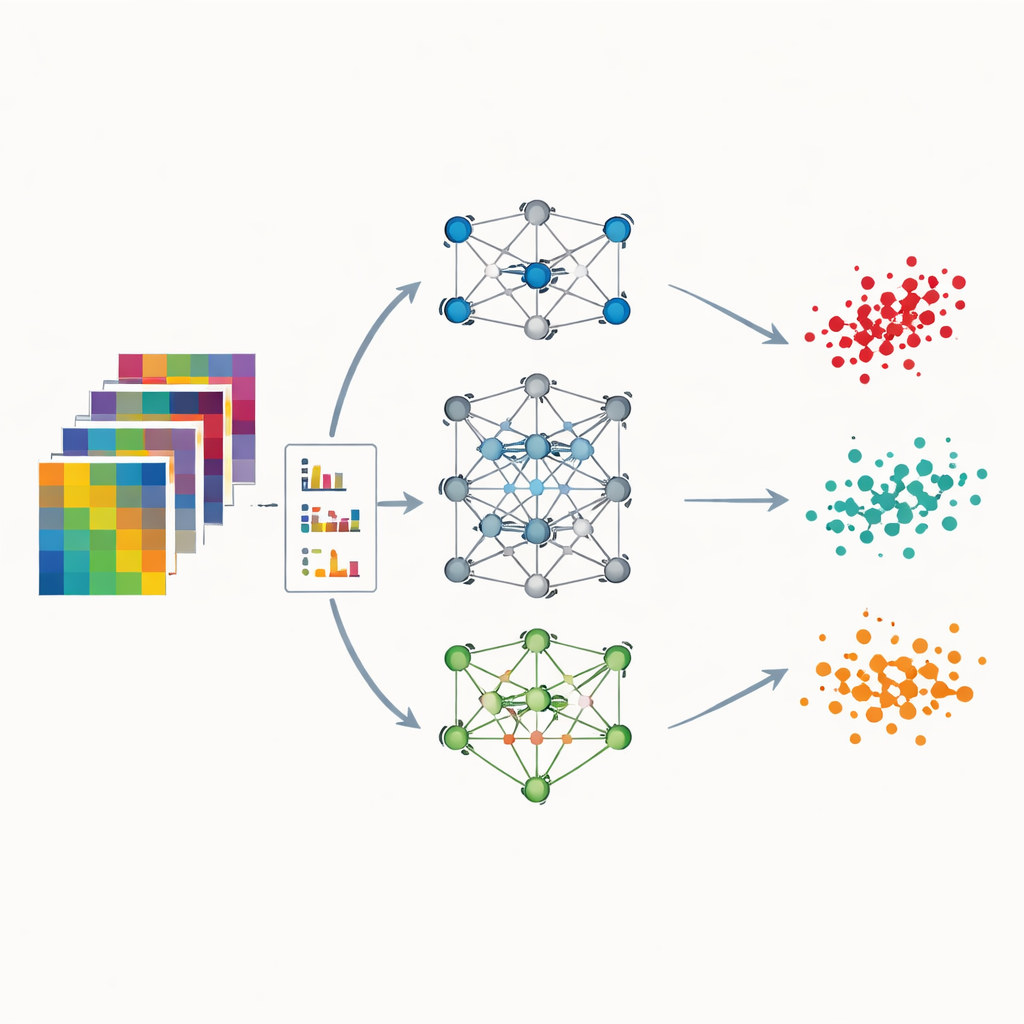
Rather than using huge, fully trained deep networks, the authors rely on a family of efficient models known as reservoir computing. In these systems, the complex internal connections are fixed in advance; only a simple output layer is adjusted during training, making them fast and stable even on difficult time signals. The paper tests several variants, including echo state networks (both standard and deep), spiking models inspired by brain activity, and a random-projection model called Random Vector Functional Link (RVFL). For each GAF image, the team first extracts texture and statistical features—such as measures of smoothness, contrast, and irregularity—and then feeds these compact summaries into the reservoir models to decide which fault is present and how severe it is.
How well does the method actually work?
The researchers evaluate their pipeline on a widely used benchmark: a bearing test rig from Case Western Reserve University, where controlled defects of different sizes are introduced in various parts of the bearing and run at several speeds. They apply GAF transformations, generate thousands of synthetic images with SA-ConSinGAN, and then use ten-fold cross-validation to thoroughly test each model. The RVFL classifier combined with one of the GAF variants achieves essentially perfect performance, correctly identifying every fault type and every severity level across all tested conditions. Deep echo state networks also perform extremely well, while the more biologically detailed spiking models lag somewhat behind. A noise-robust GAF version particularly helps the recurrent reservoirs cope with small defects and slight speed variations, improving reliability when signals are faint and messy.
What this means for real machines
In simple terms, the study shows that turning vibration data into carefully designed images, enriching them with realistic synthetic samples, and analyzing them with efficient reservoir-based models can provide near-perfect early warning of bearing problems. The approach is fast enough to be practical, needs relatively little real-world data, and can distinguish not only whether a bearing is faulty but also how far the damage has progressed. This makes it a strong candidate for predictive maintenance systems, where operators want to repair or replace parts just in time—before a small flaw grows into a costly or dangerous failure.
Citation: Shah, A., Vakharia, V., Kumar, Y. et al. SA-ConSinGAN and reservoir computing fusion for accurate bearing fault classification and severity identification using GAF-based techniques. Sci Rep 16, 9027 (2026). https://doi.org/10.1038/s41598-026-39807-7
Keywords: bearing fault diagnosis, predictive maintenance, vibration analysis, reservoir computing, data augmentation