Clear Sky Science · en
Mechanism and engineering practice of roof stability for secondary gob-side entry retaining in deep mines
Why keeping mine tunnels open matters
Deep underground coal mines rely on a network of tunnels to move people, air, and equipment. Normally, many of these tunnels are abandoned and new ones are dug as mining advances, which is costly and risky. This study explores a smarter way to reuse existing tunnels safely in very deep mines, cutting costs and reducing the amount of rock that must be excavated, while still protecting workers from roof collapses and dangerous ground movements.
Reusing tunnels instead of throwing them away
When a coal panel is mined, it leaves behind an empty, collapsed zone called the goaf and a roadway beside it. Traditional practice often abandons that roadway after one use. The authors focus on a newer idea called secondary gob-side entry retaining, where the same roadway is reused as a long-term airway for the next mining panel. The key step is to build a second artificial wall of backfilled material along the new goaf edge, so the roadway eventually lies between two man‑made walls. This layout allows more flexible “Y‑shaped” ventilation for high‑gas areas and reduces the need to dig fresh tunnels, cutting both cost and disruption.
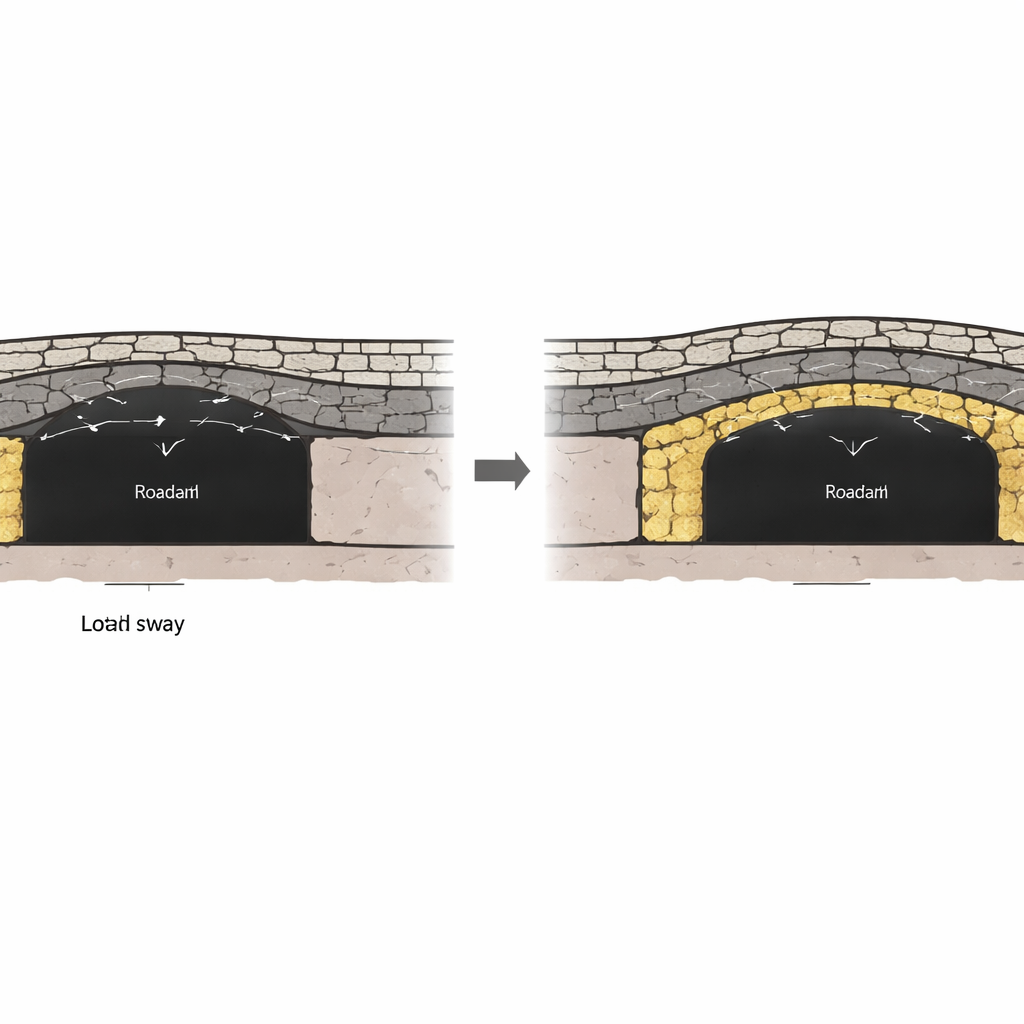
Big rock movements above the tunnel
Far above the roadway, thick layers of rock act like giant beams that bend, crack, and settle as coal is removed. The study calls this the “large structure” and shows that it does not calm down after a single mining step: the key rock blocks above the tunnel must pass through three rounds of breaking and readjustment before they become stable. One particular central block, referred to as block C in the paper, turns out to be decisive. If this block remains propped up by the surrounding rocks and backfills, the loads reaching the roadway are manageable. If it tips into the mined‑out void, however, it can slam the tunnel with sudden pressure, leading to severe deformation or even failure of the support system.
The small structure that keeps people safe
Closer to the roadway, the authors define a “small structure” made up of the immediate roof above the tunnel, the two backfill bodies, the floor rocks and the internal steel and cable supports. Unlike the more distant rock layers, this system has to carry highly uneven loads right next to the goaf. The team proposes a “four‑in‑one” control idea: the backfills confine the sides and help cut off overlying rock; bolts and cables stitch the roof layers together; floor reinforcement resists upward buckling; and internal arches and props share the remaining forces. If any one piece is too weak—or even too strong and narrow in the wrong place—the system can fail as loads shift and concentrate. The authors derive design formulas to choose backfill width and strength so that the two walls share the load rather than fail one after another.
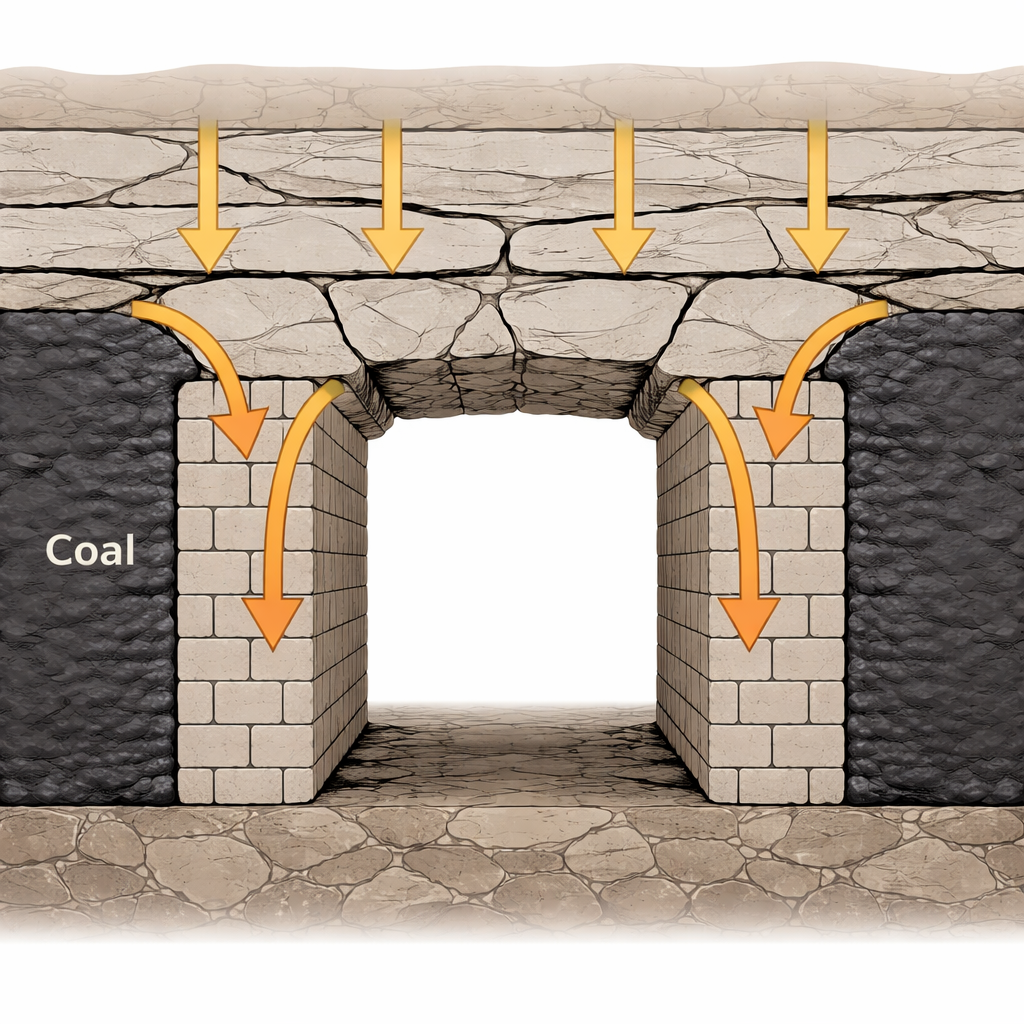
From equations to a real deep mine
The researchers turn their mechanical model into a concrete design for a working face 610 meters underground. Using measured rock properties and mining dimensions, they calculate how wide and how strong each backfill wall must be, and how much the roadway width and overhanging roof should be reduced to ease stresses. They then install a dense pattern of roof bolts and long cables, steel arches, floor treatment, and specially formulated cement‑based backfill. Throughout mining of both the first and the neighboring second panel, they monitor roof cracks, backfill stresses, and roadway deformation with borehole cameras, pressure cells, and displacement stations. The measurements show that the two backfills take on rising loads in stages and eventually stabilize, with the second backfill carrying the higher share as predicted. The tunnel walls and roof remain within acceptable movement limits, although the floor still heaves and must be trimmed.
What this means for future deep mining
In plain terms, the study shows that it is possible to safely reuse a tunnel between two mined‑out zones in a very deep coal mine, provided the rock behavior above is understood and the support system is designed as a coordinated whole. By tuning roadway width, backfill dimensions, and roof control, the mined‑out side coal and the two artificial walls can work together to hold up the rocks overhead. This approach saves excavation, supports long‑term airways, and reduces conflicts between mining and tunneling. The authors note that the method is still complex and not yet the cheapest option, but it offers a tested framework that future work can simplify and adapt for other challenging underground conditions.
Citation: Wu, J., Chen, J. & Xie, F. Mechanism and engineering practice of roof stability for secondary gob-side entry retaining in deep mines. Sci Rep 16, 9518 (2026). https://doi.org/10.1038/s41598-026-39802-y
Keywords: deep coal mining, tunnel stability, rock support, backfill walls, gob-side entry retaining