Clear Sky Science · en
Dynamic task offloading in vehicular networks using large language models for adaptive low latency decision making
Smarter Help for Busy Cars
Today’s connected cars juggle navigation, safety alerts, sensors, and even self-driving features—all of which demand fast computing. Yet a single car’s onboard computer and battery can only do so much, especially in crowded city traffic. This paper explores a new way to share that digital workload using an artificial intelligence system similar to the large language models behind modern chatbots. Placed at roadside units, this AI helps decide, in real time, where each car should send its digital “chores” so they are done quickly and with less energy use.
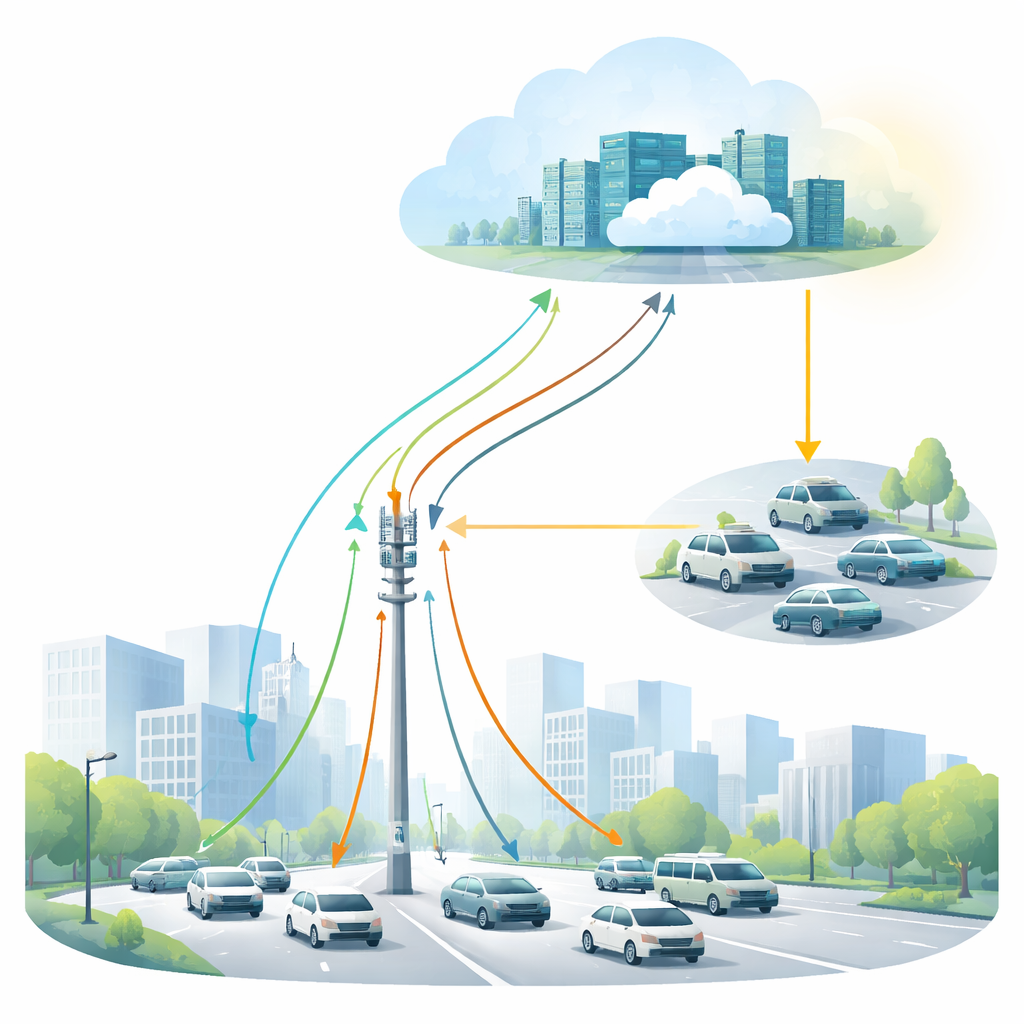
How Cars Share Their Digital Chores
In a modern traffic network, vehicles constantly generate small computing tasks: analyzing sensor data, coordinating with nearby cars, or consulting maps and traffic patterns. Each task can be handled in three ways: a car can process it itself, send it to another better-equipped vehicle, or offload it to a roadside or cloud computer. The challenge is choosing the best option in a split second while cars move at high speed and network connections come and go. Traditional methods rely on fixed formulas or training schemes that struggle when roads are packed, conditions change quickly, or many different factors must be balanced at once.
Putting a Powerful Brain at the Roadside
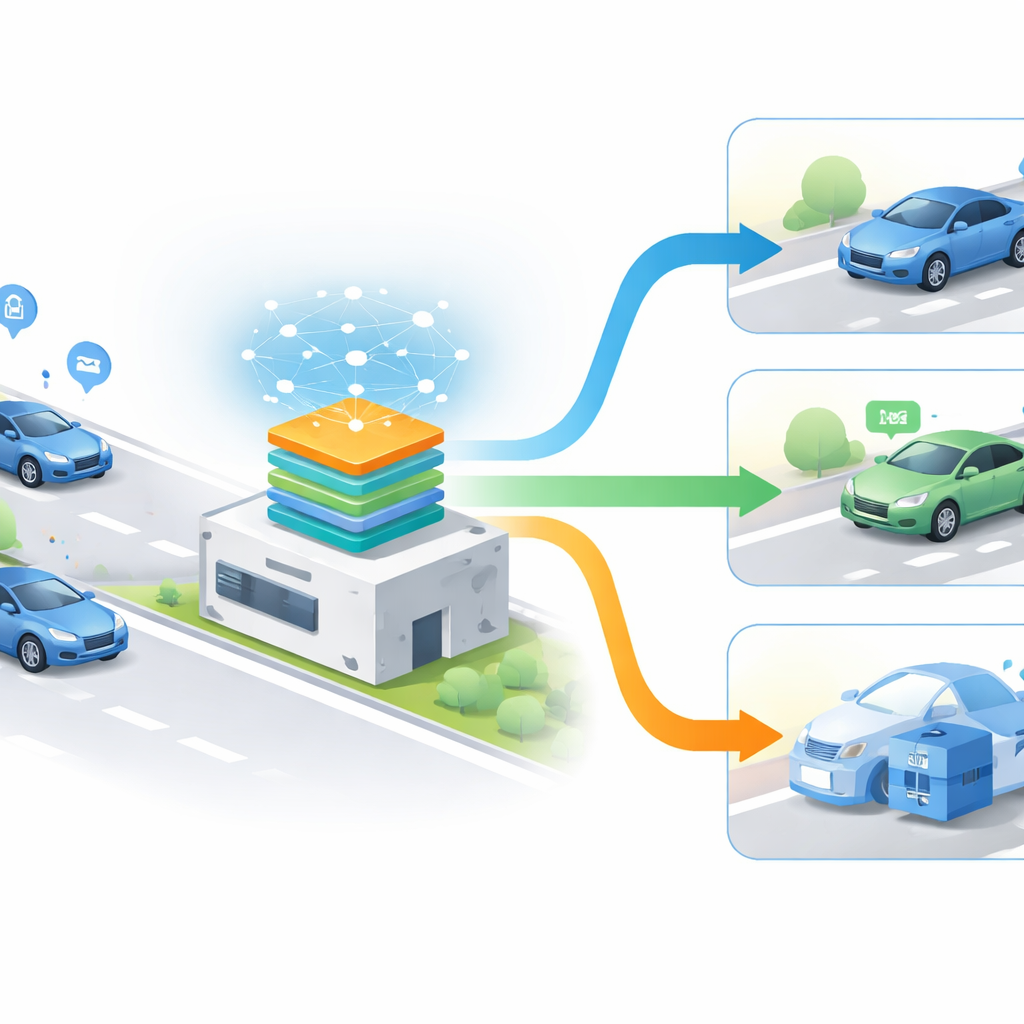
The authors propose placing a large language model (LLM) at roadside edge nodes—essentially smart boxes along the road that already help cars connect to the network. Instead of reading sentences, this LLM reads structured snapshots of the traffic situation: each vehicle’s speed, location, remaining battery, available computing power, and wireless signal quality, along with details about each task such as urgency and size. From these multi-dimensional inputs, the LLM “reasons” about which car or edge node should execute a given task, considering speed, distance, link stability, and energy costs together rather than one by one. It acts like a traffic controller for digital work, steering each task toward the option most likely to finish on time and with minimal battery drain.
From Simple Rules to Adaptive Reasoning
To highlight the benefits of this approach, the study compares the LLM-based system with two common alternatives: a simple rule-based method that uses a fixed weighted score and advanced tree-based machine learning models (Random Forest and XGBoost). Those baselines treat the decision as a rigid formula or a collection of decision trees. They work reasonably well when there are few cars and simple conditions, but they falter as traffic becomes denser, vehicles move faster, or many different status signals must be considered. In contrast, the LLM learns complex relationships during training and can instantly adjust which factors it cares about most—for example, favoring a more stable connection when cars are moving quickly, or saving battery when the network is congested.
What the Simulations Reveal
The authors test their framework in a detailed simulator that mimics real city roads, wireless links, and moving vehicles. They vary how many cars are on the road, how fast they move, and how much information is fed into each model. Across these scenarios, the LLM-based system finishes more tasks successfully, with lower delay and better energy use, than both the deep reinforcement learning methods reported in earlier work and the tree-based models tested here. On average, it cuts task waiting time by about 15% and improves energy efficiency by more than 20% compared with a strong reinforcement learning baseline, while still completing about 97.5% of tasks. When the LLM is tuned and compressed to run on a graphics processor at the roadside, its own decision-making delay becomes small enough for time-critical driving applications.
Challenges at the Edge of the Road
These gains come with trade-offs. Large language models are hungry for memory and computing power, which is a concern for roadside units that may need to run on limited hardware. As the number of vehicles and tasks grows, the edge nodes can experience high CPU and memory usage. The black-box nature of such models also makes it hard to explain why one car was chosen over another for a particular task. The authors discuss ways to ease these problems, such as compressing the model, using lower-precision arithmetic, and improving tools that reveal how the model makes its choices.
What This Means for Future Roads
Overall, the study suggests that using LLMs as decision engines in vehicular networks could make connected and autonomous cars more responsive and energy-aware, especially in crowded, fast-changing conditions. By treating the whole road system as a living, shifting puzzle and reasoning over many signals at once, these models can choose where to run each digital chore more effectively than fixed rules or older learning methods. If engineers can tame their resource demands, LLM-driven task offloading may become a key ingredient in future smart transportation systems, helping traffic flow more smoothly and safely while keeping vehicles’ batteries and networks under control.
Citation: Trabelsi, Z., Ali, M., Qayyum, T. et al. Dynamic task offloading in vehicular networks using large language models for adaptive low latency decision making. Sci Rep 16, 9144 (2026). https://doi.org/10.1038/s41598-026-39791-y
Keywords: vehicular edge computing, task offloading, large language models, autonomous vehicles, low latency networks