Clear Sky Science · en
Health risk assessment of air pollution in Xinjiang, Northwest China
Why this dusty region matters for your lungs
Xinjiang, in China’s far northwest, is famous for its deserts and mountains—but also for some of the country’s toughest air-quality challenges. This study looks at what a decade of air pollution means for the health of people living there. By tracking several major pollutants from 2015 to 2024 and linking them to health risks, the researchers show how dust storms, city emissions, and recent policies have reshaped the air people breathe and the diseases they may face.
A land shaped by deserts and cities
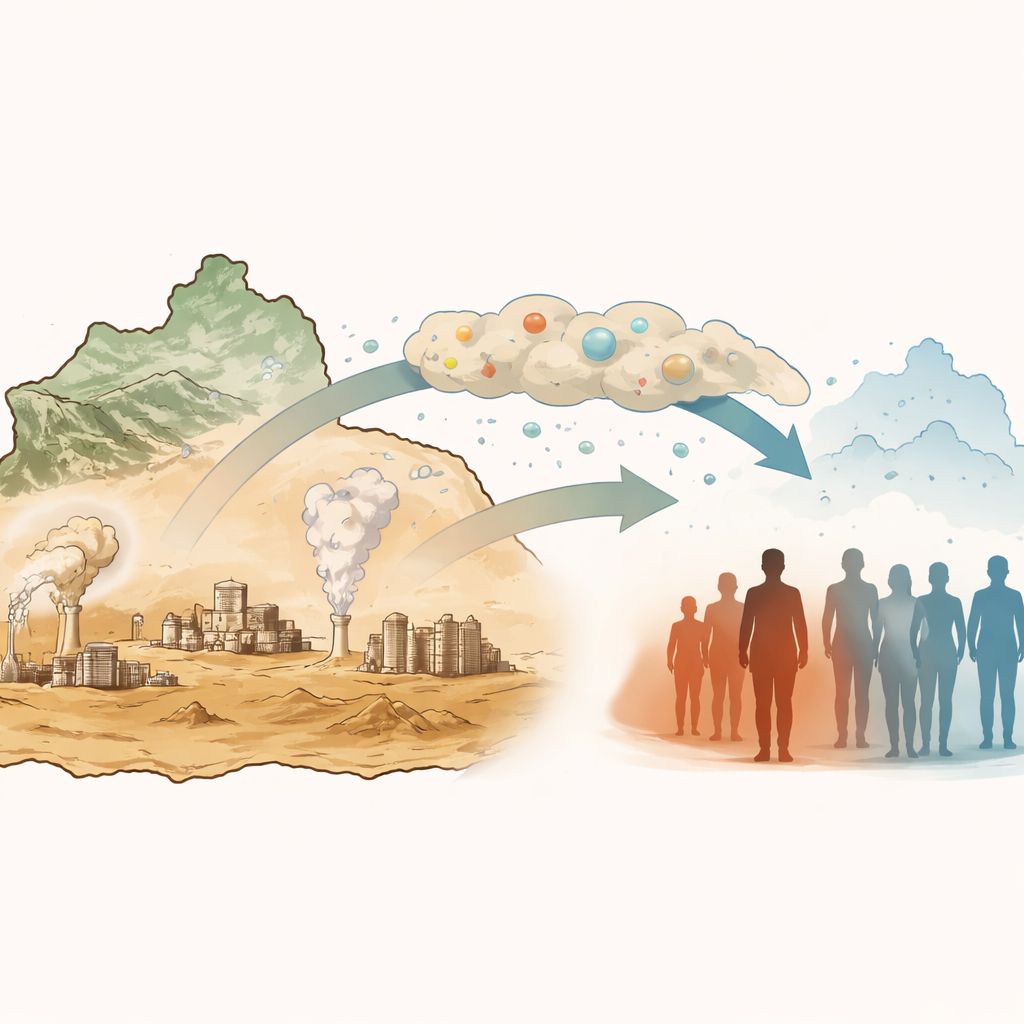
Xinjiang’s geography creates a natural laboratory for air pollution. The region is framed by three mountain ranges that enclose two basins, including the Taklamakan Desert—one of the world’s largest sources of dust. Southern Xinjiang sits closer to this desert and endures frequent sandstorms, while the north has more industry, traffic, and larger cities. The team analyzed daily data on six common air pollutants—two types of particle pollution and four gases—for 13 prefectures over ten years. They compared two time windows: before 2020, and after 2020, when new environmental policies and COVID-19 lockdowns sharply cut industrial and traffic activity.
The hidden weight of tiny particles
The results reveal that particle pollution, especially coarse dust known as PM10, is the main threat to air quality in Xinjiang. Average PM10 levels were high enough to exceed national health standards year after year, with southern areas such as Hotan and Kashgar suffering the worst conditions. Southern residents endured about 288 polluted days per year—more than three times the burden in the north. Even though levels of sulfur dioxide, carbon monoxide, fine particles, and nitrogen dioxide dropped notably after 2020, the combined picture shows that these improvements only partly eased the health load because dust remained stubbornly high.
More than one pollutant, more than one risk
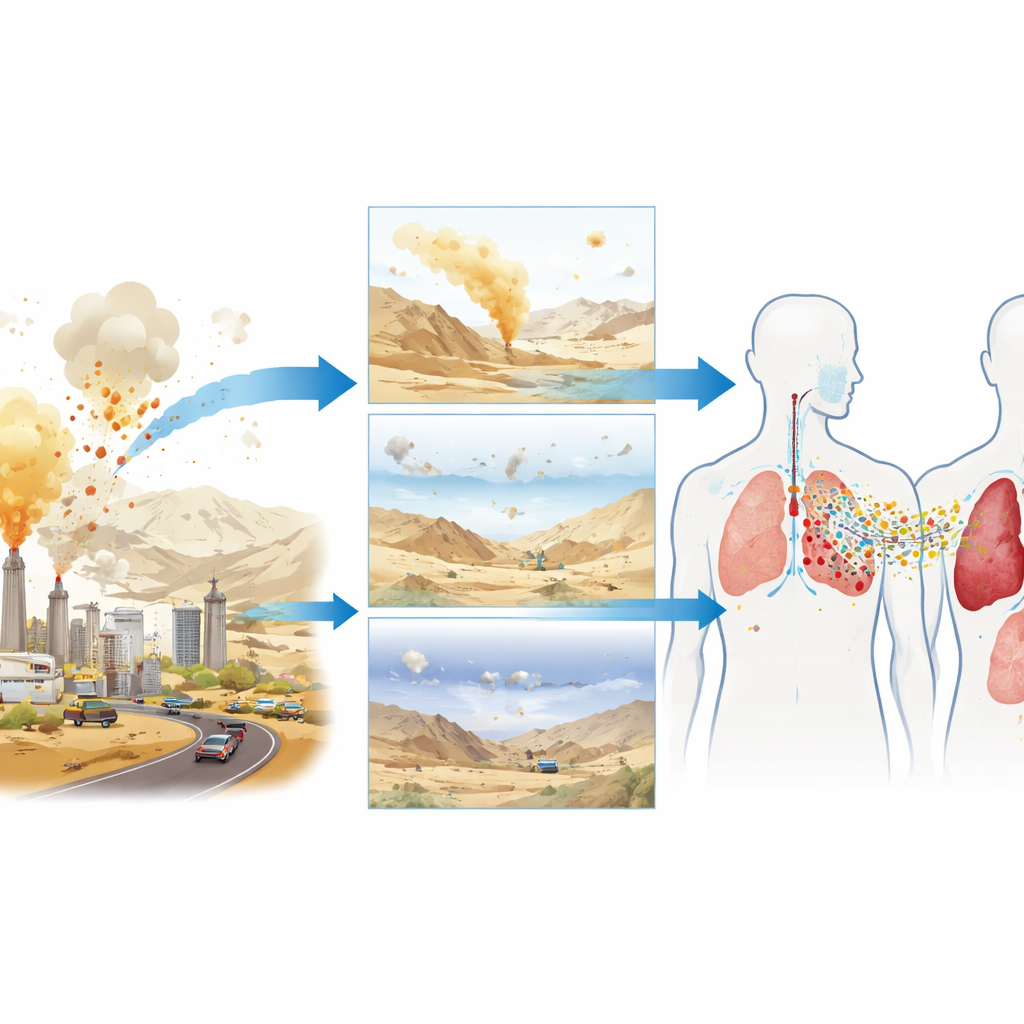
Most public air reports are based on a single “worst” pollutant, but in reality people inhale mixtures. To capture this, the researchers used combined indices that stack the effects of all six pollutants and then translate them into health risk. These tools revealed that standard air-quality scores tend to underestimate danger, especially on days when several pollutants are moderately high rather than one being extreme. In southern Xinjiang, about 80% of the total excess health risk came from PM10 alone. In the north, the picture shifted: nitrogen dioxide from traffic and industry became the leading driver of risk, even though its concentrations were lower than dust. Spring and winter were the most hazardous seasons; in spring, over one-third of Xinjiang’s population was exposed to air that fell into a “severe” risk level.
Lives behind the numbers
By linking pollution data with mortality statistics, the study estimates how many extra deaths each year can be traced to dirty air. During the earlier period, air pollution was associated with roughly 706 deaths annually across Xinjiang, with the highest toll in densely populated Kashgar. Thanks to cleaner energy, stricter controls, and pandemic-related slowdowns, this number fell by about a quarter in the later years, to 522 deaths per year. Still, the burden remained uneven. Southern prefectures bore much larger risks than the north, and even where air quality improved, many residents—especially in spring and winter—continued to breathe air that could worsen heart and lung disease.
What can be done to breathe easier
To a non-specialist, the study’s message is clear: living downwind of a major desert and amid growing cities is not just a visibility problem, it is a health problem. Coarse dust and traffic-related gases combine with weather patterns and local topography to trap pollution where people live, raising risks of respiratory and cardiovascular disease. The authors argue that solutions must be tailored: cutting PM10 in the dusty south with green belts and land restoration, and curbing nitrogen dioxide and ozone in the industrialized north through cleaner energy and vehicles. Seasonal alerts, medical preparedness, and even special leave during sandstorm days could help protect the most exposed communities. Taken together, the decade-long record shows that strong policy can save lives—but also that in regions like Xinjiang, the fight for clean air is far from over.
Citation: Li, H., Xue, Z., Cheng, B. et al. Health risk assessment of air pollution in Xinjiang, Northwest China. Sci Rep 16, 7847 (2026). https://doi.org/10.1038/s41598-026-39776-x
Keywords: air pollution, dust storms, public health, Xinjiang, particulate matter