Clear Sky Science · en
Development characterization and machinability study of high entropy alloy reinforced aluminium metal matrix composite
Stronger, Lighter Metals for Everyday Technology
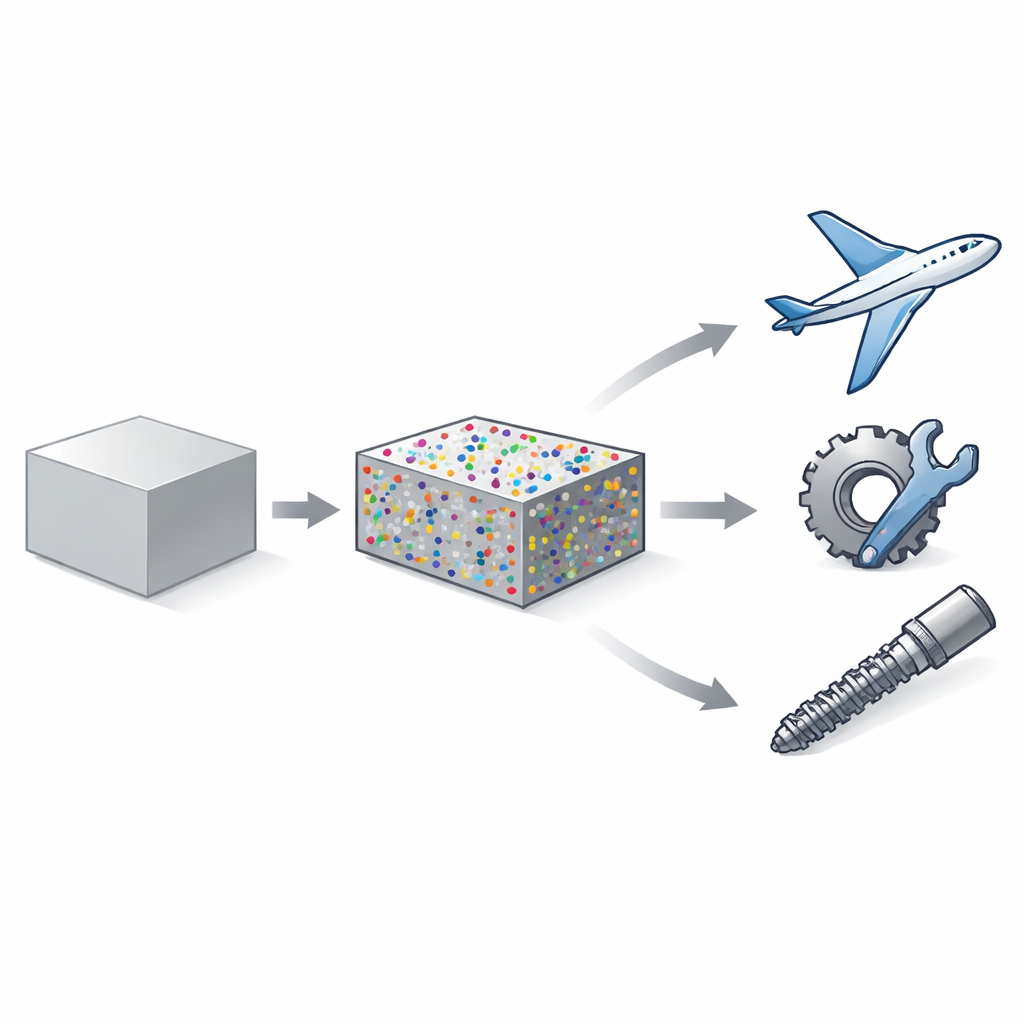
From aircraft and cars to medical implants and precision tools, modern technology depends on metals that are both strong and lightweight. Aluminum alloys already play a huge role because they are light, but they can struggle when parts must endure high loads, wear, and demanding machining. This study explores a new recipe for aluminum that mixes in a special class of metallic powders called high entropy alloys, aiming to create components that are tougher, longer-lasting, and still easy enough to shape into complex parts.
Building a New Kind of Aluminum
The researchers started with a common industrial aluminum alloy known as Al 6063, widely used in buildings, vehicles, and consumer products. Into this molten aluminum they stirred a small amount—just 3 weight percent—of a finely powdered high entropy alloy made from iron, chromium, manganese, aluminum, and nickel. Using a stir-casting setup, they carefully heated, mixed, and poured the blend into preheated molds so that the tiny particles spread evenly throughout the metal as it cooled. This created what is called a metal matrix composite, where the aluminum forms the body of the material and the high entropy alloy particles act like microscopic reinforcements.
Peering Inside the Metal’s Hidden Structure
To find out whether the new composite really differed from ordinary aluminum, the team used a suite of imaging and analysis tools. Electron microscopes and atomic force microscopes revealed a rough, layered surface with small dark spots corresponding to the embedded high entropy alloy particles. Chemical mapping confirmed that all five elements from the powder—aluminum, iron, chromium, manganese, and nickel—were present inside the composite and well distributed. X-ray diffraction measurements showed that the reinforcement created a dual internal structure with two types of crystal arrangements. One contributes more strength, while the other allows the metal to deform without breaking suddenly. Together, these phases help the composite resist both high loads and high temperatures.
How the New Metal Handles Stress
Mechanical tests compared the new composite with the original Al 6063 alloy. In tension tests, where samples are pulled until they snap, the reinforced metal carried noticeably higher loads and showed increased tensile strength and yield strength. In compression tests at elevated temperature, the composite withstood higher stresses and larger strains before failure, signaling better load-bearing ability and good hot-strength. Microscopic images of broken samples revealed cracks starting mainly around the tiny reinforcement particles. Even so, many of these particles showed that they had shared the load effectively, and the overall fracture behavior combined both tough and brittle features. This balance allowed the material to absorb more energy before it failed, an advantage in applications where impacts or sudden loads are a concern.
Finding the Best Way to Cut and Shape the Metal
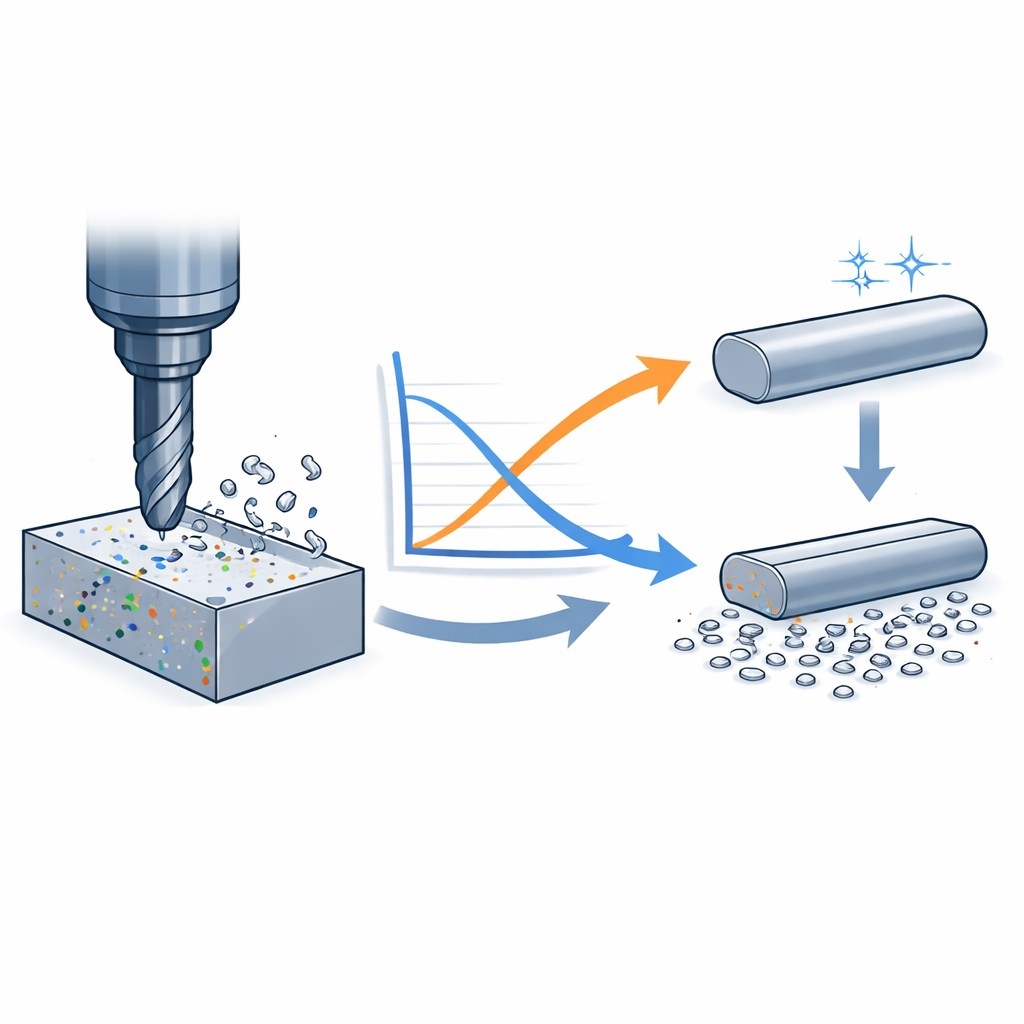
Creating a strong material is only half the challenge; manufacturers must also be able to machine it efficiently into real parts. The team tested how the new composite behaves during milling, a common cutting process that uses a rotating tool. They systematically varied spindle speed, feed rate, and depth of cut across 27 experiments and measured two key outcomes: how quickly material was removed and how smooth the cut surface became. Because these goals often conflict—removing material faster can roughen the surface—they applied advanced decision-making methods that weigh both speed and surface finish at once. Across several mathematical ranking approaches, one particular combination of cutting settings at relatively low spindle speed emerged as the best compromise between a high removal rate and a fine surface. A second setting at higher speed favored maximum removal rate at the cost of a rougher finish.
Why This New Metal Matters
In plain terms, the study shows that a small dose of high entropy alloy powder can turn an ordinary aluminum alloy into a stronger, tougher, and still machinable engineering material. The reinforced composite resists higher forces, maintains stability at elevated temperature, and can be cut under carefully chosen milling conditions to deliver either smoother surfaces or faster production, depending on what a part requires. These qualities make it a promising candidate for demanding uses such as aerospace components, precision tooling, and biomedical implants, where every gram saved and every extra margin of strength can translate into better performance and longer life.
Citation: Das, S., Bose, A., Sapkota, G. et al. Development characterization and machinability study of high entropy alloy reinforced aluminium metal matrix composite. Sci Rep 16, 9283 (2026). https://doi.org/10.1038/s41598-026-39772-1
Keywords: aluminum composites, high entropy alloy, milling optimization, lightweight materials, surface finish