Clear Sky Science · en
Behavioral responses of captive-bred post-hatchling and juvenile sea turtles to different colors of single-use plastic film
Why sea turtles and plastic bags matter to us
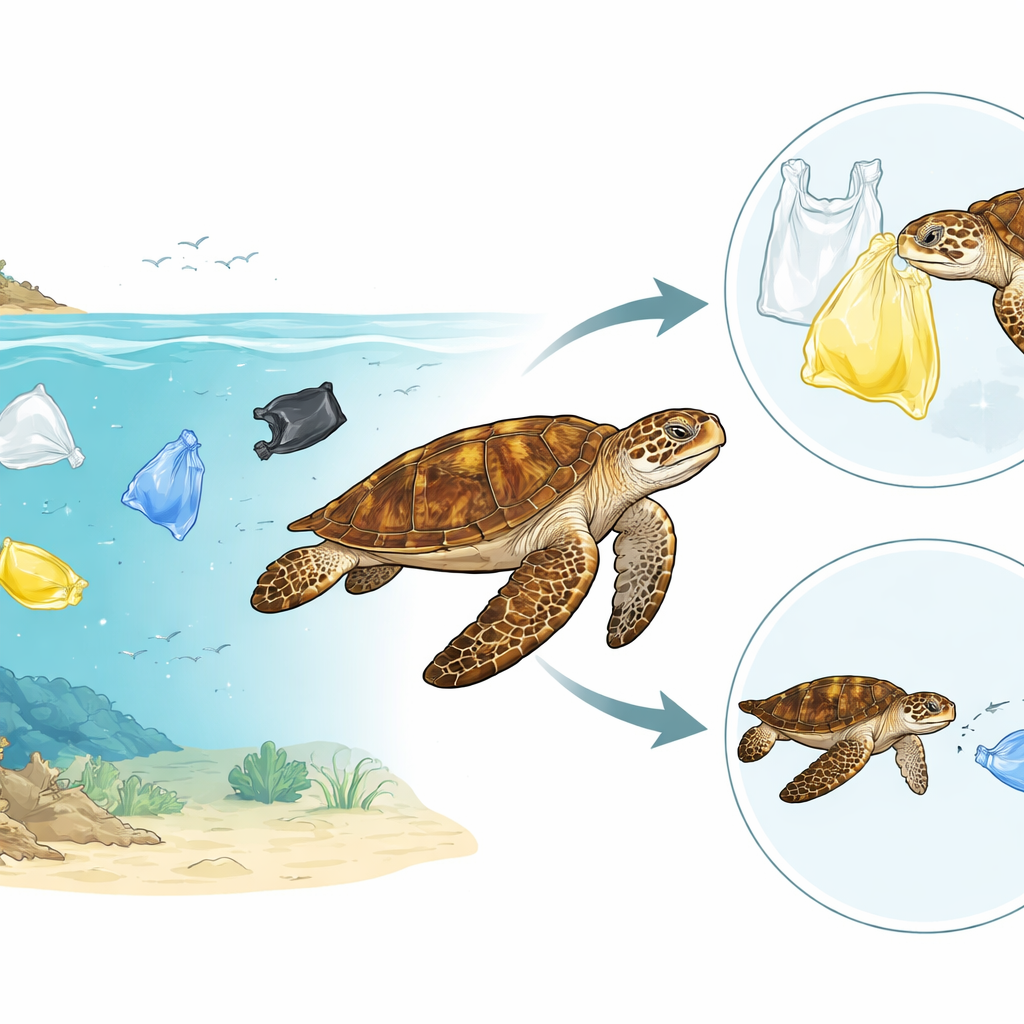
On beaches around the world, sea turtles swim through waters filled with floating bags, wrappers, and bottle labels. Many of these plastics end up in their stomachs, sometimes with fatal results. This study asks a simple but crucial question: do young sea turtles go after some kinds of plastic more than others, and if so, why? By watching how captive-bred hawksbill turtles reacted to everyday plastic films in different colors, the researchers shed light on how our packaging choices can shape the hidden risks these animals face.
Testing turtles with everyday trash
To explore this problem, the team worked with hawksbill turtles raised in an aquarium in South Korea, where their health and history were well known. They studied two age groups: 4-year-old juveniles about to face the open ocean, and tiny 10-week-old post-hatchlings just starting to explore their world. The scientists presented the turtles with six kinds of plastic films commonly found in turtle stomachs: clear food packaging, white and black shopping bags, yellow snack packaging, red ramen wrappers, and blue bottle labels. All items were cleaned to remove smells, weighted or suspended so they floated in mid-water, and filmed from above and the side.
Watching who bites what
During short trials, each turtle was given the chance to approach and interact with the plastic. For juveniles, all six colors were presented at once in a larger tank so that clear choices could emerge. For post-hatchlings, which became agitated by many items at once, plastics were presented one at a time. The researchers carefully replayed the videos and counted every bite or beak touch, treating both as signs that a turtle was interested in eating the object. They also noted which plastic each juvenile approached first, and measured how closely each plastic’s color matched the turtles’ usual food and the tank background using a color meter.
Older turtles show risky preferences
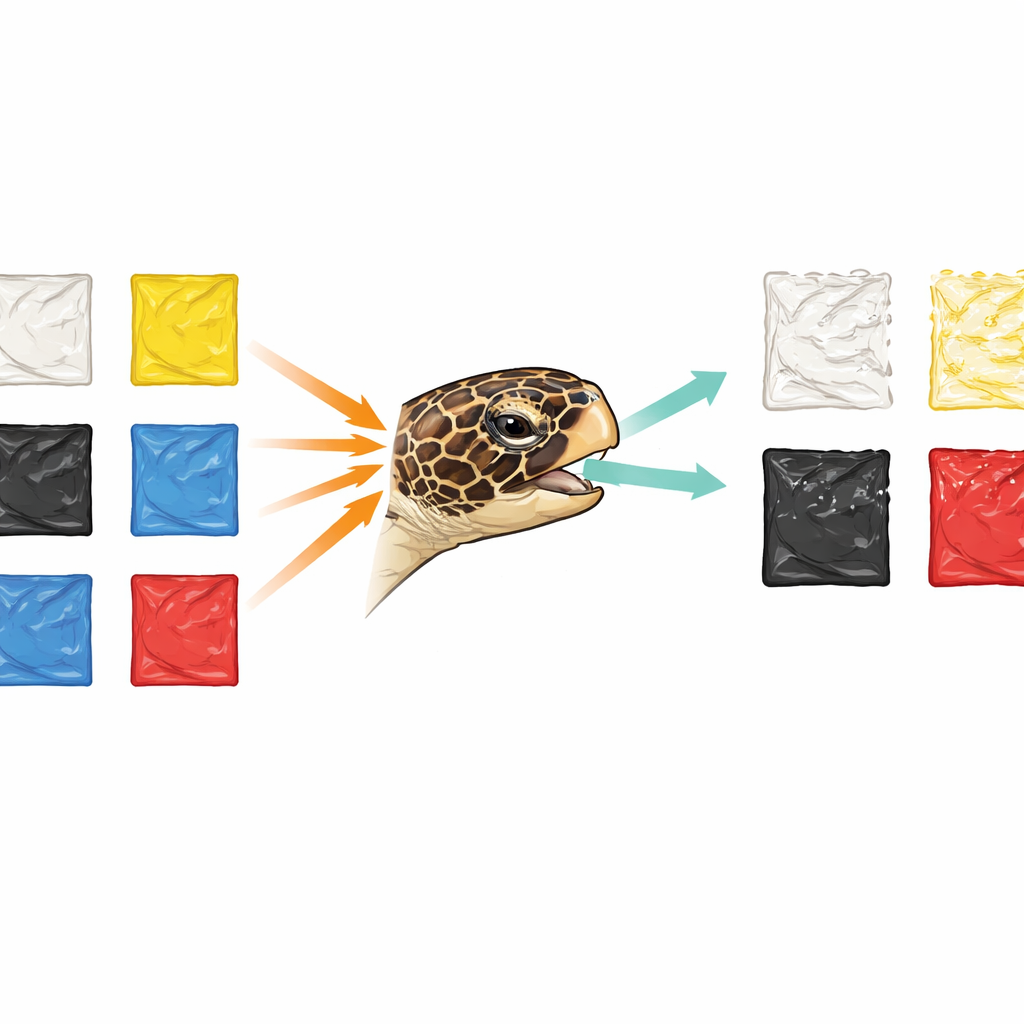
The 4-year-old juveniles showed strong and consistent preferences. They approached and bit clear food packaging and white plastic bags in the largest share of trials, followed by yellow snack wrappers and black bags. They almost completely ignored blue bottle labels, and reacted only weakly to the red ramen packaging. Overall, light-colored and black films drew the most interest, while blue drew the least. These patterns mirror both earlier experiments where the same turtles were tested with dyed jellyfish, and field studies showing that wild turtles often gulp down white and transparent plastics. The results suggest that to a hungry juvenile turtle, pale, soft, jellyfish-like films look a lot like food, especially when they stand out clearly against the tank background.
Baby turtles may bite almost anything
The smallest turtles told a different story. The 10-week-old post-hatchlings bit or touched all plastic types at similarly high rates, with no clear favorite color. They even snapped at bubbles created by their own swimming, a behavior rarely seen in the older turtles. This lack of selectivity hints that very young turtles have not yet learned which sights signal real food. Instead, they may simply investigate almost any small object they see, regardless of color. Because the plastics were washed to remove smell, the study also suggests that post-hatchlings may depend more on motion or chemical cues than on color alone during their earliest feeding attempts.
What this means for oceans and packaging
Taken together, the findings point to two overlapping dangers. Very young turtles seem likely to swallow many different types of debris simply because they are undiscriminating feeders. As they grow, juveniles become more selective, but their instincts and early experiences guide them toward soft, light-colored plastics that resemble natural prey. This “evolutionary trap” means that plastic bags and clear wrappers can mislead turtles at multiple life stages. The authors argue that reducing production of thin plastic films, and favoring less attractive colors such as strong reds or blues for packaging, could help lower the risk. Combined with efforts to curb microplastics and manage larger debris, such changes in design and policy could make the seas a little safer for these ancient mariners.
Citation: Moon, Y., Noh, HJ., Han, G.M. et al. Behavioral responses of captive-bred post-hatchling and juvenile sea turtles to different colors of single-use plastic film. Sci Rep 16, 8298 (2026). https://doi.org/10.1038/s41598-026-39765-0
Keywords: sea turtles, plastic pollution, marine debris, animal behavior, conservation