Clear Sky Science · en
Chemical and structural characterization of ramie-based epoxy composites reinforced with macadamia nut shell biochar
Turning Farm Waste into Strong Materials
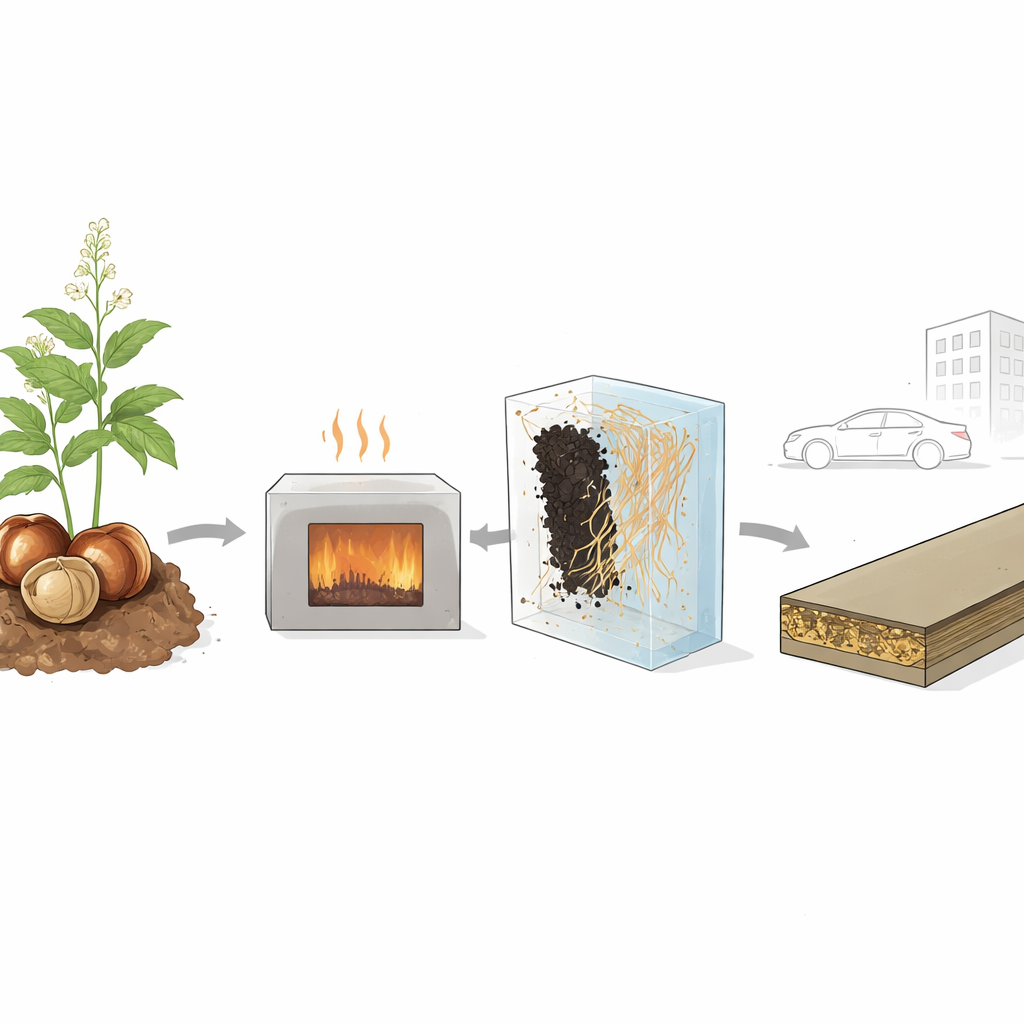
Modern products, from cars to building panels, demand materials that are both strong and kind to the planet. This study explores a clever way to turn two agricultural by‑products—ramie plant fibers and discarded macadamia nut shells—into a lightweight composite material that could replace some petroleum‑based plastics and fiberglass parts. By transforming nutshells into a fine carbon powder called biochar and blending it with plant fibers and epoxy resin, the researchers show how trash from farms can become tough, durable components for future green engineering.
Why Plant Fibers and Nutshells Matter
Traditional composites, such as those reinforced with glass or carbon fibers, offer excellent strength but are energy‑intensive to make and difficult to recycle. In contrast, plant fibers are renewable, lighter, and can help reduce the environmental footprint of manufactured goods. Ramie, a fiber crop widely grown in Asia, is especially attractive because its strands are naturally strong and stiff. At the same time, the booming macadamia industry produces huge amounts of hard shells that typically have little value. These shells are rich in carbon and, when heated without oxygen, can be converted into biochar—a porous, charcoal‑like material that may act as a tiny reinforcing grain inside plastics.
From Nutshell to High‑Surface Biochar
The team first focused on turning macadamia nut shells into a useful filler. They cleaned and dried the shells, then heated them in a low‑oxygen furnace at about 350 °C. This process, known as pyrolysis, burned off volatile parts of the biomass and left behind a carbon‑rich char. After ball‑milling and sieving, the resulting powder consisted of fine particles only a few micrometers across, with a rough, cracked surface full of pores. Advanced tests showed that this biochar had a large internal surface area and a partly ordered carbon structure. Those features mean many contact points where it can grip surrounding resin and fibers, and enough thermal stability to survive the high temperatures involved in curing epoxy.
Building the Green Composite
Next, the researchers combined three ingredients: treated ramie fibers, epoxy resin, and different amounts of macadamia biochar. They kept the total ramie content at 40 percent by weight and varied the biochar between 1, 3, and 5 percent, naming the samples MR1, MR3, and MR5. The biochar was first mixed and ultrasonically dispersed in the liquid resin to help spread the particles evenly. Then the resin was poured over aligned bundles of ramie fibers in a mold, pressed, and cured. The resulting flat panels were cut into standardized test pieces. The team then measured how much force these samples could withstand in tension and bending, how well they absorbed sudden impacts, how hard their surfaces were, and how they behaved when exposed to heat and water.
Finding the Sweet Spot for Strength
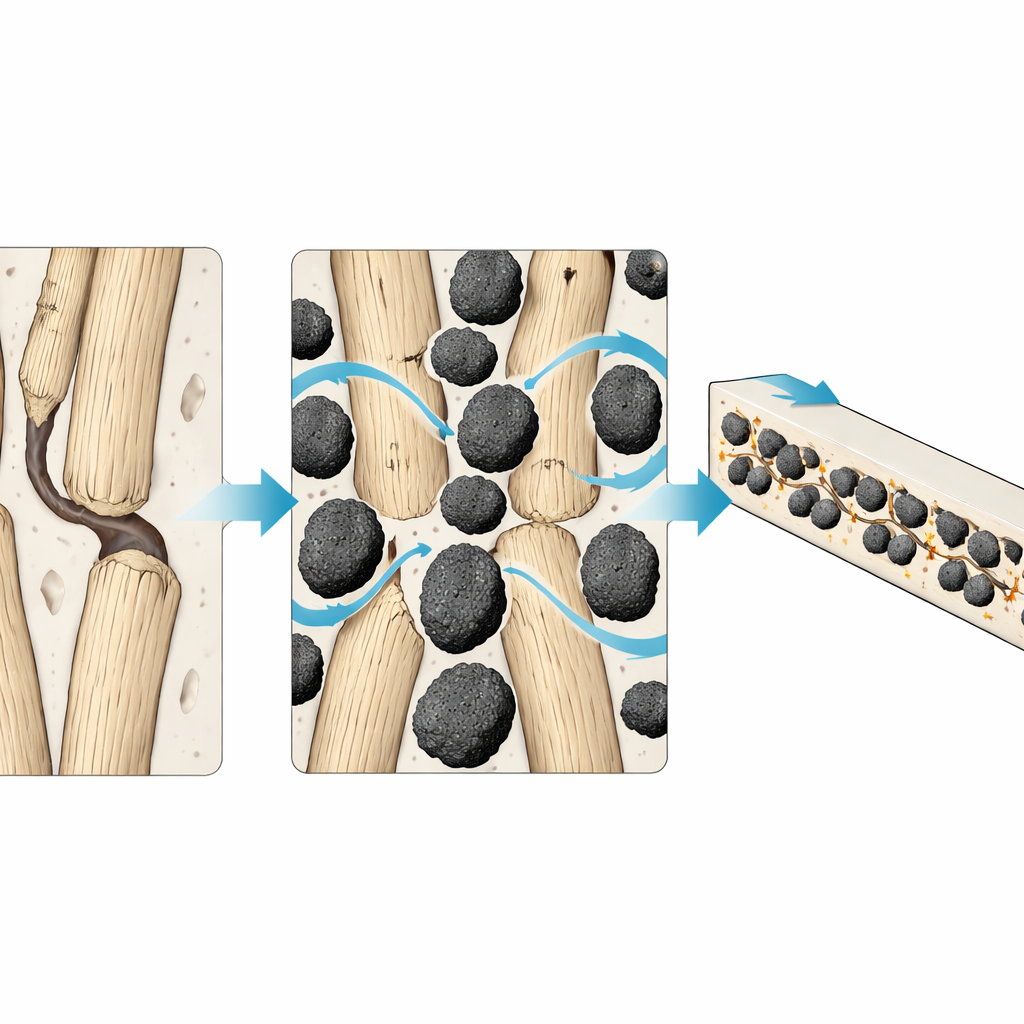
The standout result was the composite with 3 percent biochar (MR3). Compared with the 1 percent version, MR3 showed about one‑third higher tensile strength, nearly one‑fifth higher bending strength, and roughly half again as much impact resistance. Microscopic images revealed why: biochar particles in MR3 were well distributed around the ramie fibers, filling tiny gaps and creating a rough, interlocking interface. This allowed stresses to spread smoothly between fibers and resin, and it forced cracks to twist and branch instead of slicing straight through. At 5 percent biochar, however, the particles began to clump together. These clusters created weak spots and tiny voids that slightly reduced strength and toughness despite the higher filler content.
Heat, Water, and Long‑Term Durability
Beyond simple strength tests, the team studied how the composites handled heat and moisture—two key challenges for real‑world use. Thermal analysis showed that MR3 resisted decomposition to higher temperatures and left behind more protective char than the other samples, meaning it would be more stable in hot environments. Water‑soak tests revealed that MR3 absorbed the least moisture, suggesting that biochar can help block pathways for water to creep along the plant fibers. Even after immersion and drying, MR3 retained more than 95 percent of its original tensile and bending strength and nearly all of its impact resistance, pointing to good durability under humid or wet conditions.
What This Means for Everyday Products
In plain terms, this work shows that there is a “just right” amount of nutshell biochar that turns ramie‑epoxy composites into stronger, tougher, and more heat‑resistant materials without sacrificing lightness. At about 3 percent biochar, the composite performs better than lower or higher loadings because the particles are well dispersed and tightly bonded to the fibers and resin. By unlocking value from agricultural waste streams, such materials could one day appear in lightweight car parts, building panels, or other components where reducing both weight and environmental impact matters.
Citation: Palaniappan, M., Kumar, P.M., Sivanantham, G. et al. Chemical and structural characterization of ramie-based epoxy composites reinforced with macadamia nut shell biochar. Sci Rep 16, 9374 (2026). https://doi.org/10.1038/s41598-026-39764-1
Keywords: biochar composites, natural fiber materials, agricultural waste reuse, sustainable polymers, lightweight structures