Clear Sky Science · en
Seismic performance of reinforced concrete beam column joints strengthened with ECC shells
Why stronger building joints matter
When an earthquake hits, the most vulnerable parts of a reinforced concrete frame are often the joints where beams and columns meet. If these joints fail suddenly, entire floors can collapse, even if the rest of the structure is relatively undamaged. This paper explores a new way to wrap these critical joints in a thin, high‑performance concrete "shell" that can stretch, crack in a controlled way, and help buildings ride out strong shaking more safely.
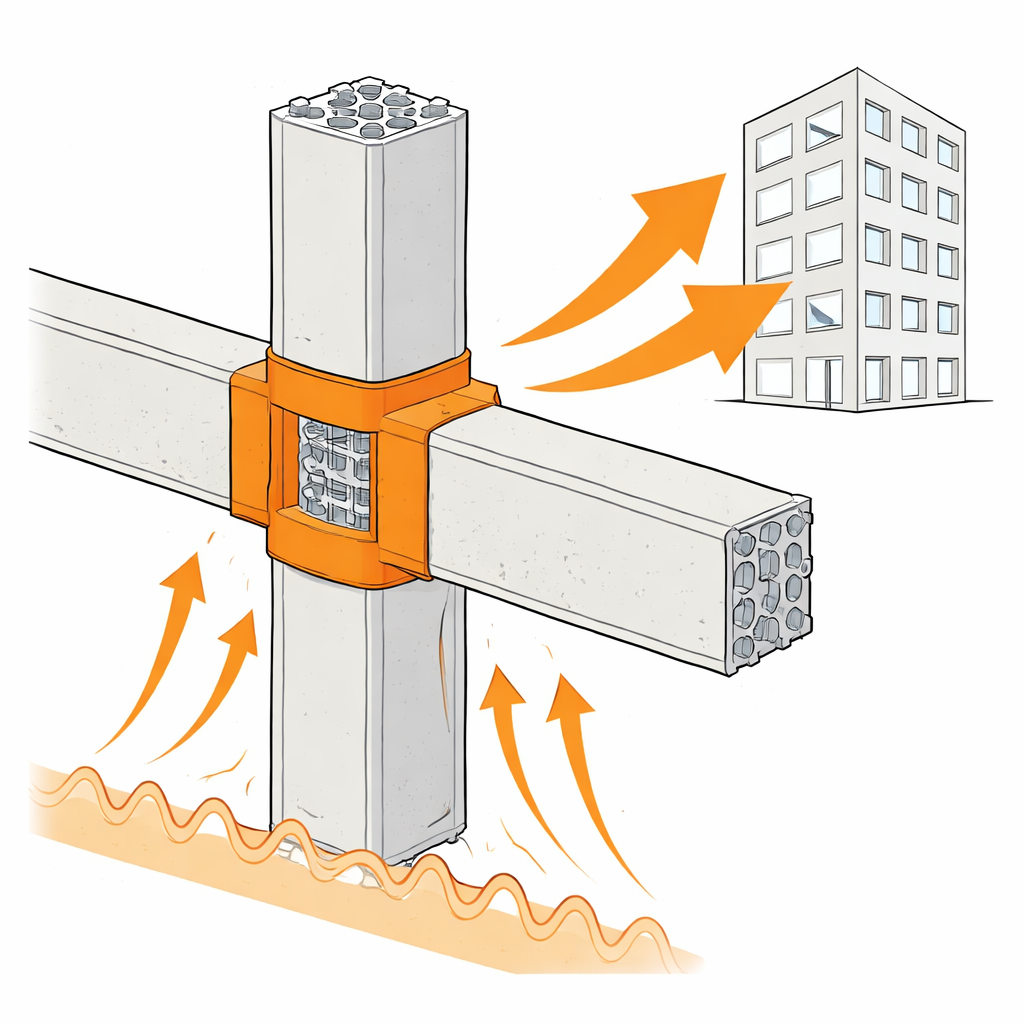
A tougher shell around a weak spot
The study focuses on beam–column joints in reinforced concrete frames, especially the cross‑shaped interior joints common in many buildings. These joints must transfer loads in two directions and are prone to brittle, sudden failure during earthquakes. The researchers propose adding an outer shell made of engineered cementitious composite (ECC), a kind of fiber‑rich concrete that can stretch several percent without breaking apart. Instead of one or two large cracks, ECC develops many tiny ones that stay very narrow, allowing it to dissipate energy and even self‑heal when exposed to moisture. By wrapping the joint region with an ECC shell, the team aims to protect the fragile core concrete, control cracking, and shift damage away from the joint to safer regions of the beams.
Virtual testing with detailed computer models
Rather than relying only on costly full‑scale tests, the authors built a refined finite element model—a numerical representation of the joint that tracks how concrete, steel, and ECC deform and crack under repeated loading. They first validated this model using experimental data from two large specimens: one conventional joint and one strengthened with an ECC shell. The simulated and measured load–deflection curves matched closely, with differences in ultimate load under 5 percent. The model also reproduced the observed crack patterns: wide, concentrated shear cracks in the unstrengthened joint versus finer, more distributed cracking and reduced damage where the ECC shell was used. This gave the researchers confidence to use the model for an extensive parametric study.
What controls earthquake performance
Using the validated model, the team varied four key design parameters: the height of the ECC shell along the beam and column, the shell thickness, the amount of longitudinal steel in the beam, and the vertical load pressing on the column (axial compression ratio). They tracked how these changes affected strength, stiffness, ductility, and energy dissipation. Increasing shell thickness from 30 to 90 millimeters raised the peak load by almost 12 percent and noticeably improved deformation capacity, but further thickening to 150 millimeters brought only small gains, revealing a clear saturation point. Raising the amount of beam reinforcement had the largest impact: boosting the steel ratio from 0.05 to 0.2 percent increased peak load by about 152 percent and significantly enlarged the stable, energy‑dissipating range of motion. Shell height mainly influenced where damage formed, helping move plastic hinges away from the joint, while a moderate axial compression ratio (around 0.3) gave the best mix of stiffness and deformability.
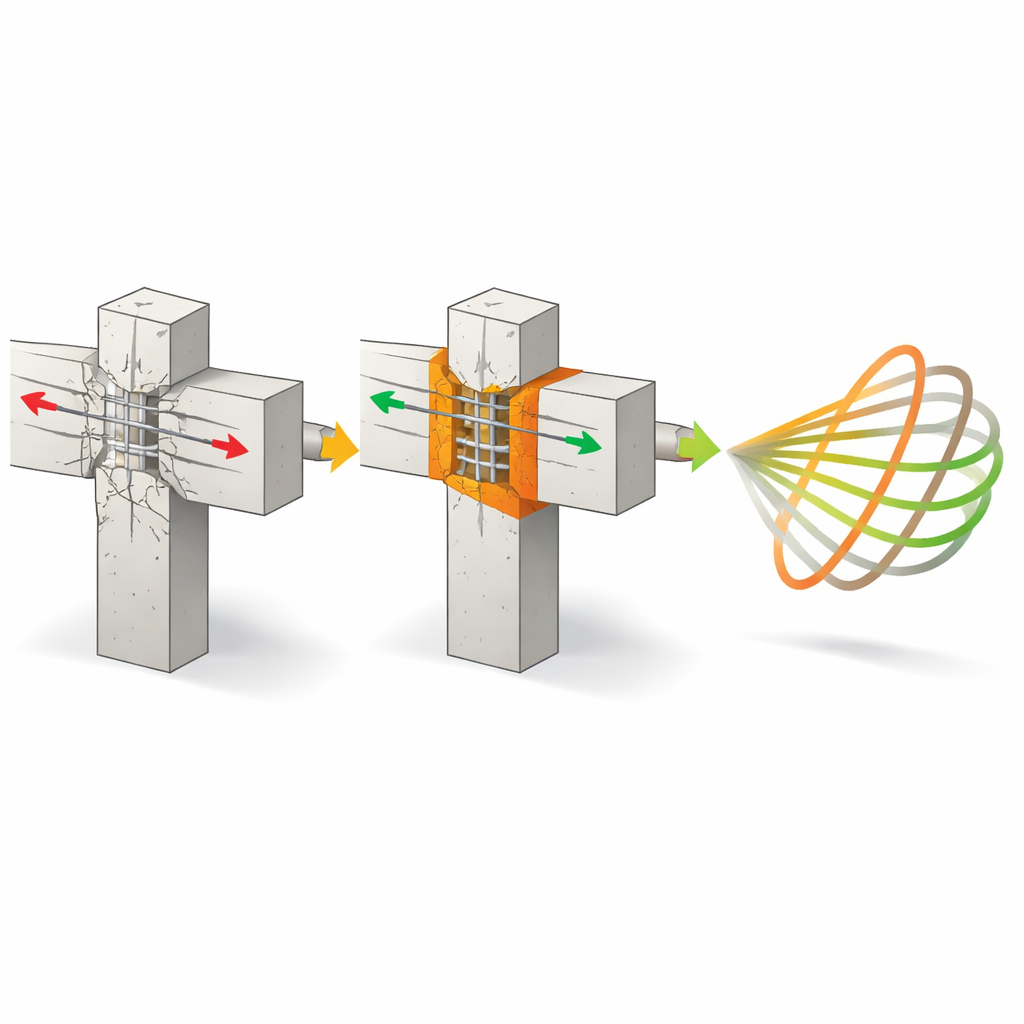
From simulations to practical design tools
To make their findings usable in engineering practice, the authors condensed the parametric study into simple predictive models. They used multiple linear regression to link ultimate load capacity to shell height, shell thickness, reinforcement ratio, and axial compression ratio. This statistical model explained about 94 percent of the variation in strength across all simulated cases, highlighting that beam reinforcement and ECC thickness are the dominant levers. In parallel, they derived a new theoretical formula for the shear strength of ECC‑strengthened joints by representing the joint core as a system of diagonal struts and transverse braces in the ECC and steel. When checked against both simulations and physical tests, this shear‑capacity model stayed within about 8 percent of observed values, well inside typical design tolerances.
What this means for safer buildings
For non‑specialists, the takeaway is straightforward: wrapping beam–column joints with a well‑designed ECC shell can make concrete frames both stronger and more forgiving during earthquakes. The shell does not just add bulk; it reshapes how forces flow through the joint, encourages many small cracks instead of a few catastrophic ones, and shifts serious damage away from the most critical connection. The study shows that with the right combination of shell thickness and steel reinforcement—and without excessive vertical loading—engineers can reliably predict and upgrade the seismic capacity of existing or new buildings. While the work is based on a specific range of materials and configurations, it points toward practical, performance‑based retrofit strategies that could help keep buildings standing and occupants safer when the ground shakes.
Citation: Xiao, Z., Wang, L. & Huang, R. Seismic performance of reinforced concrete beam column joints strengthened with ECC shells. Sci Rep 16, 8137 (2026). https://doi.org/10.1038/s41598-026-39753-4
Keywords: earthquake engineering, reinforced concrete joints, engineered cementitious composites, seismic retrofitting, finite element simulation