Clear Sky Science · en
AI-enabled drones for date palm pollination
Robots That Help Date Palms Bloom
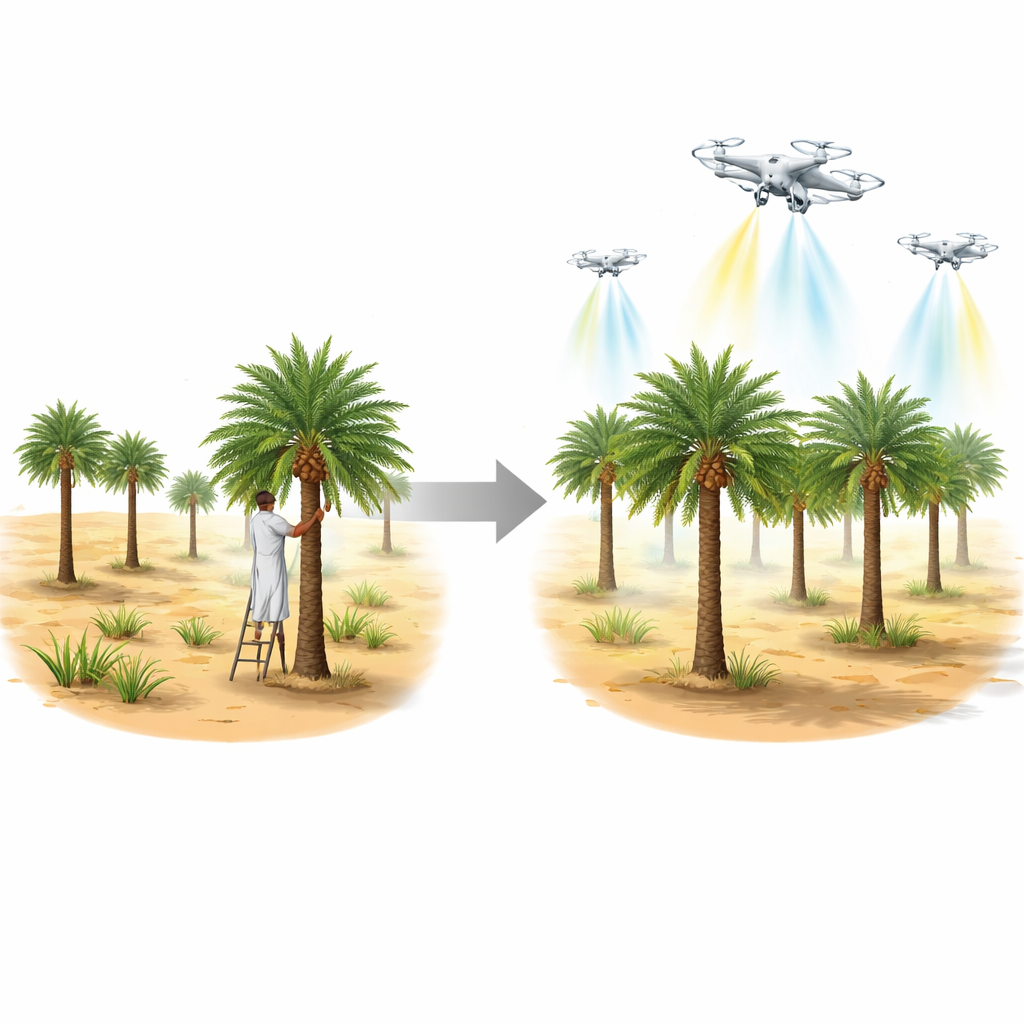
Date palms are a lifeline for many dry regions, supplying food, income, and cultural heritage. Yet getting each tree to bear fruit still depends on a tedious task: workers must climb tall trunks and dust pollen onto flowers by hand. This paper explores how small flying robots, guided by artificial intelligence, could take over much of that work, making pollination faster, cheaper, and more sustainable for farmers.
Why Pollinating These Trees Is So Hard
Date palms grow in hot, often harsh environments and can reach the height of a multi-story building. Their male and female flowers are on separate trees, so pollen has to be transferred deliberately. Traditional methods—tying male flower strands into female clusters or puffing dry pollen powders—demand skilled labor, careful timing, and large amounts of pollen. As farms grow and skilled workers become scarce, these methods struggle to keep up, especially because flowering is spread out over weeks, requiring several visits to the same trees. Climate change and the loss of natural pollinators only add to the pressure.
Drones Join the Orchard
Recent advances in small flying machines and smart cameras have opened the door to a new approach: drone-assisted pollination. In this study, the authors design and model a drone system that can find the flowering parts of date palms and spray them with a fine mist of pollen solution. They explore two modes. In the semi-autonomous mode, a human operator launches and steers the drone near each tree, while onboard software spots the flowers and controls the spray. In the fully autonomous mode, the drone follows a programmed flight path, checks its own battery and sensors, avoids obstacles, detects flowers, aligns itself, sprays, and flies back to base with little human help. Both approaches aim to replace hours of tree climbing with minutes of guided flight.
Teaching Drones to See Flowers
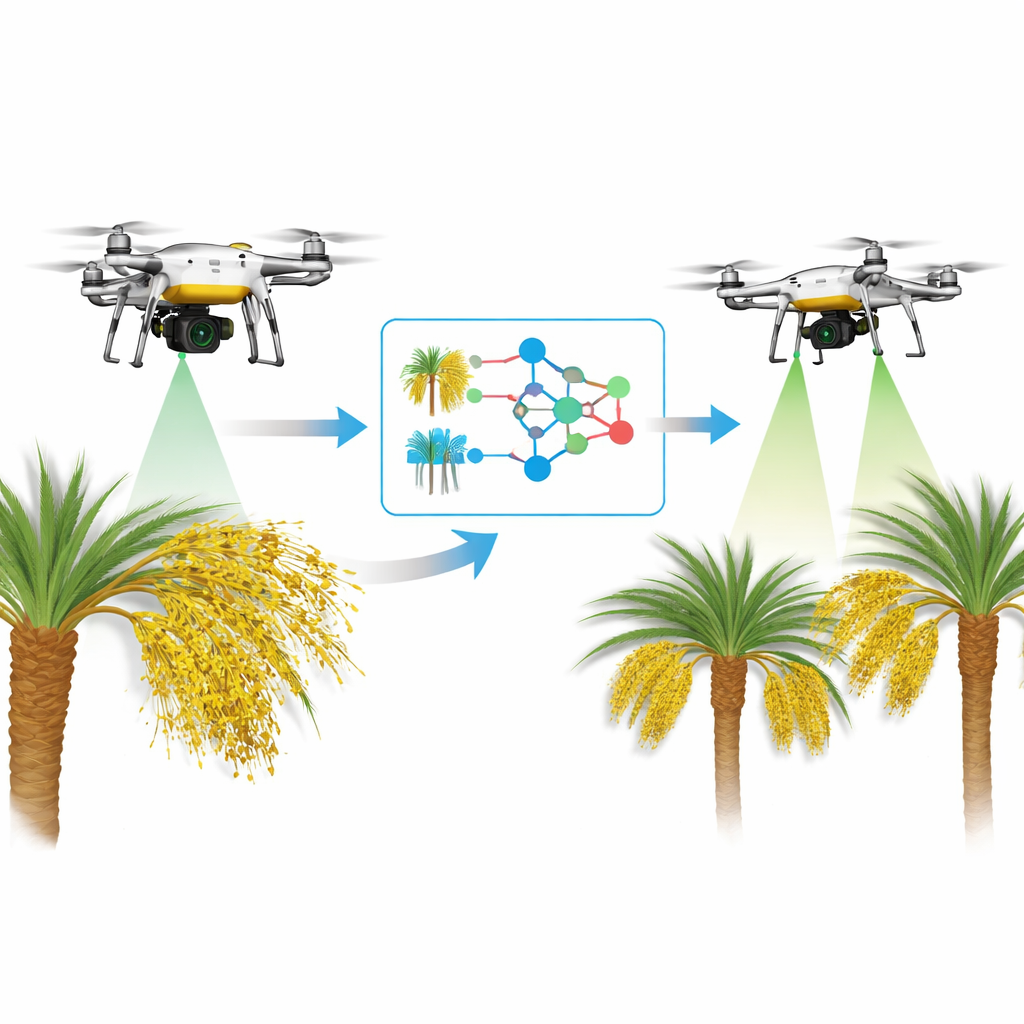
To make this possible, the drones must “see” the flower clusters clearly enough to know where and when to pollinate. The researchers built a large image dataset of palm canopies captured under different lighting, angles, and growth stages. Experts then drew boxes around the flower clusters so that computer vision programs could learn to recognize them. The team trained modern “you only look once” (YOLO) models—fast deep-learning systems that can spot objects in real time—on this dataset. They experimented with several versions and related models, then compressed and optimized the best performers to run efficiently on a small, low-power computer board mounted on the drone. After careful tuning, the system could analyze video frames at more than ten images per second while keeping detection accuracy high enough to guide precise spraying.
Designing the Flying Helper
Alongside the vision system, the authors engineered a quadcopter platform tailored to orchard work. They calculated how much thrust the motors and propellers must generate to safely lift the frame, battery, and a liter of pollen solution, and how long the drone could stay in the air before recharging. With a typical battery, the test platform can pollinate about six trees per flight, each tree taking roughly one minute for the drone to align and spray all major flower clusters. The study also compares different drone layouts—four, six, or eight rotors—highlighting trade-offs between agility, payload, reliability, and cost. For large farms, the authors show that using multiple drones in parallel can shrink the total time needed to pollinate a thousand trees from many hours with a single machine to just a couple of hours with a small fleet.
Saving Labor, Pollen, and the Environment
A key advantage of the system is how it uses pollen. Instead of showering trees with thick, powdery clouds, the drone applies a diluted liquid suspension directly where it is needed. According to the authors’ calculations and comparisons with existing commercial systems, their design can cut pollen use by about 97 percent per tree while still delivering a similar effect. At the same time, they estimate that labor requirements drop by roughly 80 percent, since one operator and a small number of drones can replace a larger crew of climbers. The same platform can also be adapted for precise delivery of fertilizers or pesticides, reducing chemical waste and runoff.
What This Means for Farmers
The work does not yet prove how much extra fruit farmers will get, because the study focuses on engineering performance rather than long-term harvest data. Still, the results show that AI-guided drones can reliably find date palm flowers, reach them with a gentle spray, and do so using far less labor and pollen than traditional methods. In plain terms, this prototype suggests that future farms could rely on small fleets of smart flying helpers to handle one of their most demanding seasonal jobs, freeing people from risky climbs while helping to secure reliable harvests in some of the world’s driest regions.
Citation: AlRaeesi, I., El-Khazali, R. AI-enabled drones for date palm pollination. Sci Rep 16, 10158 (2026). https://doi.org/10.1038/s41598-026-39739-2
Keywords: drone pollination, date palm farming, precision agriculture, agricultural robotics, computer vision