Clear Sky Science · en
Hydrothermal transformation of kerogen and oil in Low-permeability rocks of the domanic deposits in carbon dioxide media
Unlocking Hidden Oil in Ancient Rocks
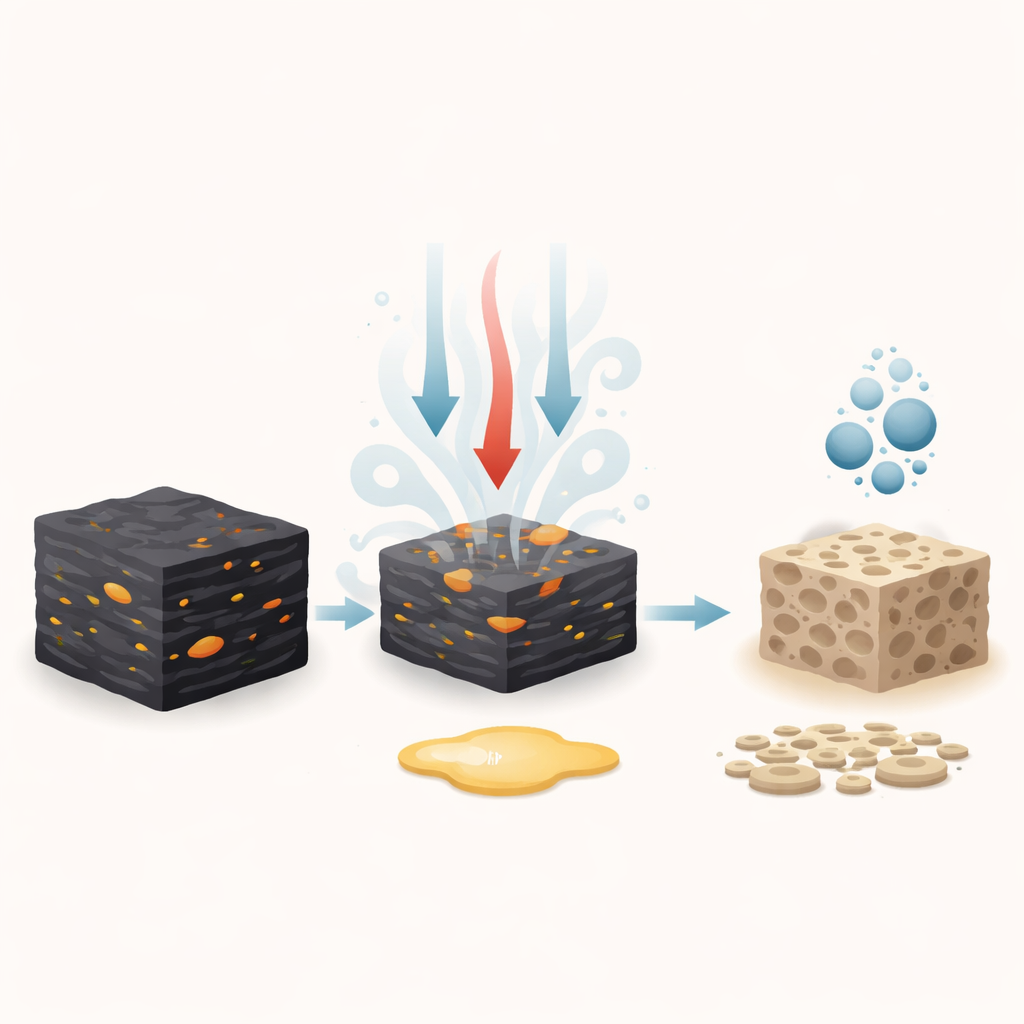
Much of the world’s remaining oil is locked inside rocks that do not easily let fluids pass through them. In Russia’s Domanic formations, huge amounts of potential fuel sit trapped as a solid, plastic-like organic substance called kerogen. This study explores whether carefully heating such rocks in the presence of water and carbon dioxide can speed up nature’s slow oil-making process and turn that solid material into usable oil and gas on human timescales.
Why These Hard Rocks Matter
The Domanic deposits of Tatarstan in Russia hold billions of tons of organic-rich rock but are very difficult to exploit with standard drilling and fracturing methods. Unlike many North American shale plays, much of the organic matter here has not yet fully turned into liquid oil; instead, it remains as kerogen bound within a dense carbonate–silica rock. Because this kerogen is solid and tightly held, it does not dissolve in ordinary solvents and cannot flow to wells. Finding a way to gently “finish” this natural transformation inside the reservoir could open a major new energy resource while avoiding large surface mining operations.
Simulating Fast-Forwarded Geologic Time
To mimic and accelerate what normally happens over millions of years underground, the researchers placed crushed cores from the Tavel oil field into a steel reactor with water and carbon dioxide. They then heated the rock–fluid mixture to 250, 300, or 350 degrees Celsius for 24 hours at high pressure, conditions similar to deep hydrothermal systems in the Earth’s crust. After each run, they measured how much kerogen remained in the rock, how much liquid extract could be pulled out with solvents, and what kinds of gases and liquid hydrocarbons had formed. By comparing the products at different temperatures, they could track the step‑by‑step breakdown of solid organic matter into more mobile oil and gas.
From Heavy Residues to Lighter Oil and Gas
The experiments showed that higher temperatures sharply intensified the conversion of kerogen. At 250 degrees, mostly heavy, sticky components were released, and the rock still retained most of its solid organic content. At 300 degrees, more of this heavy material began to crack into lighter saturated hydrocarbons, raising the share of simpler, oil-like molecules in the extracted liquid. At 350 degrees, the change was dramatic: the indicator of kerogen content in the rock dropped to a small fraction of its original value, and the overall organic carbon in the rock fell accordingly. At the same time, the amount of extractable liquid increased by about two‑thirds, and the liquid became richer in light saturated and aromatic hydrocarbons while the proportion of stubborn, tar‑like asphaltenes declined more than twofold.
Gas Formation and Rock Changes
Alongside liquid oil, the hot water and carbon dioxide mixture generated significant volumes of gas. With rising temperature, methane, ethane, propane and butanes all increased, as did hydrogen, carbon monoxide and especially carbon dioxide. At 350 degrees, the total hydrocarbon gas yield was dozens of times higher than at 250 degrees, a sign that intense cracking reactions were underway. The study also found that many of the large ring‑rich molecules in kerogen reshaped into smaller aromatic structures, including sulfur‑bearing species such as thiophenes and benzothiophenes. In effect, the rock–fluid system shifted into a regime where the solid organic matrix was being rapidly chopped into lighter, mobile molecules that can move through pores and fractures more easily.

What This Means for Future Oil Recovery
For non‑experts, the takeaway is that the researchers have shown a controlled way to “cook” stubborn organic‑rich rocks so that they yield much more useful oil and gas. By heating Domanic rock in water with carbon dioxide to about 350 degrees Celsius, they achieved near‑complete destruction of solid kerogen and a strong increase in light, flowable hydrocarbons, without forming extra inert carbon residues. This suggests that carefully designed hydrothermal processes using carbon dioxide could help unlock large unconventional oil resources while simultaneously using the same gas that contributes to climate change as a working fluid underground. The work does not solve all environmental or economic questions, but it provides an experimentally grounded recipe for turning hard‑to‑access kerogen into producible shale oil in these challenging formations.
Citation: Mikhailova, A., Ammar, AK., Saeed, S.A. et al. Hydrothermal transformation of kerogen and oil in Low-permeability rocks of the domanic deposits in carbon dioxide media. Sci Rep 16, 8013 (2026). https://doi.org/10.1038/s41598-026-39738-3
Keywords: shale oil, kerogen, hydrothermal conversion, carbon dioxide flooding, unconventional reservoirs