Clear Sky Science · en
Impact of microwave pretreatment on drying kinetics, mass transfer and thermodynamic characteristics of Barhi dates during drying process
Why These Little Fruits Matter
Barhi dates are small, golden fruits that are prized in the Middle East and beyond for their sweetness, soft bite, and rich nutrition. Yet at their early, crunchy Khalal stage, they spoil quickly because they are full of water and sugars that invite microbes. This study asks a practical question with big implications for farmers and food companies: can a brief burst of microwave energy before drying make Barhi dates dry faster, more evenly, and with less wasted energy?
From Fresh Fruit to Long-Lasting Snack
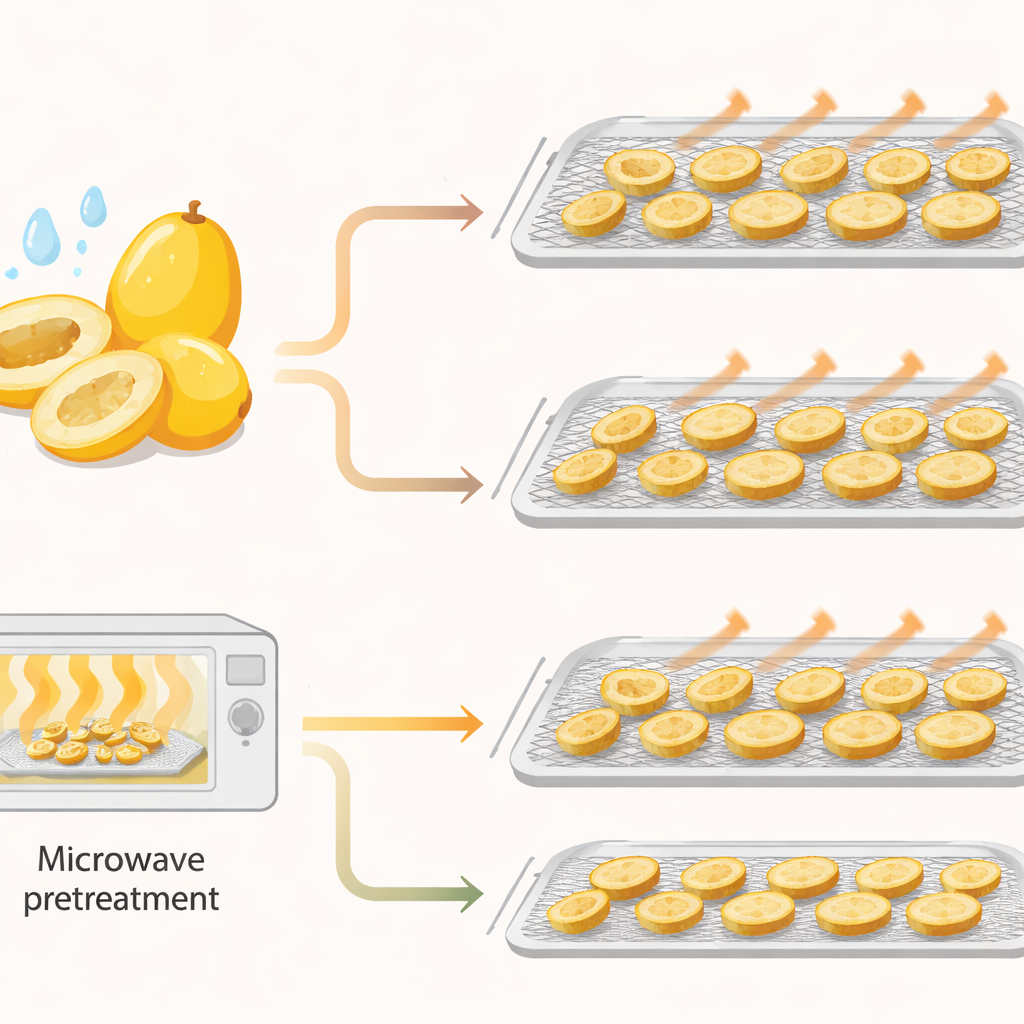
To explore this, the researchers worked with thin slices of Barhi dates. Some slices were dried in hot air as usual, while others first received a short microwave treatment and were then dried under the same hot-air conditions. They tested three drying temperatures and three air speeds, carefully tracking how much water left the fruit over time and how quickly it happened. By comparing the two groups, they could see whether the microwave step really changed how moisture moved from the inside of the fruit to the surrounding air.
Speeding Up the Drying Journey
The first clear finding is about time. Across all temperatures and air speeds, microwave-pretreated slices reached the target dryness 18–21 percent faster than untreated ones. In the slowest, mildest setting, drying time dropped from about three days to a little over two; even under the harshest conditions, the microwave step still shaved off several hours. The early part of drying showed the biggest jump in speed: microwave-treated slices released water more quickly at the beginning, suggesting that the pretreatment had opened up pathways for moisture to escape. For a factory that dries tons of dates, that kind of time saving can translate into lower costs and higher throughput.
Following Water on the Move
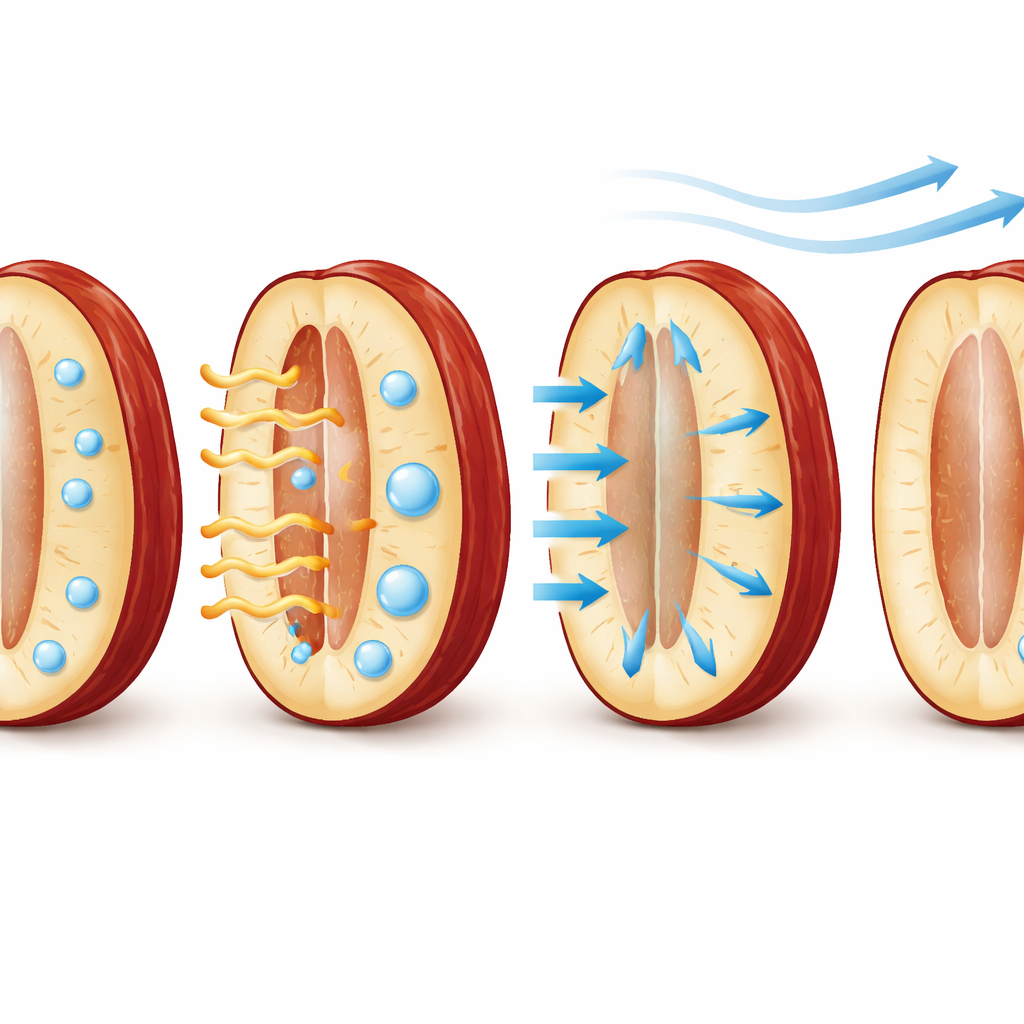
Behind these time savings is a story about how water travels inside the fruit. Using well-known equations that describe diffusion—how molecules spread from wetter regions to drier ones—the team estimated how easily moisture could move through the date flesh. The microwave-treated slices showed up to roughly three- to fourfold higher internal water mobility than untreated slices, especially at higher temperatures and air speeds. Measures of how strongly the surface air flow helps or hinders this movement also improved, indicating that water was not only moving faster inside the fruit but was also being carried away more effectively once it reached the surface. When the scientists tested several simple mathematical curves to describe the drying behavior, a flexible “logarithmic” curve consistently matched reality best, for both treated and untreated dates, but it fit the microwave-treated samples just a bit more smoothly—another sign that drying was more uniform.
What the Energy Numbers Tell Us
The study went further by looking at the “thermodynamic” side of drying—how much energy is needed, how orderly the water molecules are, and whether the process can happen on its own. The numbers showed that drying these dates always requires an input of heat; the process is endothermic and not spontaneous, meaning it will not proceed without energy from outside. Microwave-treated slices had slightly higher values for the energy needed to start water moving, but at the same time showed slightly lower “free energy” barriers overall. In everyday terms, the microwave step rearranges the fruit’s structure so that, once it is warmed, water can leave more readily. This points to better energy use: less wasted heat and more of it going directly into pushing moisture out.
Bringing It All Together for Real-World Use
For growers, processors, and even consumers who enjoy date snacks, the message is straightforward. A short microwave pretreatment before hot-air drying helps Barhi dates dry more quickly and more evenly, while offering the potential for better energy efficiency. The fruit behaves in a more predictable way during drying, which allows engineers to design equipment and schedules that minimize spoilage and energy waste. In regions where dates are a key food and income source, this kind of fine-tuning can help turn a fragile, highly perishable fruit into a stable, high-quality product that travels farther, lasts longer, and reaches more people without sacrificing its natural sweetness.
Citation: Alqahtani, N., Fikry, M. Impact of microwave pretreatment on drying kinetics, mass transfer and thermodynamic characteristics of Barhi dates during drying process. Sci Rep 16, 9022 (2026). https://doi.org/10.1038/s41598-026-39727-6
Keywords: Barhi dates, microwave drying, food preservation, drying efficiency, postharvest technology