Clear Sky Science · en
Neglecting organic alkalinity introduces greater error than assuming boron to salinity ratios in Arctic sea ice brine carbonate system calculations
Why tiny ingredients in sea ice matter
The Arctic Ocean is one of the planet’s busiest gateways for taking carbon dioxide (CO2) out of the air, and sea ice plays a surprisingly active role in that process. Scientists usually describe this behavior using a chemical yardstick called alkalinity, which reflects how well seawater can buffer acids and hold carbon. Traditionally, they have assumed this yardstick is controlled almost entirely by simple dissolved salts and minerals. This study shows that in Arctic sea ice, a small overlooked part of alkalinity linked to organic material can quietly skew our estimates of how much CO2 the ice–ocean system is really absorbing.
Salt water, frozen oceans, and hidden organics
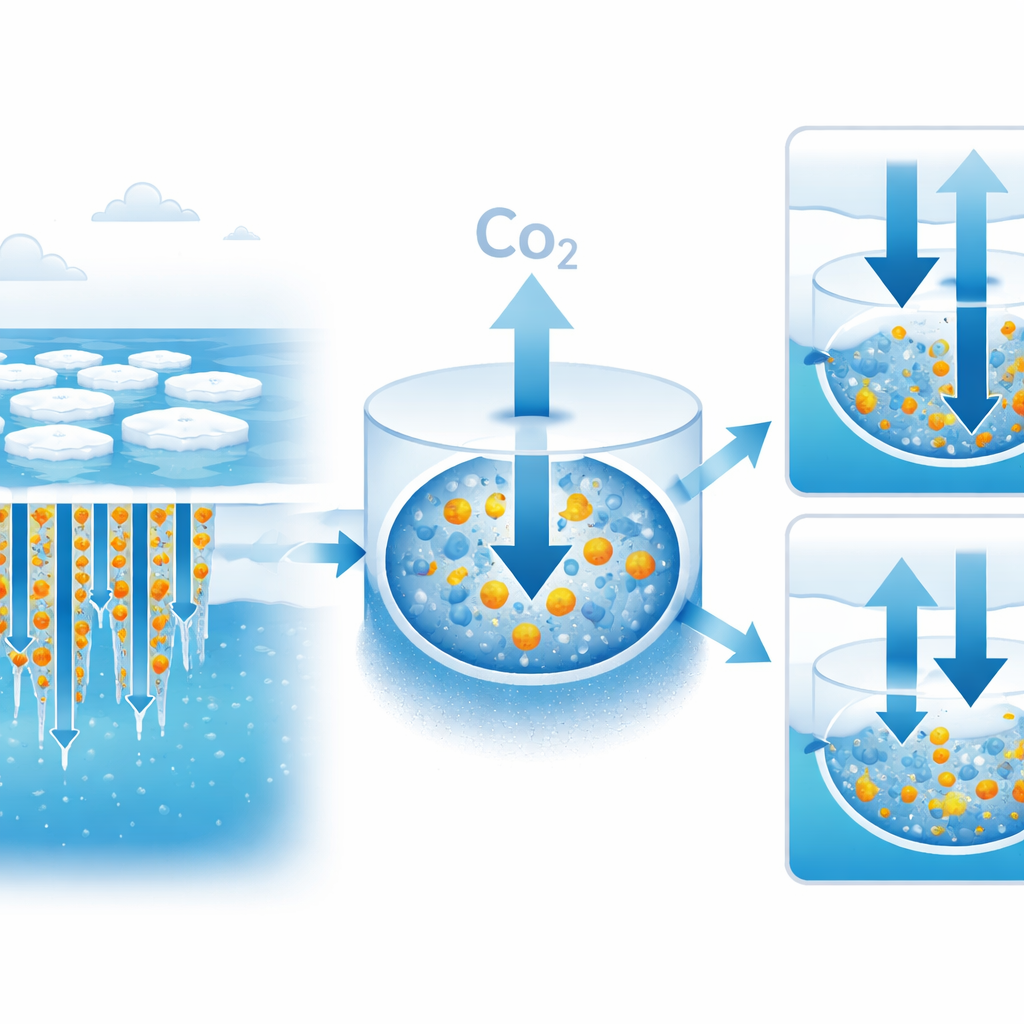
When seawater freezes, pure ice crystals form and squeeze out salty liquid called brine into narrow channels within the ice. These brine pockets trap not only salt but also dissolved organic matter—complex carbon-rich compounds from microscopic plants, bacteria, and rivers flowing into the Arctic. Previous work suggested that such organics might slightly influence alkalinity in some coastal seas, but their role in polar sea ice remained poorly documented. At the same time, another component of seawater chemistry, the element boron, is often estimated from saltiness alone, even though it can sometimes deviate from this rule. The authors set out to measure both organic contributions and boron directly in eastern Arctic sea ice and nearby waters to see which source of uncertainty matters more for CO2 calculations.
What the expedition sampled in the ice
During a 2023 research cruise in the Fram Strait and central Arctic, the team collected 140 samples from snow, sea ice cores, slushy surface water, brine from holes in the ice, and water below and between ice floes. They measured dissolved organic carbon (DOC) to see how much organic material was present, and then used a specialized back-titration technique to quantify how much of the total alkalinity was actually organic alkalinity. In a subset of samples, they also had precise measurements of pH, dissolved inorganic carbon, and boron, allowing them to test how including or ignoring organics and measured boron changed key carbonate system outputs such as the partial pressure of CO2 (pCO2) and the tendency for calcium carbonate minerals to dissolve or form.
Organic alkalinity: small fraction, big effect
Brine samples stood out as hotspots of both DOC and organic alkalinity. On average, organics contributed only about 0.1–1.0% of total alkalinity—seemingly a tiny fraction—yet this was enough to noticeably shift computed carbonate chemistry. The ratio of organic alkalinity to DOC matched values seen in other high-organic, ice-influenced seas like the Baltic, suggesting a broadly similar behavior of these compounds across very different regions. When the researchers corrected alkalinity to remove the organic share and recomputed carbonate parameters, calculated pCO2 in brine increased by up to 84 microatmospheres, while the saturation state for calcium carbonate minerals (important for shell-forming organisms) dropped by as much as 0.2–0.3 units. In other words, the brine looked less ready to build minerals and more loaded with CO2 than standard calculations had implied.
Boron versus organics: which uncertainty matters more?
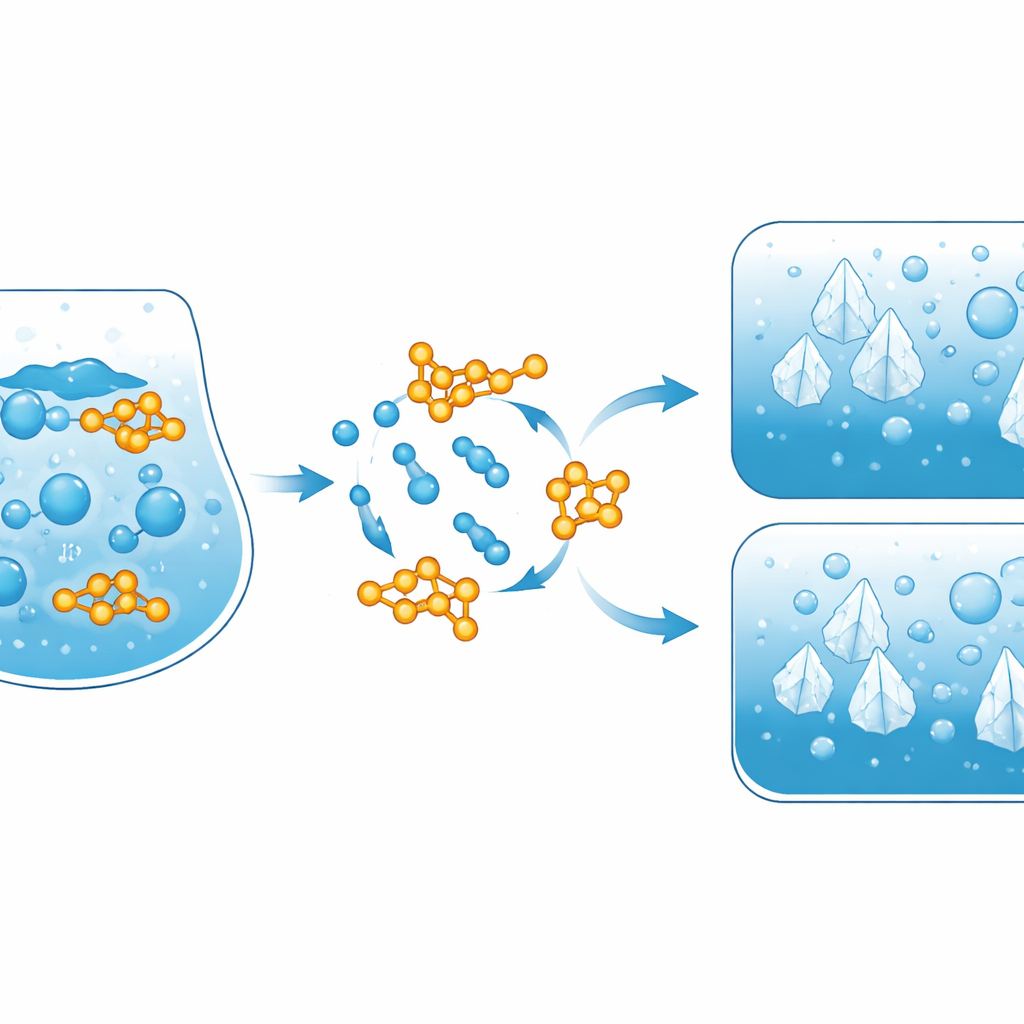
Because earlier work in the same area showed that boron does not always follow its usual link with salinity, the team compared two types of error head-to-head: using a standard boron–salinity ratio versus measured boron, and including versus omitting organic alkalinity. They ran model cases in which they changed only boron, only organics, or both, always starting from the same measurements of dissolved inorganic carbon and alkalinity. Deviations caused by using the standard boron assumption were modest: pCO2 shifted by at most about 5 microatmospheres, and changes in pH and mineral saturation were small. By contrast, neglecting organic alkalinity systematically underestimated pCO2 (making the water appear more eager to take up CO2 from the air) and overstated mineral saturation. When they compared different ways of computing pCO2 from the same samples, the best agreement came from methods that explicitly included organic alkalinity, underscoring that even small organic contributions improve internal consistency.
What this means for Arctic CO2 uptake
The study concludes that in Arctic sea ice brine and the waters just below the ice, ignoring organic alkalinity introduces far larger errors into carbonate system calculations than assuming boron follows its usual relationship with salinity. Because most past assessments of CO2 exchange in these regions have relied on alkalinity-based calculations that omit organics, they probably overestimate how strongly sea ice and under-ice waters draw down atmospheric CO2, especially during spring melt when organic-rich brine is released. The authors argue that future polar campaigns should either measure very precise pH or directly measure organic alkalinity—and at least track dissolved organic carbon as a proxy—to better constrain Arctic carbon budgets and predictions of ocean acidification.
Citation: Rush, S., Lee, CH., Lee, K. et al. Neglecting organic alkalinity introduces greater error than assuming boron to salinity ratios in Arctic sea ice brine carbonate system calculations. Sci Rep 16, 9393 (2026). https://doi.org/10.1038/s41598-026-39719-6
Keywords: Arctic sea ice, organic alkalinity, carbon dioxide uptake, dissolved organic carbon, carbonate chemistry