Clear Sky Science · en
Modelling the effect of motivation on mental health components with fuzzy logic among elite athletes
Why this matters for sport and mental health
Elite sport often looks glamorous from the outside, but behind the medals and highlight reels are athletes juggling intense pressure, constant evaluation, and very real risks to their mental health. This study asks a simple but crucial question: how do an athlete’s inner drive, their sense of safety in the team, and their everyday mood combine to shape the chances of anxiety, depression, strain, and burnout—and can we model that mix in a way that coaches and psychologists can actually use?
The hidden pressures inside high performance
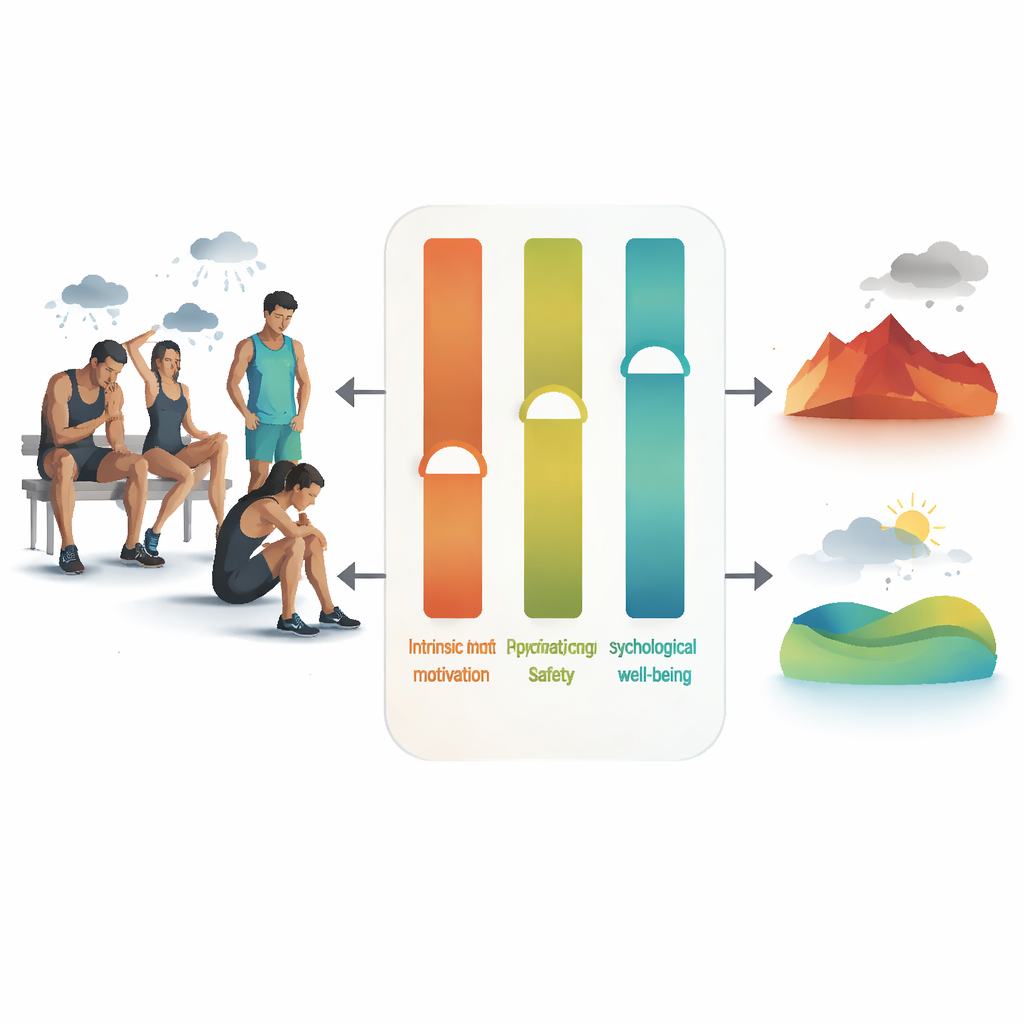
Top athletes live in environments where injuries, selection battles, public criticism, and role uncertainty are part of daily life. These stressors can fuel anxiety, low mood, and exhaustion, but they can also coexist with joy, growth, and purpose. The authors focus on three psychological ingredients that sit at the heart of this tension. Intrinsic motivation is the inner drive to train and compete for enjoyment, mastery, or personal meaning. Psychological safety is the feeling that one can speak up, admit mistakes, and ask for help without ridicule or punishment. Mental well-being reflects positive functioning—feeling balanced, connected, and capable of handling life’s demands. Together, these elements form a kind of psychological “ecosystem” that can either cushion or amplify the impact of stress.
How the study was carried out
The researchers worked with 247 athletes from a range of sports, both professional and amateur, who completed standard questionnaires on motivation, psychological safety, well-being, anxiety, depression, athlete-specific strain, and burnout. First, the team used conventional statistical methods to see how each factor related to mental health. As expected, higher psychological safety and well-being were linked to less anxiety, depression, strain, and burnout. Intrinsic motivation showed small protective links in simple correlations, but when all variables were considered together it sometimes predicted higher anxiety and depression—hinting that intense drive, without enough support, may turn into pressure rather than protection. To go beyond straight-line relationships, the authors then turned to a more flexible mathematical tool that could capture shades of gray instead of simple yes-or-no risk.
Using “fuzzy” rules to mirror real life
Rather than forcing athletes into rigid categories like “low risk” or “high risk,” the team built a fuzzy-logic model. In this approach, scores are translated into partial memberships in overlapping groups such as low, medium, and high. For example, someone’s anxiety might be partly “medium” and partly “high” at the same time. The model takes three inputs—intrinsic motivation, psychological safety, and well-being—and uses a set of transparent “if–then” rules to predict four outputs: anxiety, depression, strain, and burnout. Rules reflect clinical experience and theory: low motivation raises risk, while safety and well-being buffer it; when both are high together, they offer extra protection. The system then combines all the rules and converts the fuzzy result back into a single risk estimate that lines up with familiar clinical scales.
What the model revealed about risk and protection
When the researchers compared this fuzzy system to standard regression models, the fuzzy approach generally predicted athletes’ mental health scores more accurately and did so without becoming a “black box.” Visual maps from the model showed three striking patterns. First, when motivation, safety, and well-being were all low, there was a steep climb in anxiety, depression, strain, and burnout—an uphill “risk slope.” Second, as psychological safety or well-being improved, that slope flattened: even with low motivation, higher safety or well-being pulled athletes toward lower risk. Third, when safety and well-being were both high, the model produced a broad “basin” of low risk across all outcomes, suggesting a resilient zone where athletes could withstand setbacks without sharp jumps in distress. The surfaces also exposed tipping points: modest increases in motivation around a midrange level could suddenly shift predicted risk down, reflecting the non-linear nature of human psychology.

What this means for athletes, coaches, and support staff
To a lay reader, the key message is that mental health in elite sport is less like an on/off switch and more like a landscape with valleys of resilience and cliffs of risk. Intrinsic motivation is vital but not enough on its own; when drive is high but the environment feels unsafe or draining, that same drive may slide toward anxiety and exhaustion. By contrast, when athletes feel psychologically safe and their overall well-being is nurtured, even moderate motivation can coexist with healthy minds. The fuzzy-logic model turns these insights into clear, visual risk maps that teams could use for early warning—spotting small drops in safety or mood before they become serious problems. In doing so, the study argues for a shift in practice: rather than only pushing for more effort and commitment, sport systems should invest just as heavily in trust, openness, and everyday emotional care.
Citation: Şenel, A.A., Adiloğulları, G.E. & Şenel, E. Modelling the effect of motivation on mental health components with fuzzy logic among elite athletes. Sci Rep 16, 8076 (2026). https://doi.org/10.1038/s41598-026-39718-7
Keywords: elite athletes, motivation, psychological safety, mental health, fuzzy logic