Clear Sky Science · en
Performances and decision framework of CNT-infused bio-based hybrid composites for lightweight smart structures
Turning Plant Waste into Tough, Smart Materials
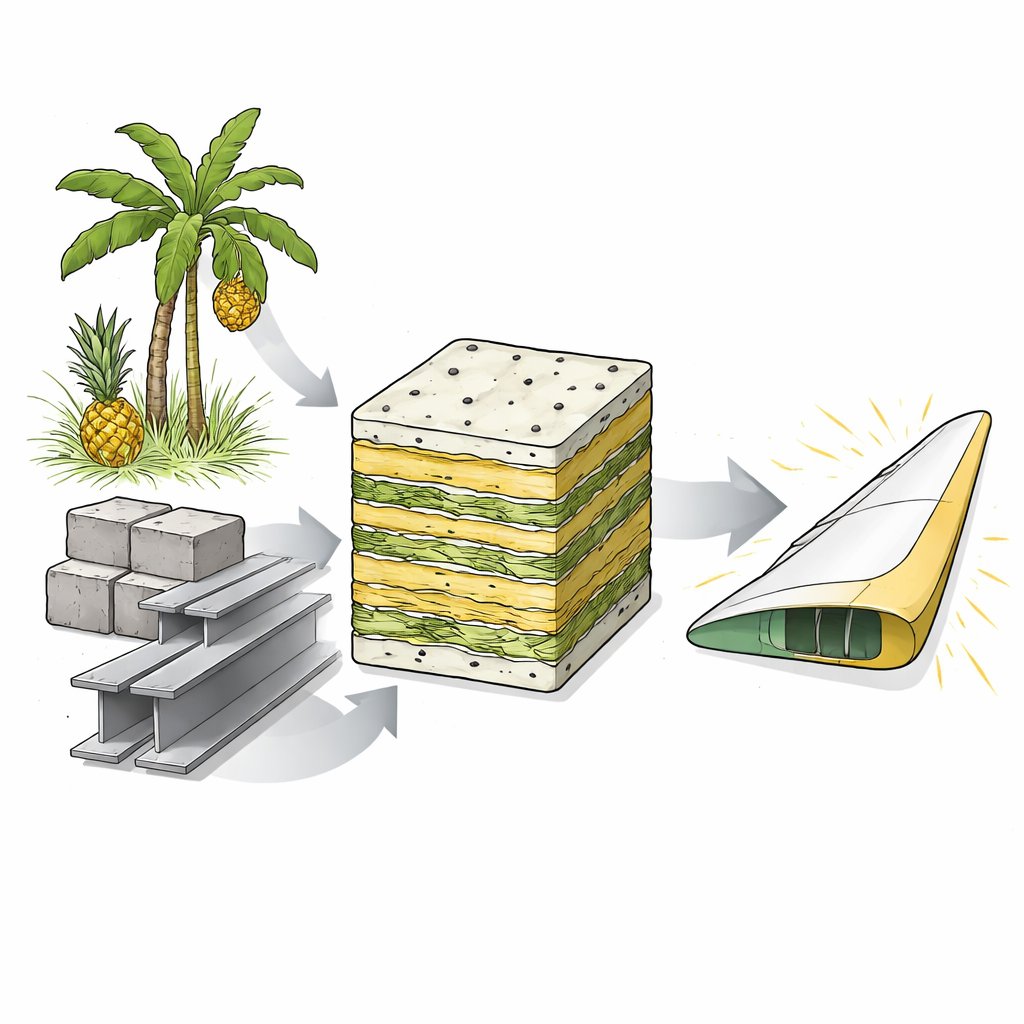
Imagine aircraft wings, car parts, or building panels made not from heavy metals or petroleum plastics, but from the leftover leaves and stems of banana and pineapple plants. This study explores how to turn such agricultural waste into strong, lightweight panels by adding ultra‑tiny carbon tubes, aiming to replace conventional materials while cutting weight, cost, and environmental impact.
From Farm Fields to Future Structures
The researchers start with two kinds of plant fibers: banana fibers taken from the plant stem, which are relatively stiff and strong, and pineapple leaf fibers, which are lighter and more flexible. Both are rich in cellulose, the same natural substance that gives wood its strength. By layering these fibers like thin sheets in different sequences and binding them with an epoxy glue, the team creates laminated panels. These panels are meant to be light yet tough enough for real structural use, such as parts that must carry significant loads.
Supercharging Natural Fibers with Tiny Tubes
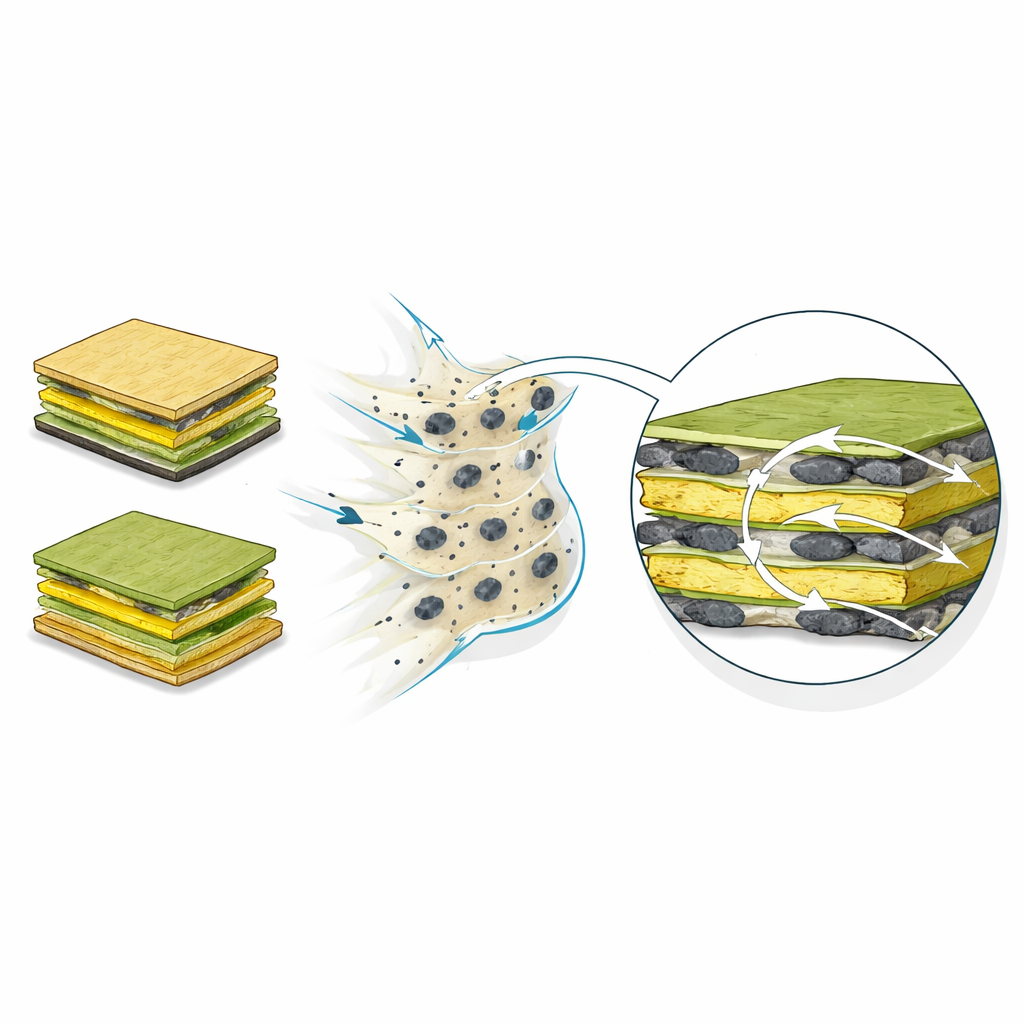
To boost performance, the team mixes in carbon nanotubes, microscopic cylinders of carbon famous for their exceptional strength and stiffness. These nanotubes are thoroughly blended into the epoxy before it seeps into the fiber layers. Detailed imaging and diffraction tests show that the nanotubes are well‑crystallized, roughly spherical at the particle scale, and can spread evenly through the glue. When properly dispersed, they create a dense web of contact between the glue and the fibers, helping stress move smoothly through the material instead of concentrating in weak spots.
Finding the Sweet Spot for Strength and Toughness
The scientists fabricate many versions of the panels, varying both the order of banana and pineapple layers and the amount of nanotubes (from none up to 6 percent by weight of the epoxy). They then subject the panels to stretching, bending, impact hits, and shear tests that try to make layers slide apart. In nearly every case, adding 3 percent nanotubes makes the material stronger and tougher: it can carry higher loads, bend further before failing, absorb more impact energy, and resist layers peeling apart. However, when nanotube content is raised to 6 percent, performance drops. At this higher dose, the tiny tubes clump together instead of spreading evenly, leaving voids and weak regions that act as crack starters.
How Layer Order Changes Performance
Surprisingly, the simple question of which fiber goes where in the stack turns out to matter a lot. Banana layers are stiffer and stronger, while pineapple layers are more compliant and stretchable. When these are alternated in patterns where stiff banana sheets sit against more flexible pineapple sheets, the panel better shares and redistributes stress. One particular arrangement, described as alternating banana and pineapple through the thickness, shows the best balance: very high tensile and bending strength, high resistance to impacts, and strong bonding between layers. Non‑destructive ultrasonic scanning and microscopic images of broken samples confirm that, in the best designs, cracks are slowed, layers stay bonded, and damage spreads more gradually instead of catastrophically.
Smart Choices with Fuzzy Logic
Because no single test tells the whole story, the authors also apply a mathematical decision framework to weigh all the measured properties at once. This approach, based on a kind of “fuzzy” logic that can handle uncertainty and expert judgment, ranks all 24 panel designs. It identifies the alternating banana‑pineapple laminate with 3 percent nanotubes as the top performer, followed closely by a few other nanotube‑enhanced hybrids. Panels without nanotubes or with poorer layer arrangements tend to sink to the bottom of the ranking.
What This Means for Real‑World Use
To a non‑specialist, the key message is that plant‑based composites do not have to be weak or fragile. By carefully choosing how to stack different natural fibers and by adding a modest amount of nanomaterial, it is possible to create panels that rival or exceed many traditional options in strength, stiffness, and impact resistance, while remaining lightweight and more sustainable. The work suggests that banana and pineapple waste, enhanced with just the right level of carbon nanotubes, could form the backbone of future “green” structural parts in vehicles, aircraft interiors, and other load‑bearing uses.
Citation: Kumar, S., Mahakur, V.K., Mishra, D.K. et al. Performances and decision framework of CNT-infused bio-based hybrid composites for lightweight smart structures. Sci Rep 16, 8531 (2026). https://doi.org/10.1038/s41598-026-39717-8
Keywords: natural fiber composites, carbon nanotubes, lightweight structures, sustainable materials, impact resistance