Clear Sky Science · en
Stabilizing collapsible soils using nano calcium carbonate to enhance mechanical properties
Why crumbling ground matters to everyday life
Across many dry regions of the world, towns and roads are built on a hidden hazard: collapsible soils that seem firm when dry but can suddenly shrink and sink when they get wet. This quiet danger can crack buildings, warp roads, and damage buried pipes. The study summarized here explores a new, low-dose, and relatively eco‑friendly way to make such soils safer, using ultra‑fine particles of common calcium carbonate—essentially nano‑scale chalk—to strengthen the ground from the inside out. 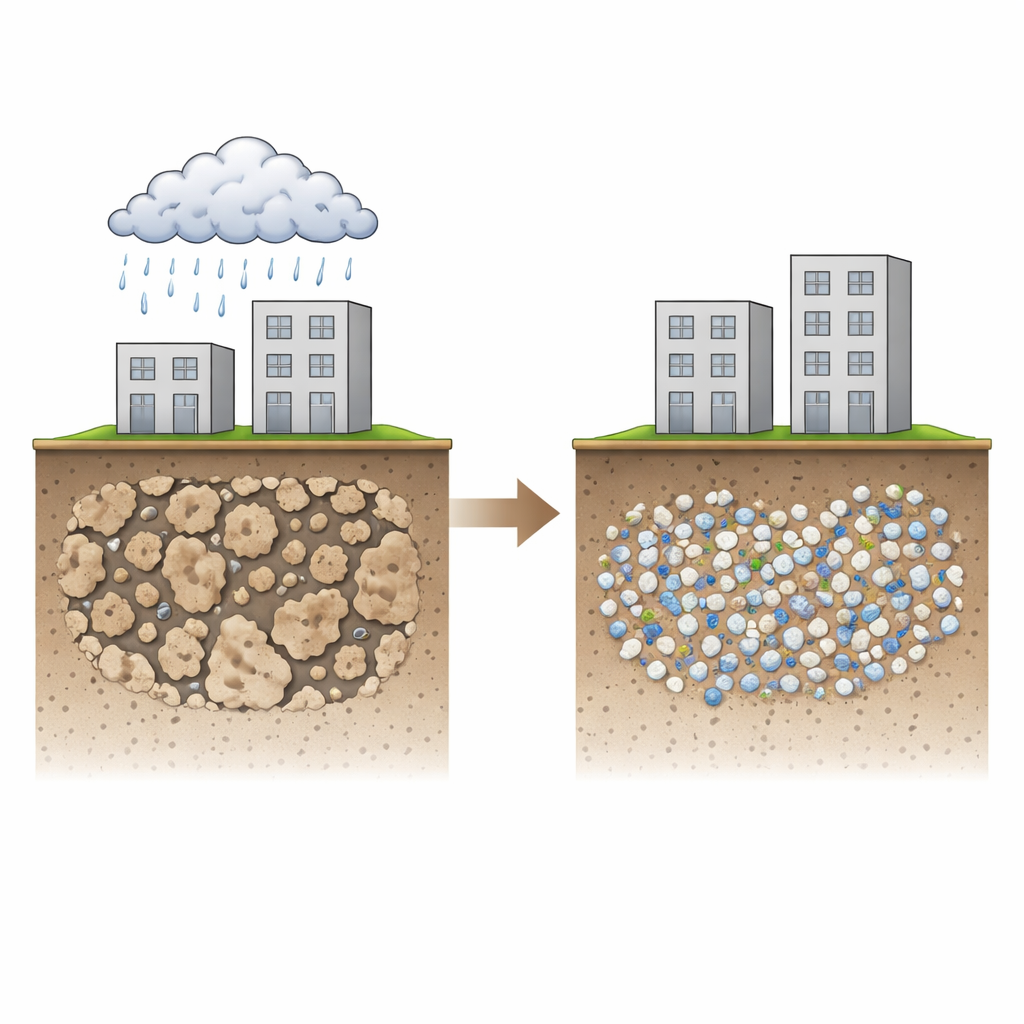
Soils that look solid but behave like a trapdoor
Collapsible loess soils, common in semi‑arid landscapes, are made of silt‑sized grains arranged in a light, open, honeycomb‑like structure. That structure is held together by weak natural “glue” and suction from dryness. When water from rain, irrigation, or leaking pipes percolates down, those delicate bonds can vanish and the soil skeleton abruptly caves in, causing sudden settlement. Traditional stabilizers such as cement and lime can make these soils stronger but come with high carbon emissions and may not perform optimally over longer times. Researchers therefore set out to test whether very small amounts of nano calcium carbonate (NCC) could both shore up collapsible loess and offer a lower‑carbon alternative.
Tiny chalk particles as soil helpers
The team collected a moderately collapsible loess from northern Iran and blended it with different NCC contents—0%, 0.2%, 0.4%, and 0.6% by dry weight. Careful two‑stage mixing was used so that the nano‑particles dispersed well instead of clumping. The blended soils were then compacted into test samples and stored for 7, 28, or 90 days to mimic short‑ and medium‑term behavior. A suite of standard tests measured how easily the soils compacted, how plastic or brittle they were, how much load they could bear in compression and tension, and how resistant they were to sliding along internal surfaces. The researchers also used ultrasonic pulse velocity (UPV)—sound waves sent through the soil—to see whether this quick, non‑destructive method could stand in for slower strength tests.
Finding the sweet spot for stronger ground
The results showed a clear “sweet spot” at 0.4% NCC. At this dose, the soil’s unconfined compressive strength roughly doubled, and its indirect tensile strength increased by about one‑and‑a‑half times compared with untreated soil. Shear strength parameters, which control how well the soil resists sliding and collapse, also improved: cohesion rose by around 81%, and the internal friction angle ticked upward. Microscopic images revealed why. In untreated samples, grains were loosely packed with many voids. With 0.4% NCC, nano‑particles filled pores, bridged between grains, and drew particles closer together, creating a denser, more interlocked framework. However, when the dose was raised to 0.6%, the nano‑particles began to clump into weak clusters, breaking the uniform structure and actually reducing strength—evidence that “more” is not always “better” at the nano scale. 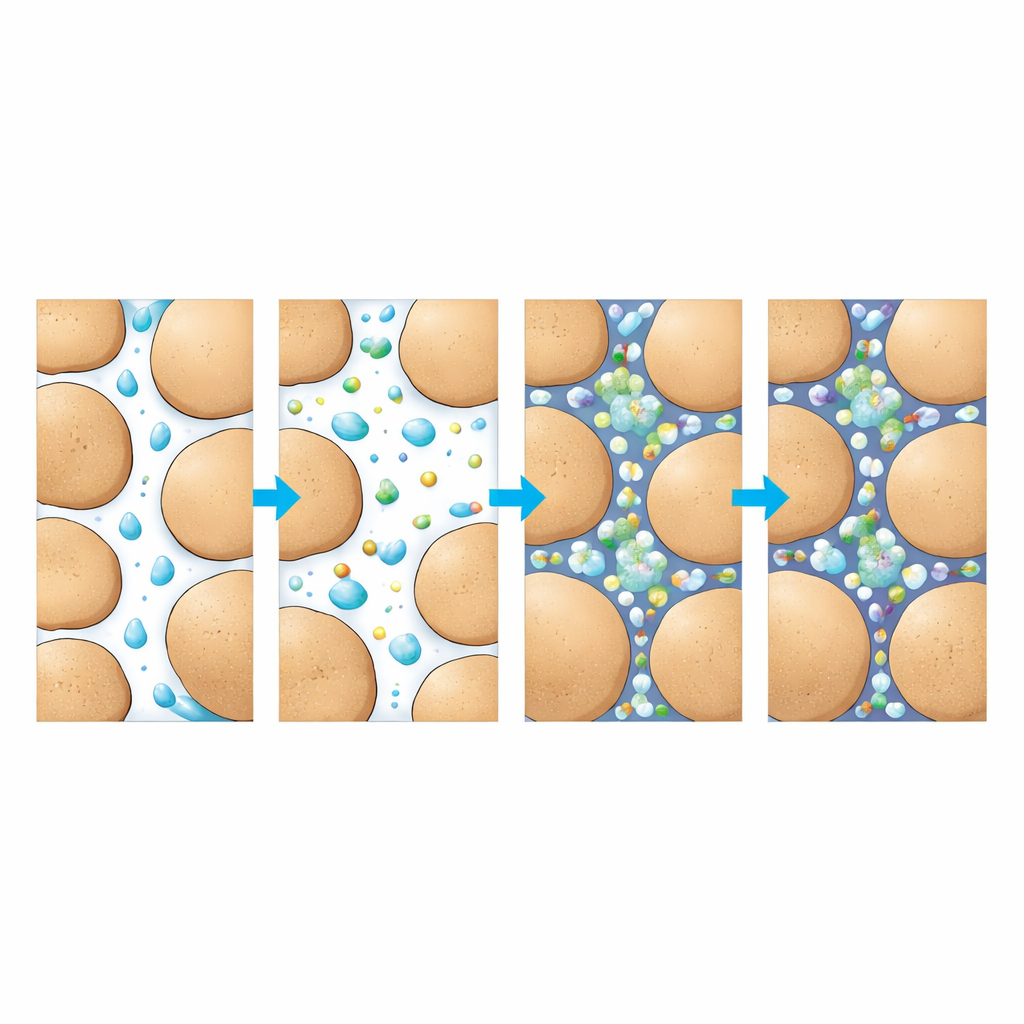
Better behavior over time and a simple health check
Time also played a helpful role. From one week to three months of curing, all NCC‑treated samples continued to gain strength, as particle contacts tightened and small amounts of calcium carbonate slowly precipitated between grains. The soil’s basic workability shifted too: the moisture level needed for best compaction increased modestly, while indicators of excessive softness decreased, signaling a firmer, more stable material. Crucially for engineers, UPV measurements tracked these improvements closely. Faster sound speeds were strongly linked with higher compressive, tensile, and shear strengths, as well as greater cohesion. This means that, in the field, a handheld UPV device could offer a rapid check of whether treated ground has reached the desired quality without destroying samples.
Cleaner, safer support for future structures
Beyond performance, the study weighed environmental costs. Because NCC works effectively at very low dosages, its total carbon footprint per kilogram of treated soil was found to be far lower than that of cement or lime for similar strength gains—on the order of 80–96% lower in estimated emissions. In plain terms, a sprinkling of nano‑chalk can turn risky, collapse‑prone loess into a firmer, more reliable foundation material, while also trimming the climate impact of ground improvement. The authors conclude that 0.4% nano calcium carbonate offers a practical, sustainable way to stabilize collapsible soils and that UPV can serve as a fast “stethoscope” for checking the health of treated ground in real‑world projects.
Citation: Barimani, M., Motaghedi, H., Soleimani Kutanaei, S. et al. Stabilizing collapsible soils using nano calcium carbonate to enhance mechanical properties. Sci Rep 16, 9353 (2026). https://doi.org/10.1038/s41598-026-39716-9
Keywords: collapsible loess, nano calcium carbonate, soil stabilization, ultrasonic testing, geotechnical engineering