Clear Sky Science · en
Development of an integrated computational-experimental framework for predicting grinding force and safety in ultrasonic bone scalpels operations
Sharper Tools, Safer Spines
Spinal surgery often requires removing small pieces of bone just millimeters away from the spinal cord and nerves. Surgeons now use special ultrasonic "bone scalpels" that vibrate rapidly to cut bone while sparing soft tissue, but if the force on the bone becomes too high, there is a risk of damage to nearby nerves or blood vessels. This study shows how computer simulations and robot-controlled experiments can work together to predict those forces in advance, helping doctors and future surgical robots choose settings that keep operations both effective and safe.
Why Bone Cutting Is So Delicate
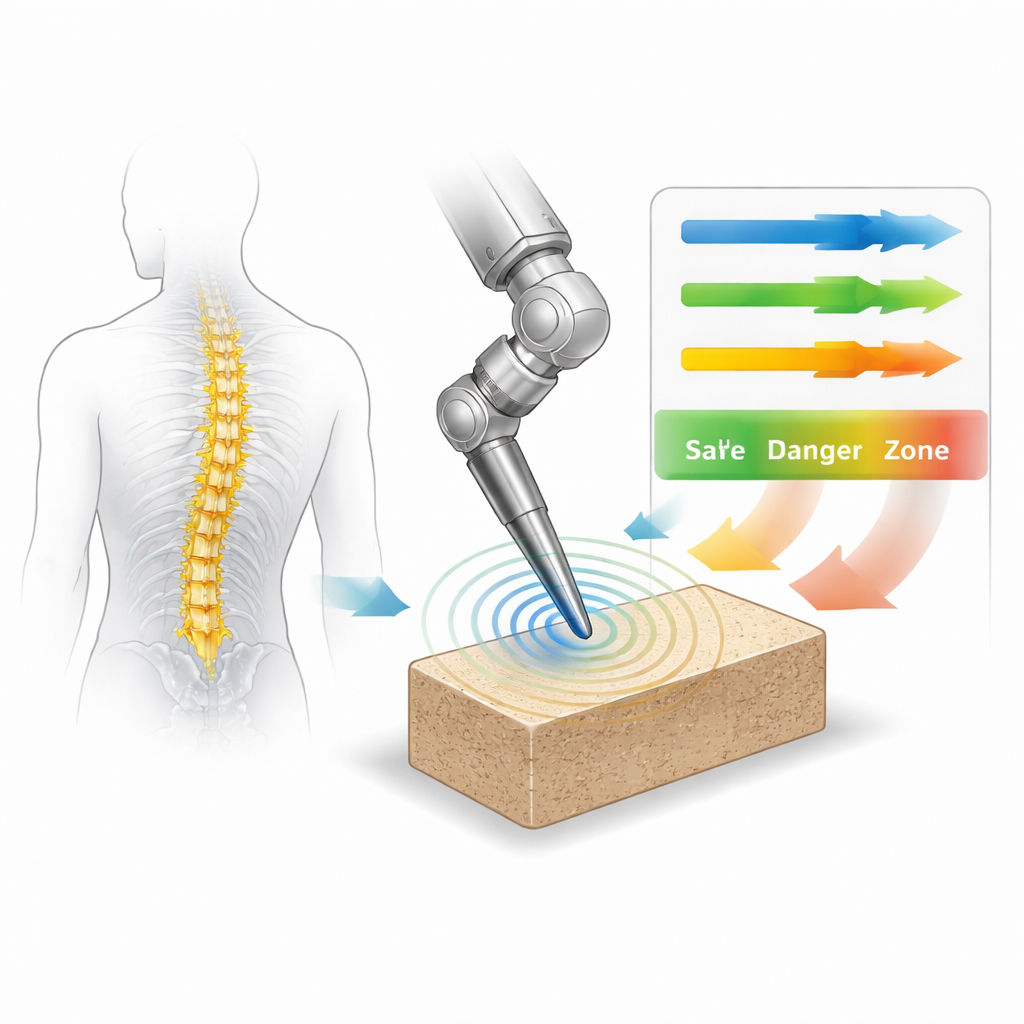
Children born with severe spinal deformities, such as hemivertebra, often need complex surgery in which malformed pieces of vertebra are removed and the spine is reshaped. Traditional high-speed drills can be difficult to control in this setting and may generate unpredictable forces on the bone. Ultrasonic bone scalpels, by contrast, use high-frequency vibration and a small grinding head to chip away bone while largely sparing soft tissue. Yet the motion of the tiny abrasive particles at the tool tip is surprisingly complex: the head rotates, feeds forward, and vibrates in multiple directions at once. Because bone itself varies from soft, spongy regions to very dense outer layers, the force produced during grinding depends on how all these motions interact with the specific bone being cut.
Building a Virtual Spine Workshop
To untangle this complexity, the researchers created a detailed three-dimensional computer model of the grinding process. They used engineering software to represent both a block of bone-like material and the spinning, vibrating cylindrical tool. The motion of each abrasive point on the tool was described mathematically, then transferred into the simulation so that the virtual tool moved in the same way as a real ultrasonic scalpel. The bone material was modeled so it could deform, crack, and chip away under rapid loading, mimicking the way real bone fails during machining. The team paid particular attention to refining the mesh—the tiny elements that make up the virtual bone—around the contact zone, so that local stresses and fractures, and therefore cutting forces, would be captured accurately.
Testing Key Knobs the Surgeon Can Turn
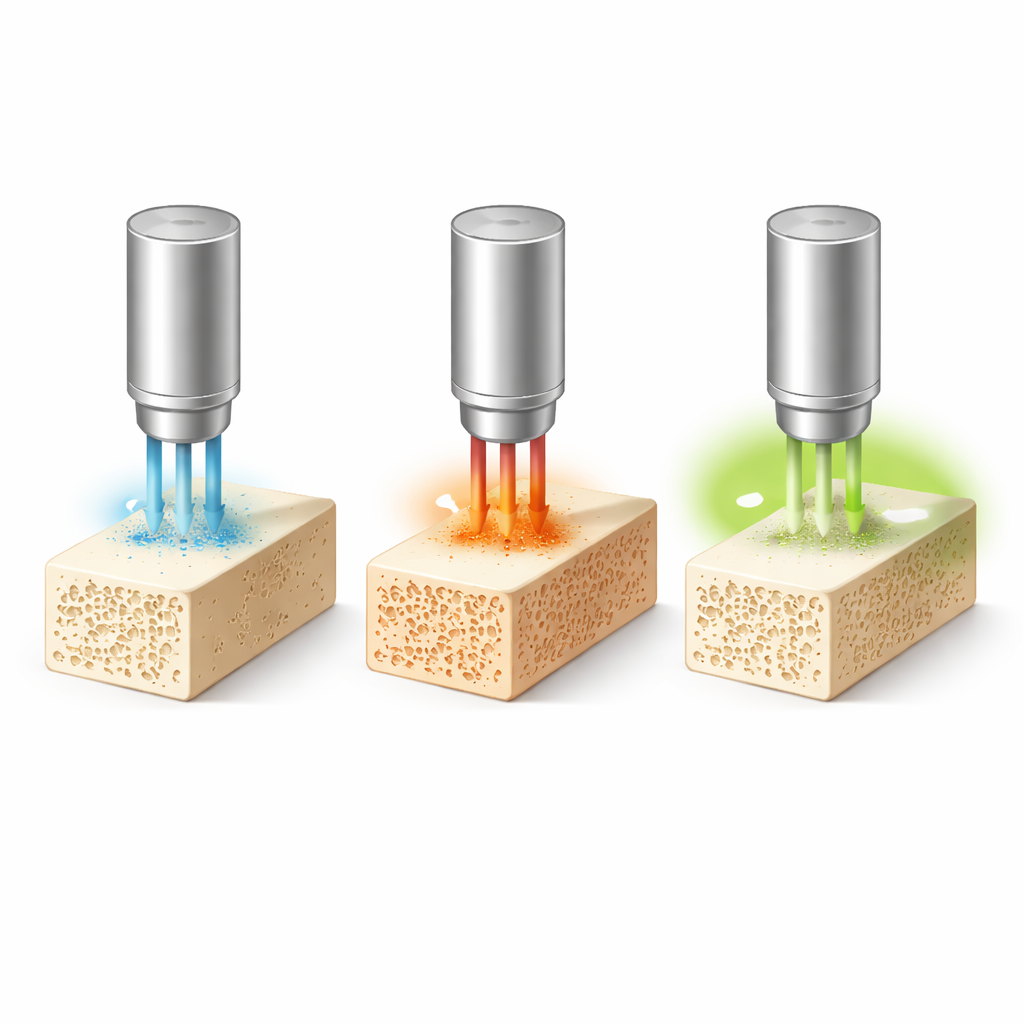
Rather than change parameters at random, the team used a structured experimental design to explore three practical "knobs": bone density, vibration amplitude, and feed rate (how fast the tool advances). With a Box–Behnken design, they ran 17 carefully chosen simulation cases that efficiently sampled combinations of low, medium, and high values of each factor. From these runs, they built a smooth response surface—a mathematical map that predicts the grinding force for any setting within the tested range. The map showed clear trends: denser bone and faster feed both raised the force, while larger ultrasonic amplitude lowered it by turning the contact into more intermittent, impact-like cutting that removes bone with less sustained resistance.
Checking the Model Against a Robot
To see whether the virtual predictions held up in the real world, the team set up a robotic grinding platform. A programmable robotic arm guided a commercial ultrasonic bone scalpel across standardized synthetic bone blocks while a six-axis force sensor measured the grinding force. They varied one parameter at a time—feed rate, vibration amplitude, or bone density—while keeping the others fixed. After filtering out noise in the force signals, they compared the measured forces with the values predicted by their response surface model. Across all tests, the typical difference was well under one newton and the worst relative error after removing extremes was about 7 percent, indicating that the combined simulation–experiment framework captured the dominant mechanics of the process.
Drawing a Line Between Safe and Risky
Armed with a reliable prediction tool, the researchers next translated a force limit from prior studies—20 newtons, a level chosen to protect delicate neural tissues—into practical operating guidelines. Using their model, they calculated which combinations of bone density, feed rate, and ultrasonic amplitude would push the grinding force above or below this threshold. They displayed the results as color-coded heatmaps, where cool colors marked safe regions and hot colors flagged hazardous ones. These maps reveal, for example, that surgeons can move faster in softer, spongy bone but must slow down or increase vibration amplitude when working in dense cortical bone to avoid excessive force.
From Planning Charts to Smarter Surgical Robots
In everyday terms, this work turns a complex, hard-to-feel interaction between a vibrating tool and living bone into a set of clear, quantitative "speed limits" for spinal surgery. By predicting how force will change as surgeons adjust tool settings or encounter different bone qualities, the framework supports safer planning before an operation and opens the door to real-time force control in robotic systems. Future versions that incorporate patient-specific imaging and more detailed bone behavior could help tailor these safety boundaries to each individual, guiding both human surgeons and intelligent robots toward more precise and less risky spine procedures.
Citation: Li, C., Chen, G., Xu, Y. et al. Development of an integrated computational-experimental framework for predicting grinding force and safety in ultrasonic bone scalpels operations. Sci Rep 16, 9347 (2026). https://doi.org/10.1038/s41598-026-39710-1
Keywords: ultrasonic bone scalpel, spinal surgery, surgical robotics, finite element modeling, surgical safety