Clear Sky Science · en
Research on online EDI order scheduling optimization strategy in manufacturing enterprises based on time-varying Markov chains
Why smarter order scheduling matters
When you buy a product that must be built to order, you probably expect it to arrive on time, even if you click “order” at the last minute. Behind the scenes, factories are juggling a flood of electronic orders from many customers while also handling older, pre-planned orders. This paper looks at how traditional manufacturing plants can use mathematical modeling and clever search algorithms to schedule these online orders more intelligently, cutting waiting times for customers without overworking people or machines.

The rise of always-on electronic orders
Many manufacturers now take orders in two ways at once: classic "offline" orders that are forecast and planned in advance, and online Electronic Data Interchange (EDI) orders that arrive directly from customers’ computer systems. EDI orders are faster, less error-prone, and cheaper to process, but they are also more volatile: customers can move dates forward, push them back, or cancel at short notice. EDI customers often demand very tight delivery windows, with only a few days of tolerance, so factories cannot simply queue these jobs in the old-fashioned first-come, first-served style. Instead, each production line must serve several EDI orders in parallel, sharing its time among them. This shift from one-at-a-time to many-at-once service creates a new type of scheduling puzzle that existing planning tools were not designed to solve.
Turning the factory into a queueing system
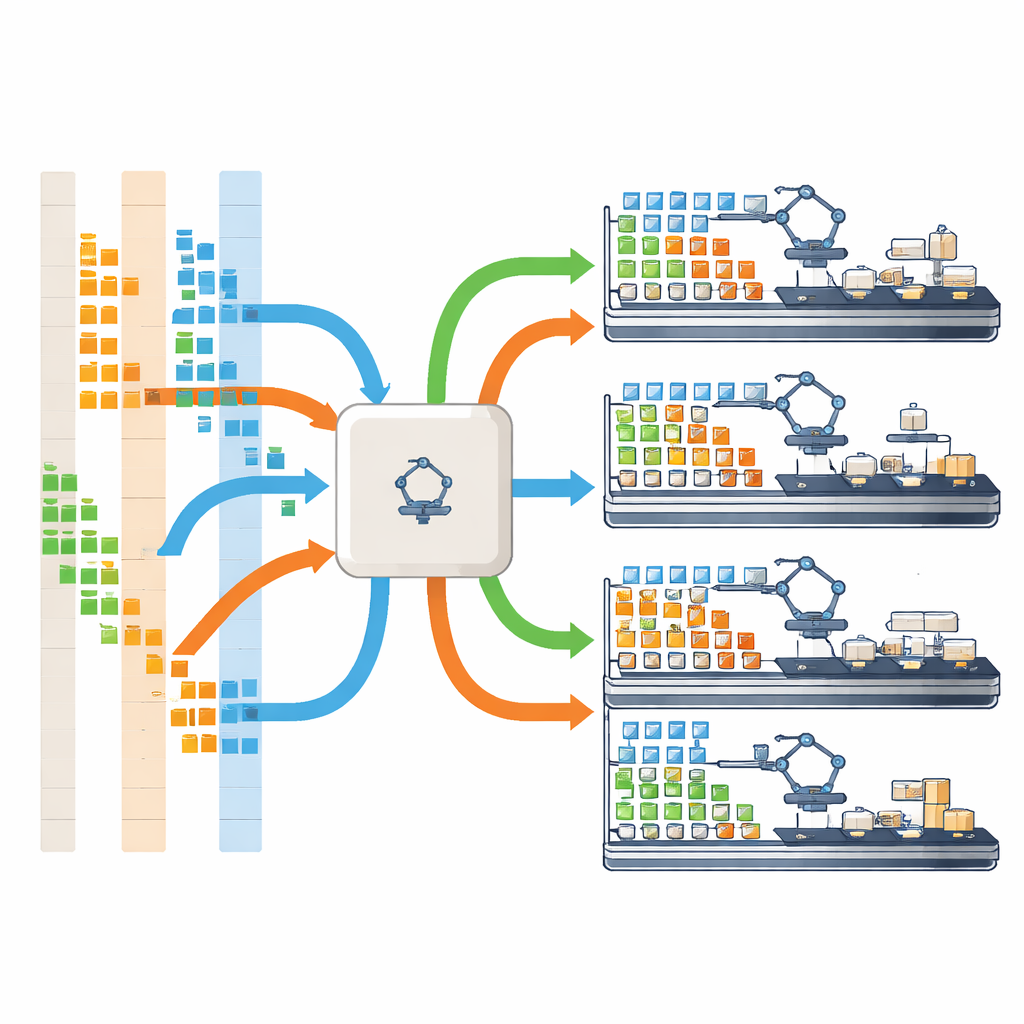
The author models the online EDI part of the factory as a queueing system, much like customers lining up at a bank where tellers can help several people at different stages of service. Time is divided into short slots, and orders arrive randomly with rates that can change from slot to slot during the day, capturing real peaks and troughs in demand. Each production line can work on several orders at once up to a fixed limit, and the speed of completing each order depends on how many are being handled in parallel. The model also respects practical rules: workers need rest between shifts, there are bounds on shift lengths, and at least one line must be running in every time slot. On top of this, the factory wants to keep the chance of an excessively long queue very low, not just keep the average queue short, because long backlogs quickly damage service levels and customer trust.
Using probability tools to measure performance
To judge any proposed schedule, the study uses a mathematical framework called a time-varying Markov chain, combined with a technique known as uniformization. In plain terms, this allows the researcher to track how the probability of every possible system state (how many orders are waiting and being processed on each line) evolves over time as orders arrive and finish. From these probabilities, the model can compute key measures such as how long orders spend in the system, how often queues exceed a safe threshold, how many production lines are active in each slot, and how much overtime workers are likely to need at the end of the day. Crucially, this analytical method produces highly accurate estimates much faster than running massive computer simulations alone, making it practical to evaluate many alternative schedules while searching for improvements.
A search strategy that learns better schedules
Building on this evaluation engine, the paper designs a Variable Neighborhood Search (VNS) algorithm to hunt for good schedules. It starts from a reasonable initial shift plan for the production lines and then repeatedly “shakes” the plan by randomly modifying a few shifts, followed by local, step-by-step adjustments such as nudging start and end times, adding or removing shifts, or shifting them forward and backward. After each change, the Markov-based method quickly re-estimates backlog times, overtime, and operating costs. If a new schedule performs better, the algorithm keeps it as the new reference point; if not, it tries a different type of change. Tests on real order data from a manufacturing firm, covering both ordinary days and days with surges of urgent EDI orders, show that VNS finds schedules that beat both the company’s existing plans and an established heuristic method called simulated annealing, while using far less computing time.
What this means for factories and customers
For non-specialists, the bottom line is that this approach helps factories decide when to run each line and how many orders to process in parallel so that customers wait less without dramatically increasing overtime or machine use. The model keeps queues under control with high reliability, smooths out peaks in workload by better matching capacity to incoming demand, and remains effective even when the assumptions about processing times are relaxed. In practice, this means more dependable delivery dates for customers, more efficient use of production resources, and a more resilient response to sudden spikes in online orders—key ingredients for the human-centered, flexible manufacturing vision associated with Industry 5.0.
Citation: Wulan, Q. Research on online EDI order scheduling optimization strategy in manufacturing enterprises based on time-varying Markov chains. Sci Rep 16, 8086 (2026). https://doi.org/10.1038/s41598-026-39708-9
Keywords: online EDI scheduling, smart manufacturing, production line optimization, queue management, Industry 5.0