Clear Sky Science · en
Time-dependent mechanical behavior and support timing of surrounding rock governed by crack closure ratio
Why slow rock movement matters underground
Deep underground power stations and tunnels are carved into rock that keeps moving long after the blasting is done. That slow, creeping motion can close up tiny cracks at first, but over months or years it can also pry those cracks open and weaken the rock around an excavation. This paper looks at how and when that quiet damage builds up in hard granite at a major hydropower site in China, and offers a new way to decide exactly when engineers should install support so that the rock helps hold itself up instead of suddenly failing.
Watching granite slowly give way
The researchers worked with granite taken from the Shuangjiangkou underground powerhouse, a large hydropower project buried several hundred meters inside a mountain. In the lab, cylindrical rock samples were squeezed under conditions meant to mimic the different pressures that rock feels at depth. Instead of loading them once to failure, the team used creep tests: the stress was increased in steps and then held steady for many hours while tiny changes in length and width were recorded. This allowed them to see how the rock first deforms quickly, then settles into a slow, almost steady change, and finally accelerates toward failure as cracks link up inside.
A new way to read the rock’s hidden cracks
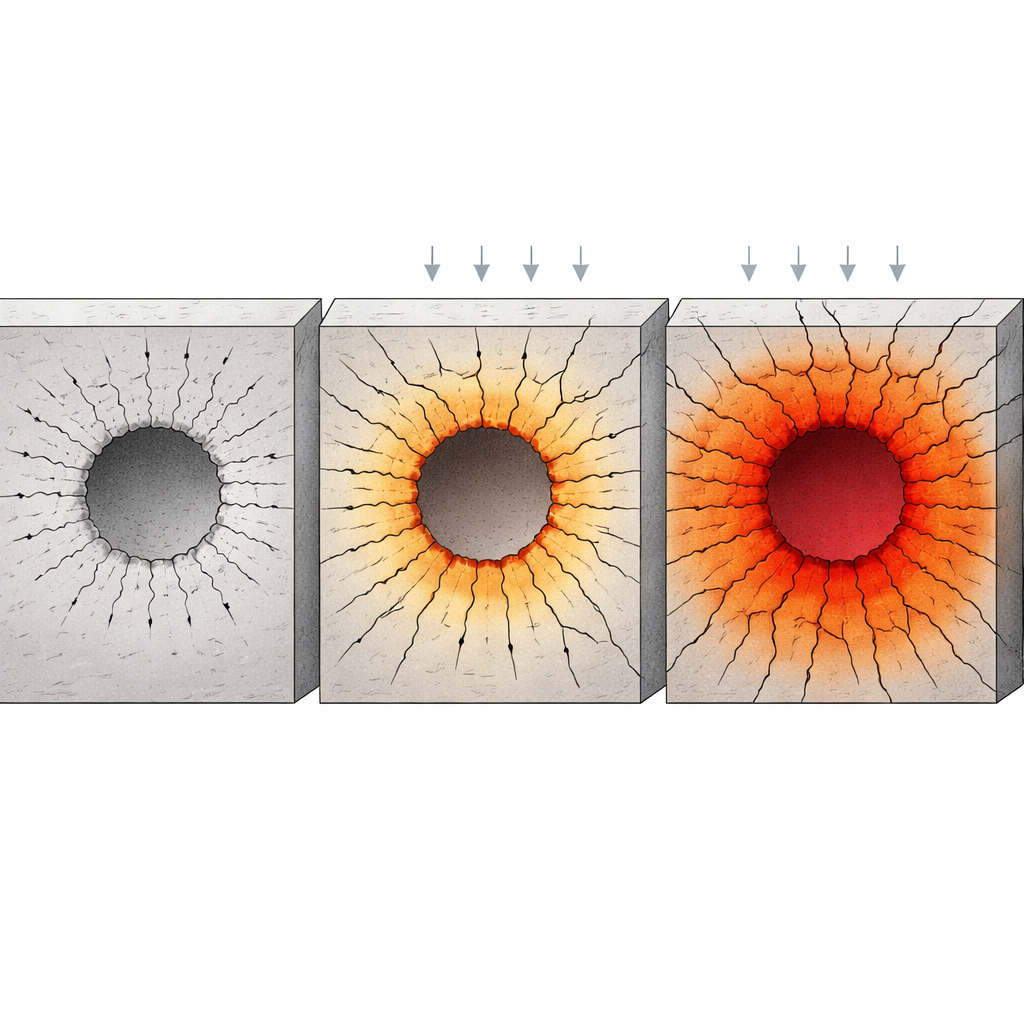
Traditional models assume that the first jump in deformation when a load is applied is purely elastic — like a spring that snaps back when unloaded. But hard rock contains countless pre-existing microcracks that close, shift, and reopen, making that assumption too simple. The authors introduced a "crack closure ratio," a number that describes how far these small cracks have moved from fully closed to widely open. By combining this ratio with standard stress–strain measurements, they separated the rock’s behavior into two parts: ordinary, recoverable deformation, and extra deformation caused by crack growth. They also tracked these effects in two directions: along the axis of loading and radially, outward from the walls of a future tunnel or cavern.
Why sideways cracking controls long-term strength
The tests showed that the rock’s long-term strength is not the same in all directions. When the team compared the stress at which steady creep suddenly switched to runaway deformation, they found that cracks growing radially — outward from an underground opening — reached this critical state at lower stress than those along the main loading direction. In other words, the rock becomes dangerously weak sideways before it does so vertically. By defining threshold values of the crack closure ratio linked to this transition, the authors built a time-dependent model that can predict when and how fast cracks will extend under different stress conditions, especially in the radial direction that most strongly controls failure around excavations.
Turning lab insight into on-site safety
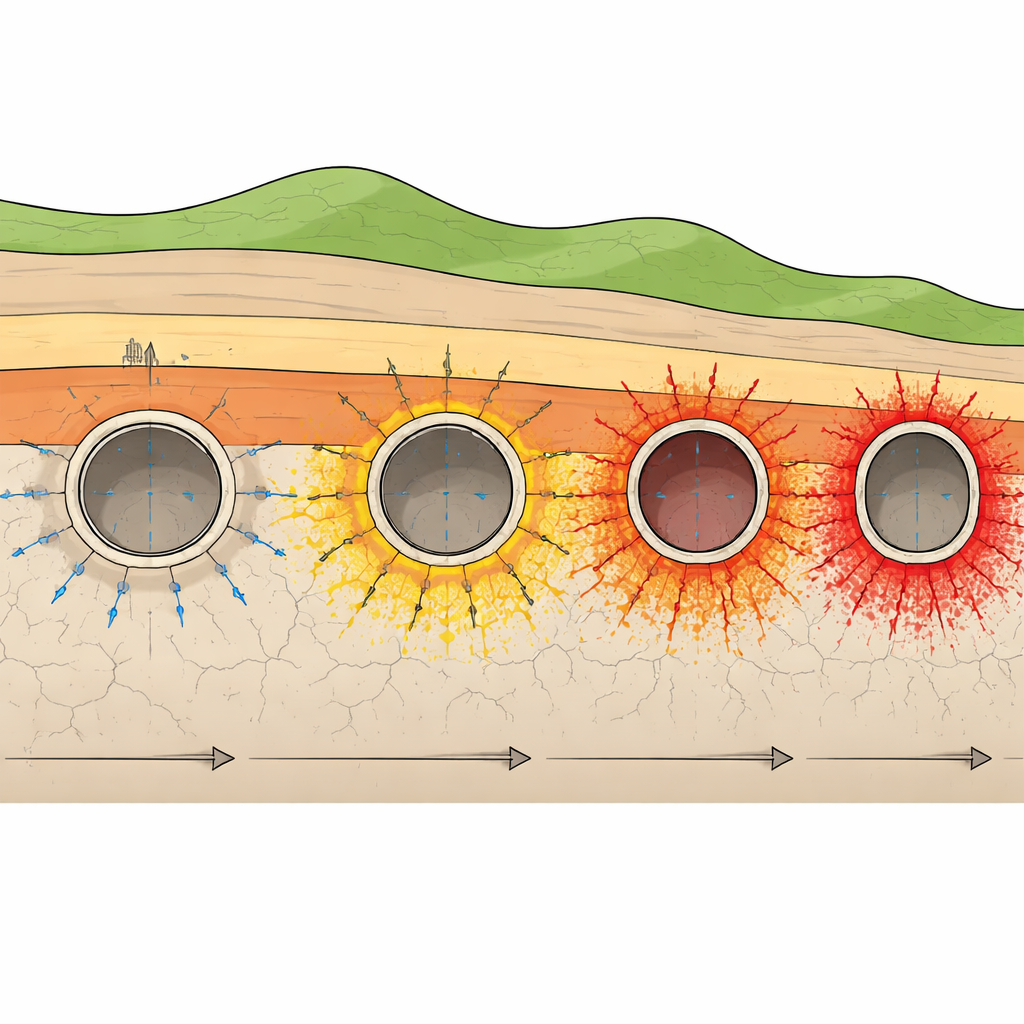
To see if their approach holds up in the field, the researchers embedded their crack-based creep model in numerical simulations of the Shuangjiangkou powerhouse excavation. They divided the surrounding rock into zones based on in-place stresses and used the model to follow how damage spreads with time after each excavation step. The simulations produced patterns of displacement and cracking that closely matched monitoring data and visible damage such as beam distortion and new fissures. Using the radial crack closure ratio, they then classified the rock around the cavern into five zones, from intact to fully failed, and tied each zone to a range of crack-closure values that can be estimated ahead of time from laboratory tests.
Picking the right moment to support the rock
For engineers, the most practical outcome is a timetable for support. The study identifies a critical value of the crack closure ratio that marks the boundary between rock that is still largely self-supporting and rock that has lost most of its strength. By calculating when different locations around the cavern are expected to cross this line, the authors propose staged support categories: immediate support where failure begins almost at once, several levels of delayed support where damage builds more slowly, and final "stabilization" support after most movement has settled. This approach lets designers plan support so that the rock carries as much of its own weight as possible — saving material and cost — while still avoiding sudden collapses driven by slow, time-dependent crack growth.
Citation: Qian, L., Yao, T., Liu, E. et al. Time-dependent mechanical behavior and support timing of surrounding rock governed by crack closure ratio. Sci Rep 16, 9696 (2026). https://doi.org/10.1038/s41598-026-39707-w
Keywords: rock creep, underground caverns, microcracks, support design, granite stability