Clear Sky Science · en
Early motor deficits, sleep dysfunction and reduction in dopaminergic neurons in a PARK7-/- zebrafish larval model of Parkinson’s disease
Why tiny fish matter for a big brain disease
Parkinson’s disease is usually diagnosed when people develop tremors and stiffness, but long before that, subtle changes in movement, touch, and sleep are already underway. This study uses transparent zebrafish larvae, only a few days old, to recreate early features of Parkinson’s disease in a simple animal. By watching how these tiny fish swim, sleep, and sense touch, and by looking closely at their brain cells, the researchers build a powerful new model that can speed up the search for treatments aimed at slowing or stopping the disease, not just easing symptoms. 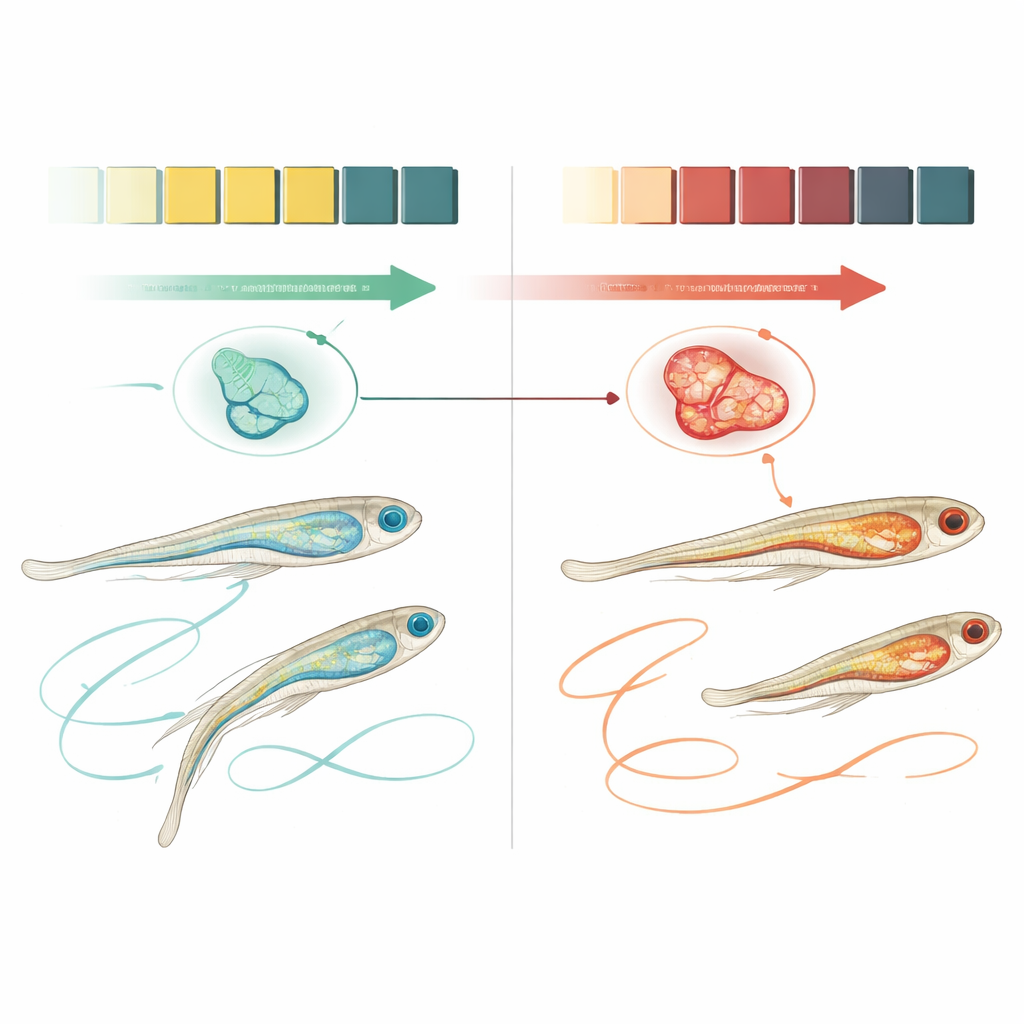
Building a fish version of early Parkinson’s
The team focused on a gene called PARK7, which makes a protein known to help protect nerve cells from stress. In some families, harmful changes in this gene cause an early form of Parkinson’s, and even in typical cases of the disease, the same protein often looks damaged or misplaced in brain tissue. Using gene-editing tools, the researchers created zebrafish that completely lack PARK7. Earlier work had shown that adult fish without this gene develop movement and other brain-related problems. Here, the scientists asked a more fundamental question: do problems already appear in the larval stage, when the nervous system is still developing and the animals are only days old?
Movement and touch troubles in young larvae
At first glance, the PARK7-lacking larvae looked normal. Their body shape, eye size, and earliest tail movements right after they formed were similar to those of ordinary fish. But by five days after fertilization, differences began to surface. When placed in a monitoring system that tracks swimming over several days, the mutant larvae moved less during their usual daytime active period than their healthy siblings. The team also tested a simple reflex: gently touching the head or tail with a pipette tip. Healthy larvae almost always darted away, but PARK7-deficient larvae were noticeably less responsive, echoing the reduced sense of touch often reported in people with Parkinson’s. A chemical toxin called MPP+, which selectively harms the same type of brain cells affected in Parkinson’s, further weakened this touch response in both normal and mutant fish, showing that these circuits are especially vulnerable. 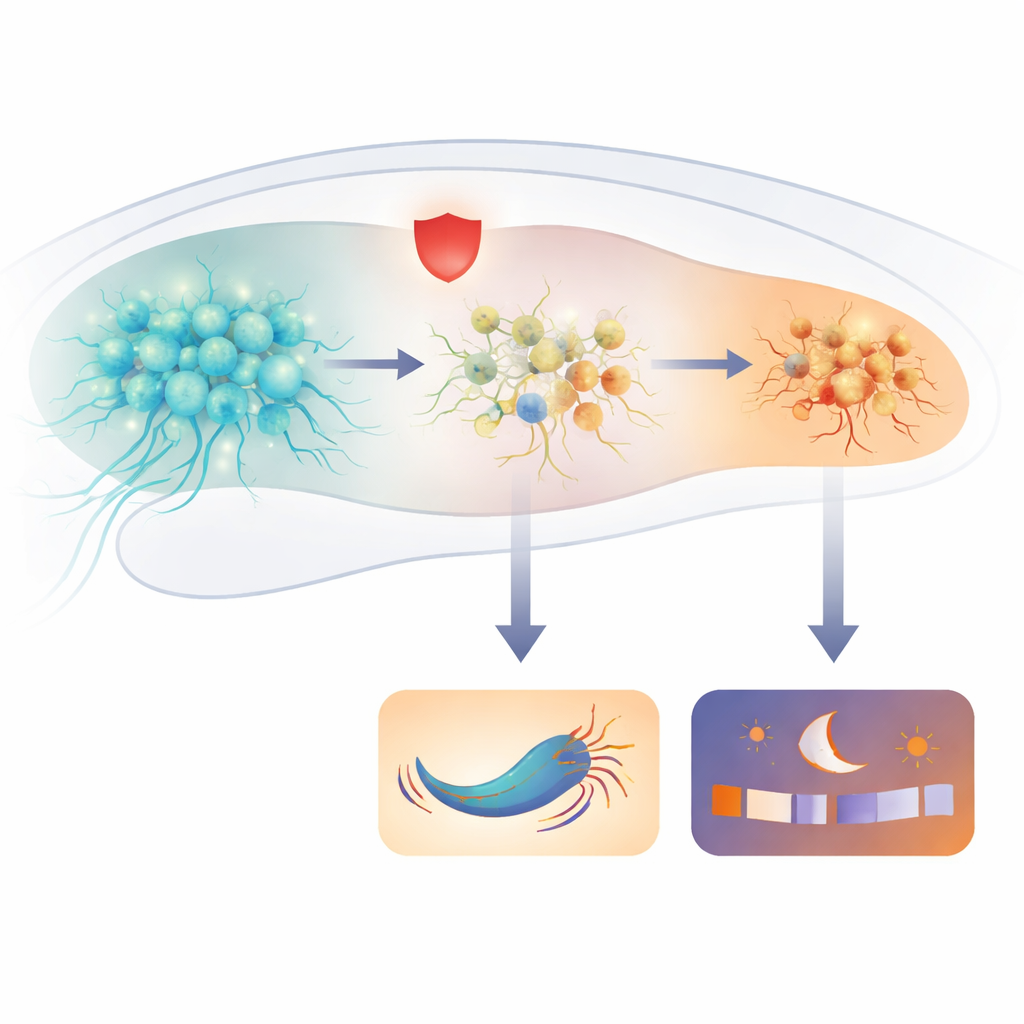
Sleep changes mirror early warning signs
Sleep problems commonly precede the classic movement symptoms of Parkinson’s by years. The zebrafish larvae offered a way to track sleep and activity around the clock under controlled light–dark cycles. All fish showed a daily rhythm, being more active in the light and quieter in the dark. However, PARK7-lacking larvae took longer to fall asleep after lights went off and spent more time asleep than usual during the light period, a pattern reminiscent of increased sleepiness during the day. Interestingly, these sleep changes persisted over several days, even as overall movement fluctuated. The toxin-treated normal fish did not develop the same sleep pattern, highlighting that the genetic loss of PARK7 captures non-motor features that the common toxin model misses.
Brain cell loss in the fish’s “movement hub”
To connect behavior with changes in the brain, the researchers examined a specific cluster of dopamine-producing nerve cells in the zebrafish diencephalon. This group closely matches the human substantia nigra, the region that degenerates in Parkinson’s disease. Using fluorescent labeling and confocal microscopy, they counted these cells at several early time points. By five days, larvae lacking PARK7 had significantly fewer of these dopamine neurons than normal fish, and the shortfall grew as the larvae aged from three to five days. Other nearby dopamine cell groups remained unchanged, indicating that the loss was focused on the same vulnerable population seen in human disease. Adding MPP+ reduced cell numbers further in both normal and mutant fish, but the mutants did not become dramatically more sensitive than their wild-type siblings at this early stage.
How this tiny model can help humans
Taken together, the work shows that zebrafish larvae without PARK7 already display a combination of reduced movement, dulled touch responses, disturbed sleep, and a selective drop in key dopamine-producing neurons. These are hallmarks of Parkinson’s disease compressed into a rapid, transparent, and genetically defined system. For non-specialists, the key message is that tiny, see-through fish can now mimic not only the obvious motor signs of Parkinson’s, but also the earlier, quieter symptoms that often go unnoticed. Because drugs can be added directly to the water and many larvae can be tested at once, this model is well suited for discovering compounds that protect vulnerable brain cells or correct early sleep and sensory problems, offering a promising path toward treatments that tackle the roots of Parkinson’s rather than just its visible effects.
Citation: Solheim, N., Pinho, B.R., Oliveira, N.A.S. et al. Early motor deficits, sleep dysfunction and reduction in dopaminergic neurons in a PARK7-/- zebrafish larval model of Parkinson’s disease. Sci Rep 16, 9525 (2026). https://doi.org/10.1038/s41598-026-39692-0
Keywords: Parkinson’s disease, zebrafish model, dopamine neurons, sleep disturbances, DJ-1 PARK7