Clear Sky Science · en
Caregiver mental health is associated with early childhood language outcomes and perception bias in rural China
Why Caregivers’ Feelings Matter for Children’s First Words
Early childhood is when a child’s language explodes from a few sounds to a world of words. Parents and grandparents often worry about whether a toddler is talking “enough,” yet they may overlook how their own emotional well-being shapes what a child hears and says each day. This study, set in rural and peri-urban China, explores a simple but powerful question: when caregivers are struggling with depression, anxiety, or stress, does it change how much they talk with their toddlers—and how accurately they see their children’s language growth?
The Setting: Toddlers Growing Up on the Margins
The research focuses on families with rural backgrounds in Sichuan Province, including both remote villages and rapidly urbanizing districts on city edges. These households tend to have lower incomes and fewer resources than long-established city families, and earlier work has shown that many of their young children fall behind in language development. In this setting, 137 caregivers of children aged about 18 to 24 months opened their homes to the research team. Enumerators interviewed caregivers, collected information on family background, and asked caregivers about their own emotional health, including symptoms of depression, anxiety, and stress.
Listening In: Measuring Daily Talk with Technology
To move beyond simple questionnaires, the team used a small audio recorder that toddlers wore in a special shirt at home for two typical days. Software analyzed these recordings to count how many words adults spoke near the child, how often back-and-forth “conversational turns” occurred, and how frequently the child vocalized. These measures captured the real soundscape of children’s lives, far more precisely than memory alone. Caregivers also filled out standard checklists about how many words their children could say and how much time they spent reading, telling stories, singing, and playing—activities known to boost language skills. 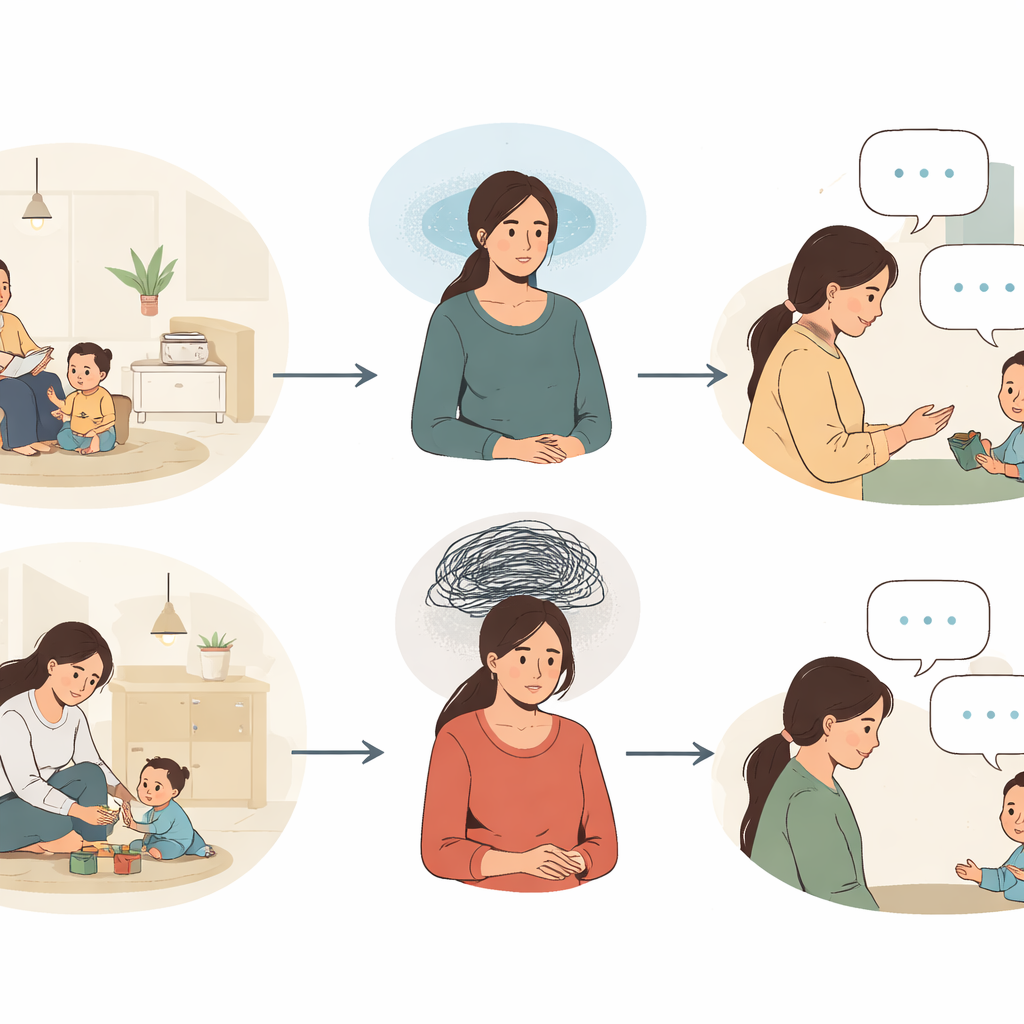
What the Recordings Revealed About Talk and Mood
When the researchers compared families, clear patterns emerged. Caregivers who reported anxiety or stress had children who vocalized less, suggesting slower language development. Depression and anxiety were linked to fewer conversational turns between adults and toddlers, revealing a thinner stream of back-and-forth talk, even when the total number of adult words was similar. In other words, the quality of interaction, not just the quantity of speech, suffered when caregivers felt emotionally unwell. These associations remained even after accounting for family income, caregiver education, the child’s age and sex, and how many adults lived at home.
Seeing Through a Distorted Lens
A striking finding was that caregivers’ feelings appeared to bend their view of reality. By comparing the objective audio data with caregivers’ own reports, the researchers calculated a kind of “perception gap.” Caregivers with depressive or anxiety symptoms tended to overestimate how advanced their children’s language was and, in the case of depression, how stimulating their own talk and play were. Rather than being overly negative, these caregivers often painted too rosy a picture of both their toddlers’ progress and their own engagement. This suggests that emotional strain can cloud recall and judgment in complex ways, making self-reports less trustworthy, especially when used to identify children at risk or to judge whether programs are working. 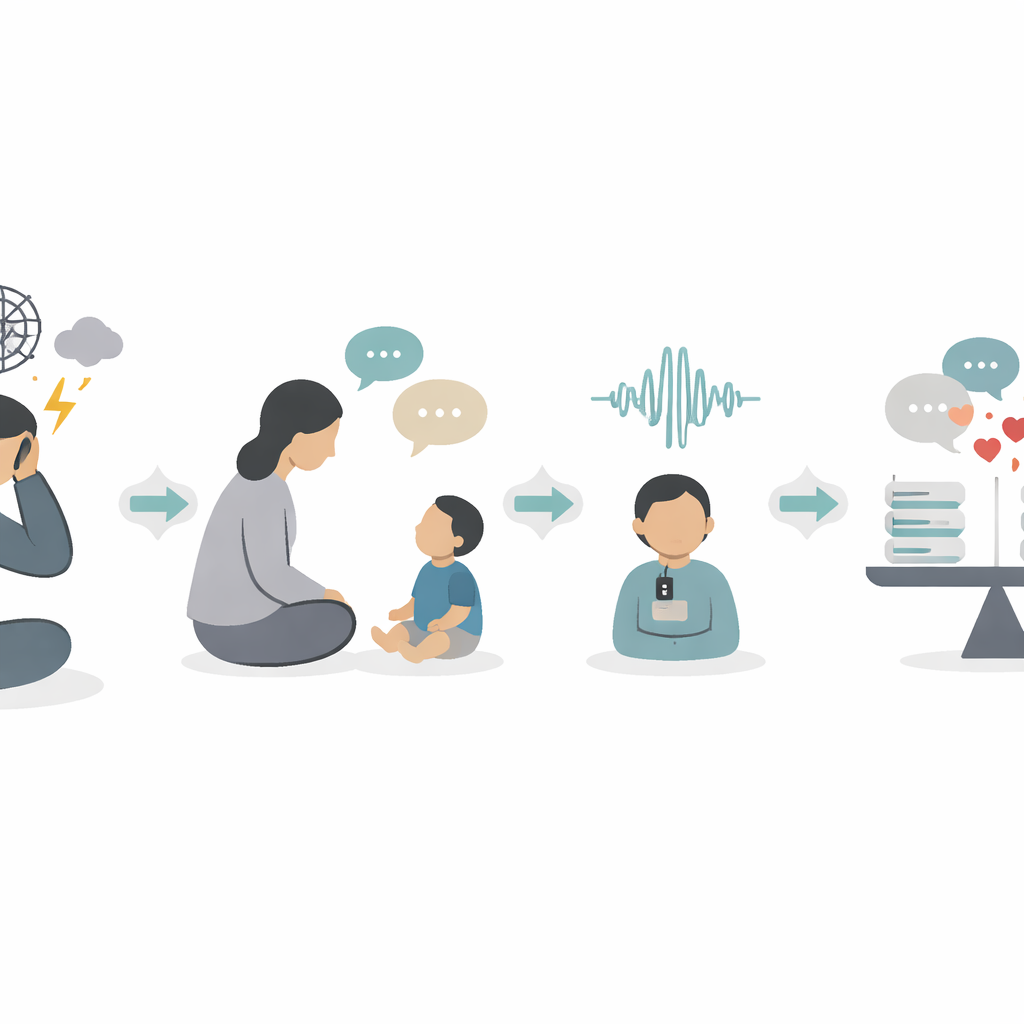
Why This Matters for Families and Researchers
The study concludes that caregiver mental health and young children’s language growth are closely intertwined. Children whose caregivers experience depression, anxiety, or stress are exposed to fewer rich conversations and produce fewer vocalizations—conditions that may hinder later learning. At the same time, those very symptoms make caregivers more likely to overestimate both their children’s skills and the language environment at home. For parents and practitioners, the message is that supporting caregivers’ emotional well-being is not just about adult health; it is also an investment in children’s first words and future learning. For researchers and policymakers, the findings are a warning: when relying on caregiver questionnaires alone, especially in low-resource settings where mental health challenges are common, important problems in early development may stay hidden unless objective measures or careful adjustments are built into the assessment process.
Citation: Jiang, Q., Qian, Y., Feng, T. et al. Caregiver mental health is associated with early childhood language outcomes and perception bias in rural China. Sci Rep 16, 8819 (2026). https://doi.org/10.1038/s41598-026-39674-2
Keywords: early childhood language, caregiver mental health, rural China, parent–child interaction, developmental assessment