Clear Sky Science · en
Behavioral and neural aftermath of right inferior frontal cortex disruption on ambiguous vocal emotion decisional processes
Why the way we hear voices matters
In everyday life, we constantly judge other people’s feelings from the tone of their voice—whether a shout signals anger, fear, or something in between. This study asks what happens in the brain when that emotional tone is unclear, and what changes if a key brain region involved in decisions is temporarily disrupted with magnetic stimulation. Understanding this helps reveal how our brains turn messy social sounds into quick, often life‑shaping judgments.
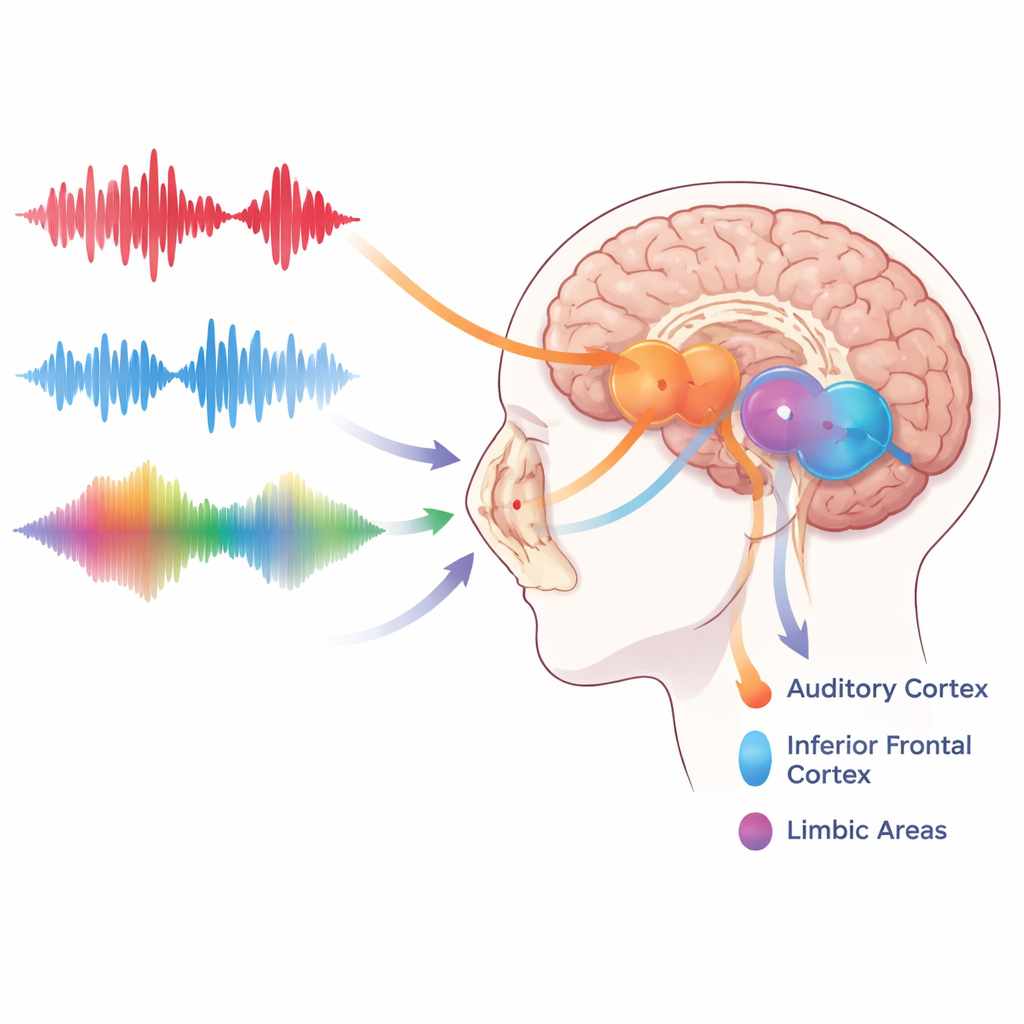
Listening to emotions in the voice
When we hear a voice, the sound first reaches the brain’s hearing centers in the temporal lobes. From there, information is passed to deeper emotional areas such as the amygdala, and to regions in the frontal lobes that help us evaluate and categorize what we hear. One such region, on the right side of the brain, is called the inferior frontal cortex. Previous work suggested that this area is especially engaged when decisions are hard—such as when an emotional signal is ambiguous—leading researchers to suspect it might be a hub for resolving uncertainty in vocal emotion.
Making emotions deliberately confusing
To probe this system, the researchers created short nonverbal vocal sounds—simple “ah”‑like bursts—expressed with anger or fear. Using a computer morphing technique, they blended recordings so that some sounds were clearly angry or clearly fearful, while others were perfect 50/50 mixes that listeners typically find hard to classify. Volunteers lay in an MRI scanner and performed a three‑choice task, labeling each sound as angry, fearful, or neutral. This design allowed the scientists to compare brain activity and behavior for “clear” versus intentionally ambiguous emotional voices under tightly controlled conditions.
Temporarily disturbing a decision hub
The key twist was the use of continuous theta‑burst stimulation, a form of transcranial magnetic stimulation that briefly reduces activity in a chosen brain area. One group received this stimulation over the right inferior frontal cortex; a control group received the same protocol over the top of the head, a site not strongly tied to voice or emotion processing. Stimulation was applied between scanning runs so that the researchers could compare brain responses before and after the procedure in both groups. They expected that weakening the right frontal region would change how people classified the most ambiguous voices, possibly making decisions faster or more accurate by “loosening” a cautious, deliberative filter.
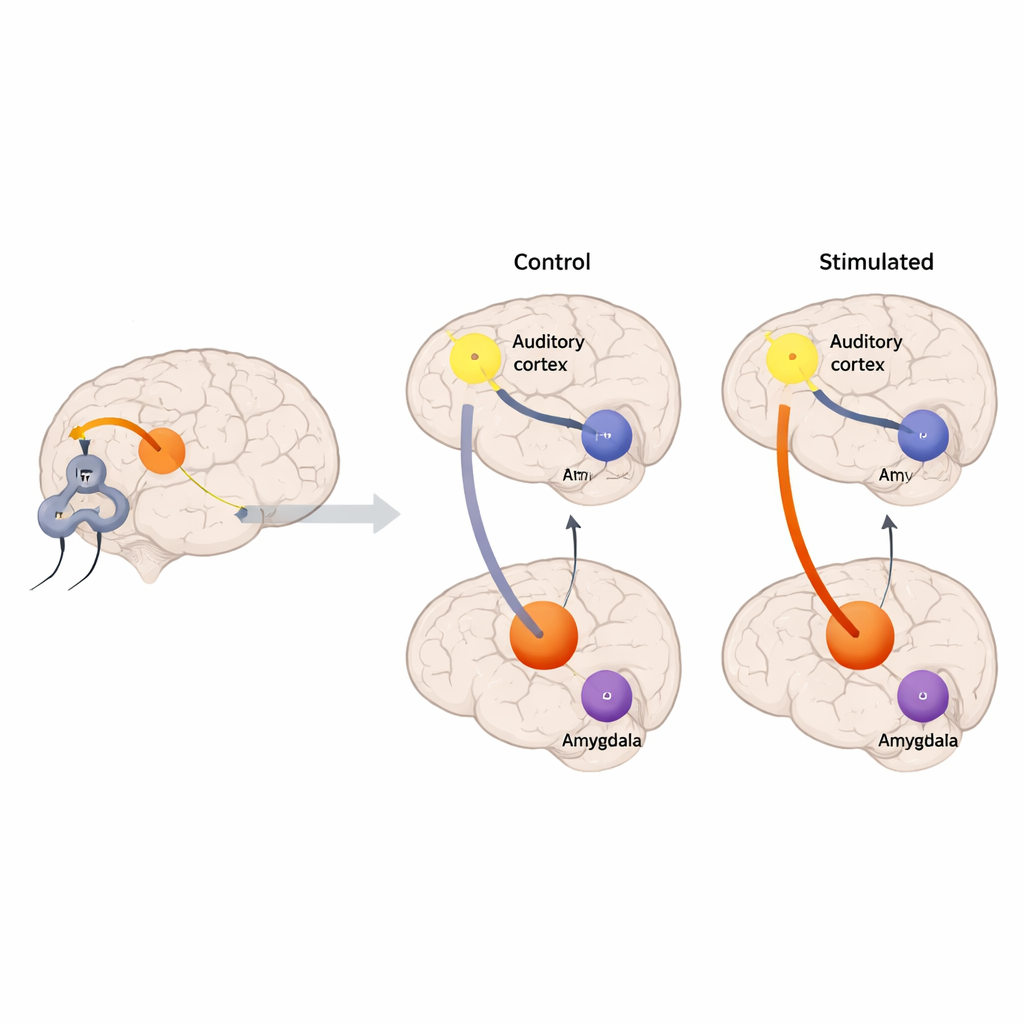
What the brain revealed—and what it did not
Behaviorally, the results were surprisingly modest. Overall accuracy stayed high in both groups, and there was no clear, stimulation‑specific improvement or decline for the 50/50 anger–fear sounds. Response times sped up somewhat after stimulation, but this pattern looked more like general practice than a targeted change in handling ambiguity. The brain scans, however, told a richer story. After right frontal stimulation, activity related to clearly emotional voices decreased in parts of the auditory cortex, and the pattern of communication between regions shifted. Connectivity strengthened between the right frontal area and the amygdala on one side, and between the amygdala and auditory cortex on the other, suggesting that the brain subtly re‑routed how it coordinated emotional and sensory information when the frontal node was perturbed.
Rethinking how we decide from the sound of a voice
Taken together, the study shows that briefly disrupting a frontal decision‑making region does not dramatically change how people label ambiguous emotional voices, but it does alter the underlying neural choreography—especially for sounds whose emotion is clear. Rather than acting only as an “ambiguity detector,” the right inferior frontal cortex seems to be part of a broader network that balances sensory detail from the ears with emotional signals from the limbic system. For lay readers, this means that our snap judgments about others’ feelings in everyday conversation likely arise from a resilient, distributed brain system, not a single switch. The work also highlights the limits of current methods and calls for future experiments to more precisely tease apart how different frontal areas shape the subtle, often intuitive choices we make based on the tone of a voice.
Citation: Ceravolo, L., Moisa, M., Grandjean, D. et al. Behavioral and neural aftermath of right inferior frontal cortex disruption on ambiguous vocal emotion decisional processes. Sci Rep 16, 9388 (2026). https://doi.org/10.1038/s41598-026-39668-0
Keywords: vocal emotion, brain stimulation, decision making, auditory cortex, social neuroscience