Clear Sky Science · en
Gamma activity concentrations of 226Ra, 232Th, 40K, and health hazard assessments of granites from Wadi El-Nabi’ mining area, Egyptian Nubian Shield
Rocks That Glow a Little
Granite countertops, polished floor tiles, and stone facades are often sold for their beauty and durability. But these same rocks quietly contain naturally radioactive elements that can add to the radiation dose we receive over a lifetime. This study focuses on a remote granite-rich valley in Egypt’s Eastern Desert, Wadi El‑Nabi’, asking a simple but important question: are these handsome granites safe to use in homes and public buildings, and what do they reveal about how radioactivity moves through the Earth?
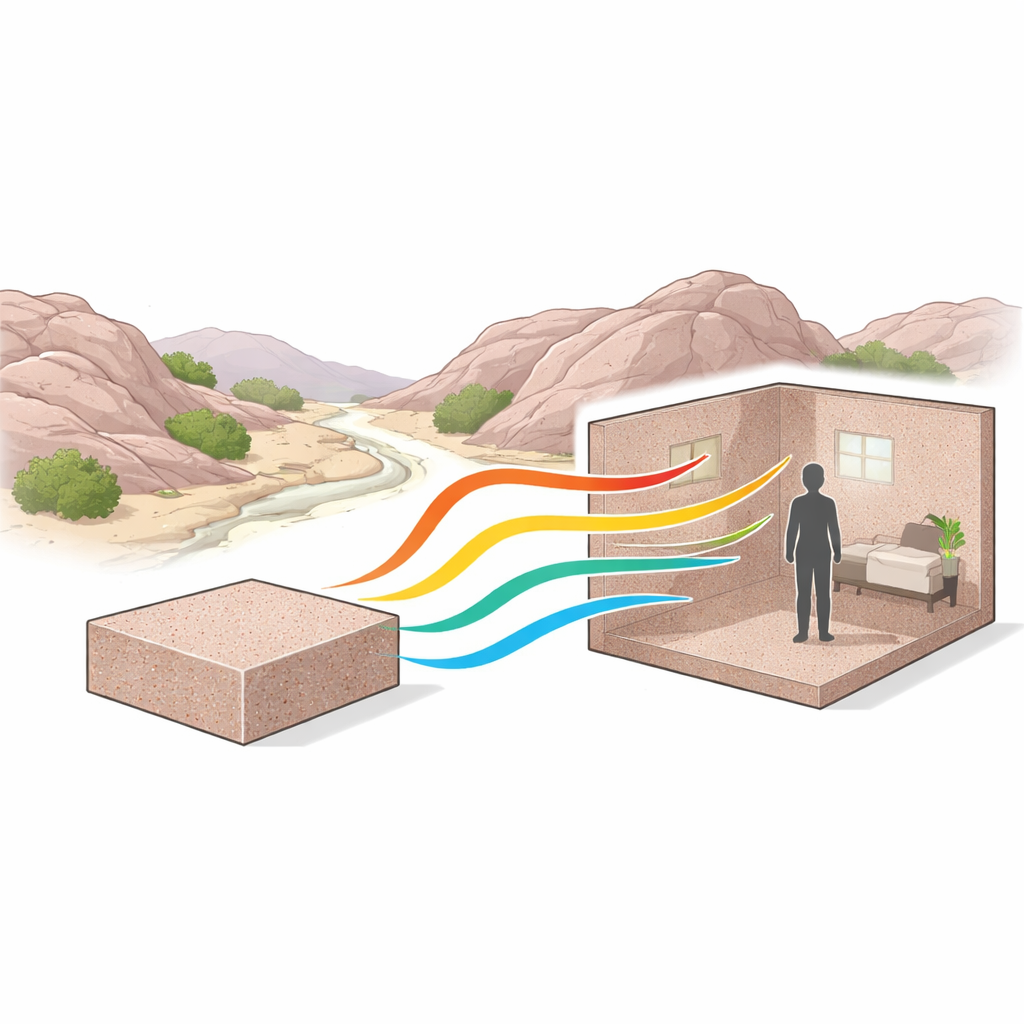
Where the Desert Meets Everyday Life
Wadi El‑Nabi’ lies in the Egyptian Nubian Shield, a vast ancient crustal block built from old volcanoes and intruding magmas. The valley is both a long‑standing mining district and a popular safari destination, with large pale pink granitic hills rising on either side. These granites, known as monzogranites and syenogranites, are attractive building stones and part of a broader regional push to use local materials in construction. Because people spend most of their time indoors, even small additions to indoor radiation from such stones can matter for public health, especially if the rocks are subtly enriched in radioactive elements like uranium, thorium, and potassium.
Measuring the Invisible
The researchers collected 35 granite samples from across the Wadi El‑Nabi’ pluton and ground them into fine powder. Using a highly sensitive high‑purity germanium detector, they measured the gamma rays emitted by three key natural radionuclides: a uranium daughter (radium‑226), thorium‑232, and potassium‑40. They then converted these measurements into a suite of standard hazard indices that estimate how much radiation a person might receive indoors and outdoors over time, and how that compares with international guidelines. Remote‑sensing images from the Landsat‑9 satellite were also processed to map zones of mineral alteration that often accompany the movement and concentration of radioactive elements in granite.
Granites with a Radiological Footprint
Both types of granite in Wadi El‑Nabi’ showed similar levels of radioactivity: radium and thorium were moderate, but potassium was consistently high, roughly double the worldwide average for granitic rocks. When the authors examined the ratios of thorium to radium and potassium, they found clear signs that uranium‑bearing elements had been mobilized and concentrated by hot fluids that percolated through the rock after it solidified. Satellite imagery supported this picture by revealing belts of altered rock—zones of kaolinization, sericitization, silicification, and fluorite‑rich veins—that line up with fractures and fault zones in the granites. In these belts, radioactive elements can accumulate to levels that no longer reflect an undisturbed crust, but a later episode of chemical reworking.
What the Numbers Mean for People
On paper, many of the basic checks look reassuring. A combined “radium‑equivalent” index, which rolls the three radionuclides into a single safety yardstick, remains below international limits for all samples. External and internal hazard indices, which judge whether gamma rays and radon from the rocks push exposure toward unsafe levels, also stay below the conventional cut‑off of one. But other indicators tell a more cautionary story. The calculated gamma dose rates for both the open air and indoor settings, as well as the estimated annual indoor doses, exceed global average values. Indices linked to lifetime cancer risk and to radiation affecting reproductive organs are higher than recommended benchmarks, especially when the granites are imagined as large interior surfaces in poorly ventilated rooms. In effect, the rocks would pass some simple screening tests, yet still raise long‑term exposure above what many agencies consider desirable.
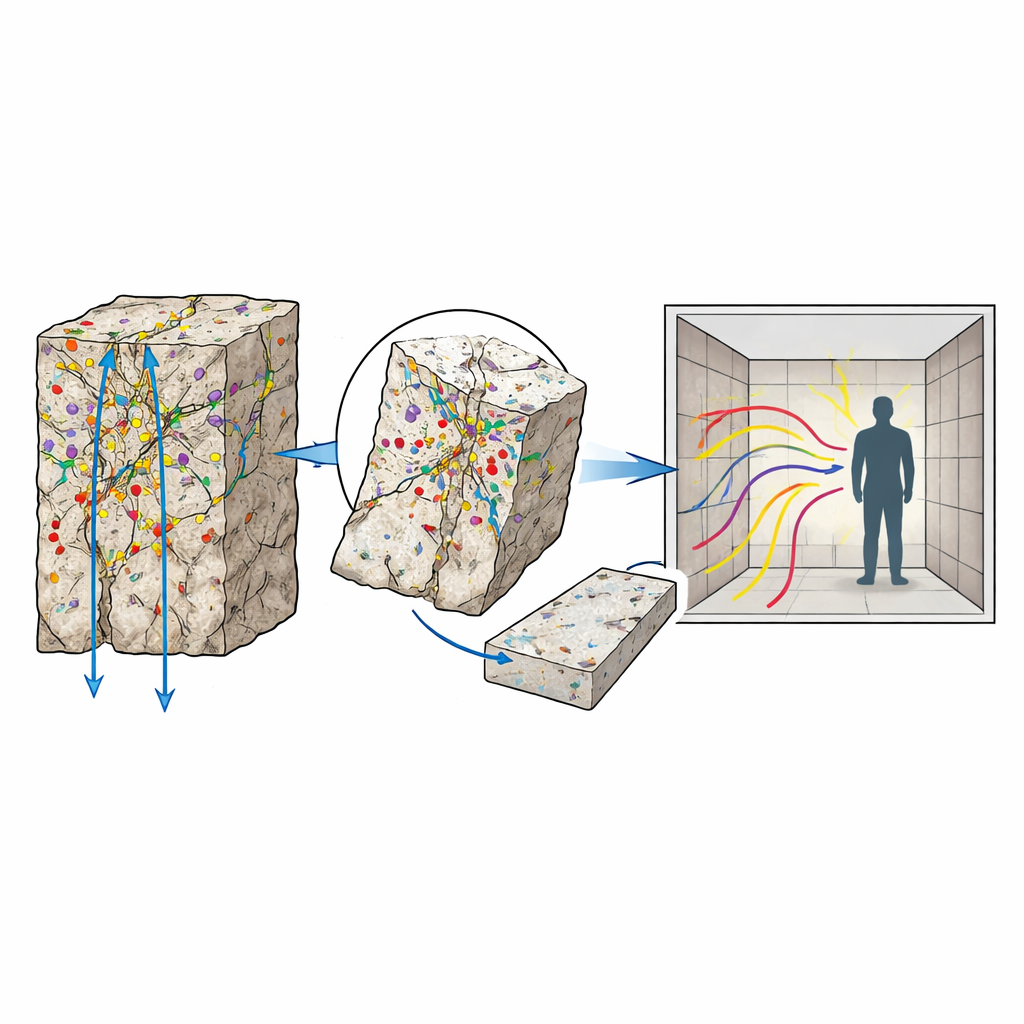
From Desert Outcrop to Design Choice
Viewed together, these lines of evidence paint a nuanced picture. Wadi El‑Nabi’ granites are not extreme “hot spots” like some mineralized granites elsewhere in Egypt, but they do carry enough natural radioactivity—concentrated in particular fractured and altered zones—to warrant caution. The authors conclude that blocks taken from the highest‑activity areas, especially around mapped alteration belts, should be avoided as indoor cladding, countertops, or flooring. At the same time, their detailed maps and measurements provide a baseline for both environmental monitoring and smart resource use: they show where quarrying can proceed with relatively low radiological concern, and where the stone is better left in the hills than brought into homes.
Citation: Shereif, A.S., Heikal, M.T.S., El Ela, A.S.A. et al. Gamma activity concentrations of 226Ra, 232Th, 40K, and health hazard assessments of granites from Wadi El-Nabi’ mining area, Egyptian Nubian Shield. Sci Rep 16, 9122 (2026). https://doi.org/10.1038/s41598-026-39664-4
Keywords: natural radioactivity, granite building stone, radiation dose, Egyptian Nubian Shield, radon and gamma rays