Clear Sky Science · en
Predicting the effects of temperature variability on nutritional status of children under five in Sub-Saharan Africa using machine learning
Why a Hotter World Matters for Young Children
Parents everywhere worry about whether their children are getting enough to eat and growing well. In many parts of Sub-Saharan Africa, this everyday concern is colliding with another global force: rising temperatures. This study asks a simple but urgent question: as the climate warms, how is the growth and nourishment of millions of children under five being affected, and can we use modern data tools to see the warning signs early?
Connecting Heat, Harvests, and Hungry Children
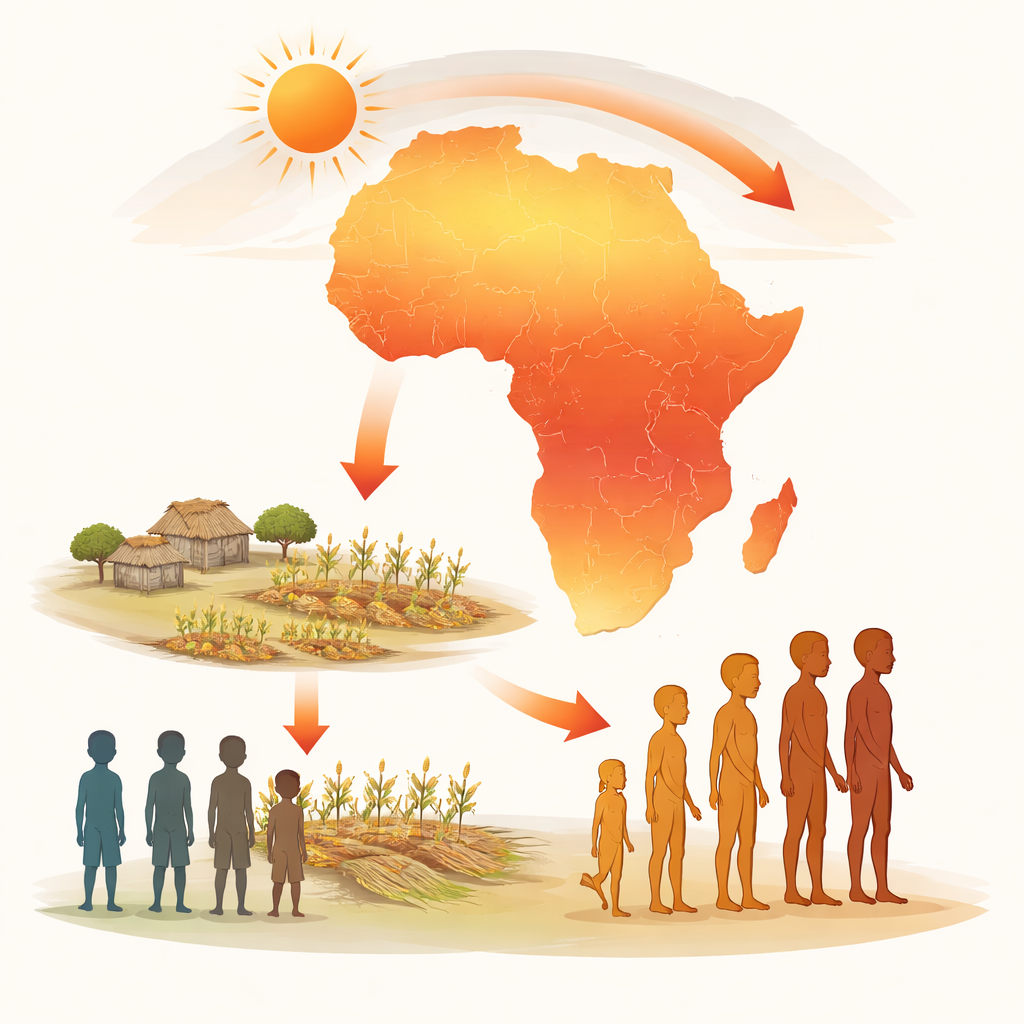
The authors focus on three common signs that children are not getting the nutrition they need: being too short for their age (stunting), too light for their age (underweight), or too thin for their height (wasting). These problems are shaped not only by what children eat, but also by the environment in which they live. In rural parts of Sub-Saharan Africa, families often depend on small farms and local water sources. Even small shifts in temperature can strain crops, raise food prices, and make clean water harder to find, setting off a chain reaction that ends at the dinner table—and in children’s growth charts.
Bringing Big Data and Smart Algorithms to Public Health
To untangle this chain, the researchers combined two powerful but very different types of information. First, they drew on health surveys of 345,837 children under five from 22 African countries, collected between 2005 and 2023. These surveys include careful measurements of children’s height and weight, as well as details about family income, parents’ education, and access to basics like safe water, toilets, and clean cooking fuels. Second, they matched each child’s community with high-resolution climate records, tracking how local temperatures have changed over nearly two decades. With these linked datasets, they then turned to supervised machine learning—computer programs that learn patterns from past data to make predictions—to see how well temperature and living conditions could forecast which children were at risk.
What the Numbers Say About Heat and Growth
The team tested several types of algorithms, including decision trees and more advanced “ensemble” methods that blend many small models into one stronger predictor. Overall, these tools did a solid job of flagging children at risk of poor growth, especially for being underweight and stunted. In some countries, predictions for stunting reached close to 90 percent accuracy. But beyond prediction, the researchers also wanted to know whether hotter conditions actually make poor growth more likely. Using statistical models that account for differences in income, education, and household conditions, they found that each one-degree Celsius rise in average temperature was linked to roughly a 1 percent higher chance of stunting, a 3 percent higher chance of being underweight, and a 10 percent higher chance of wasting. These percentages may sound small, but across millions of children they translate into large numbers of young lives affected.
Why Money, Schooling, and Basic Services Still Matter Most
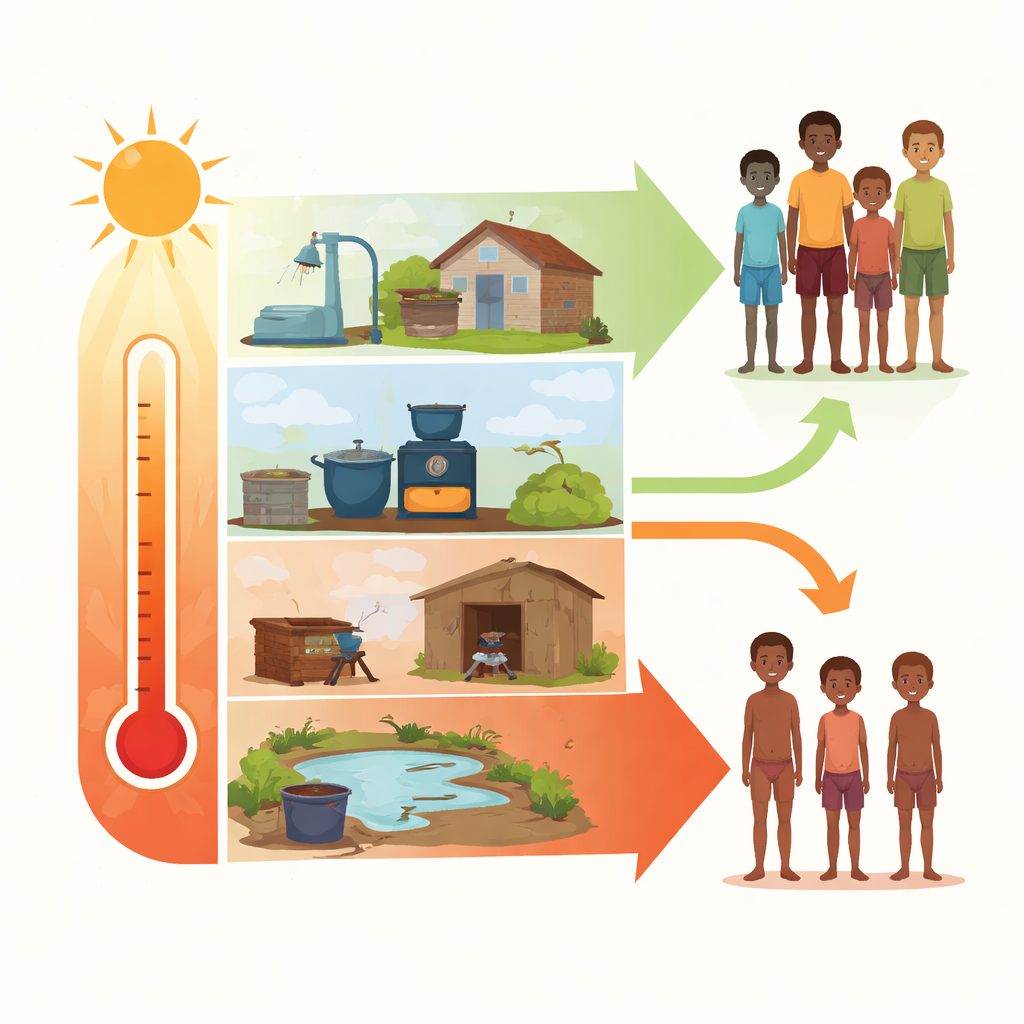
The study also highlights that heat does not harm all children equally. Children from better-off households and those with more educated mothers were less likely to be stunted or underweight, even in hotter places. Access to safe water, toilets, and cleaner cooking fuels further reduced the impact of rising temperatures. When the researchers looked country by country, they found that in some nations, such as Burkina Faso and Sierra Leone, hotter years were strongly tied to more malnutrition, while in others the link was weaker, suggesting that social protections, health systems, or local farming practices can blunt the blow of climate stress.
What This Means for the Future of Children’s Health
In simple terms, this work shows that a warming climate is quietly nudging more young children toward poor growth, especially where families already struggle with poverty and limited services. The authors argue that smart data tools can help governments spot which areas and groups are most at risk, guiding targeted nutrition programs, climate-resilient farming, and improvements in water, sanitation, and maternal education. While computers can now do a better job of predicting who is vulnerable, the real solutions remain firmly human: investing in families, farms, and basic infrastructure so that, even as the planet heats up, young children in Sub-Saharan Africa can still grow, thrive, and reach their full potential.
Citation: Bachwenkizi, J., He, C., Zhu, Y. et al. Predicting the effects of temperature variability on nutritional status of children under five in Sub-Saharan Africa using machine learning. Sci Rep 16, 8055 (2026). https://doi.org/10.1038/s41598-026-39659-1
Keywords: child malnutrition, climate change, Sub-Saharan Africa, temperature and health, machine learning in public health