Clear Sky Science · en
Multiscale characterization of micro fracture connectivity and gas migration in volcanic reservoirs using µCT and hybrid learning segmentation
Why tiny cracks in volcanic rocks matter
Far below our feet, natural gas often hides in volcanic rocks that look solid to the naked eye but are laced with hair‑thin cracks. These hidden pathways decide whether gas can move freely to a well or stays locked in the rock. This study shows how combining X‑ray microscopes and advanced computer vision can reveal those invisible cracks in three dimensions and explain why some volcanic gas reservoirs flow well while others barely trickle.
Peering inside rocks without breaking them
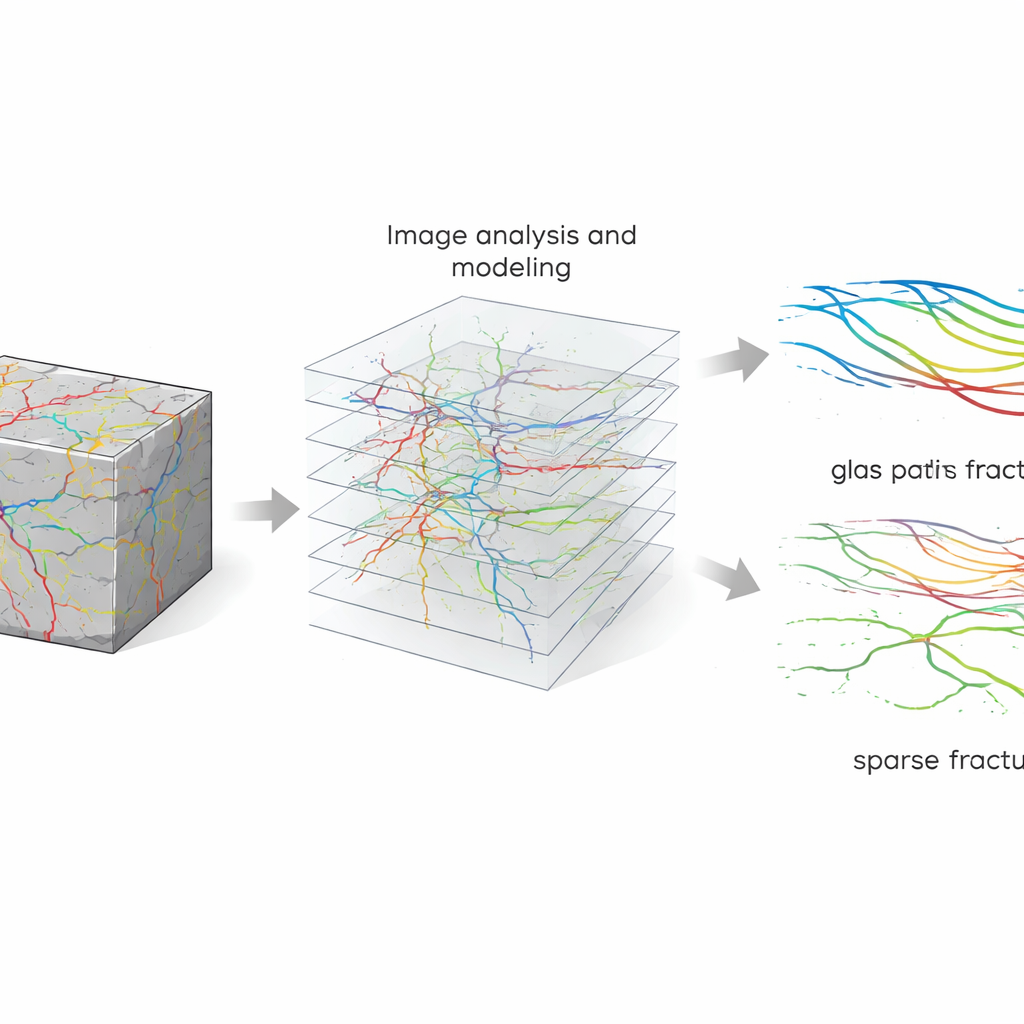
The researchers worked with four volcanic rock samples from China’s Songliao Basin, an important region for unconventional oil and gas. Instead of cutting the rocks apart, they used micro‑computed tomography (µCT), a kind of 3D X‑ray scan, to see inside each sample at a resolution of about twelve micrometers—roughly one‑tenth the width of a human hair. These scans show minerals, pores, and fractures as shades of gray. However, the cracks they cared about are extremely narrow and have poor contrast with the surrounding minerals, making them hard to distinguish by eye or with simple image‑processing tricks.
Teaching computers to see hair‑thin fractures
To tackle this, the team built a two‑step “hybrid learning” system that teaches computers to separate fractures from solid rock. First, they used an ensemble method called Random Forests to do a quick, coarse classification on 2D image slices. A semi‑automatic “label‑as‑you‑train” routine let the scientist correct machine mistakes on just a few slices out of hundreds, greatly reducing tedious hand‑labeling. This first step cleans away much of the noise and gives a reasonable guess of where fractures lie. Next, they fed stacks of neighboring slices into a more powerful deep‑learning network called U‑Net++, configured in a “2.5D” mode that captures how cracks continue from slice to slice without the heavy cost of full 3D learning. Together, these steps produced very accurate fracture maps, reaching a Dice score—a measure of overlap between prediction and truth—of about 0.90 in only ten training rounds.
From digital cracks to 3D gas pathways
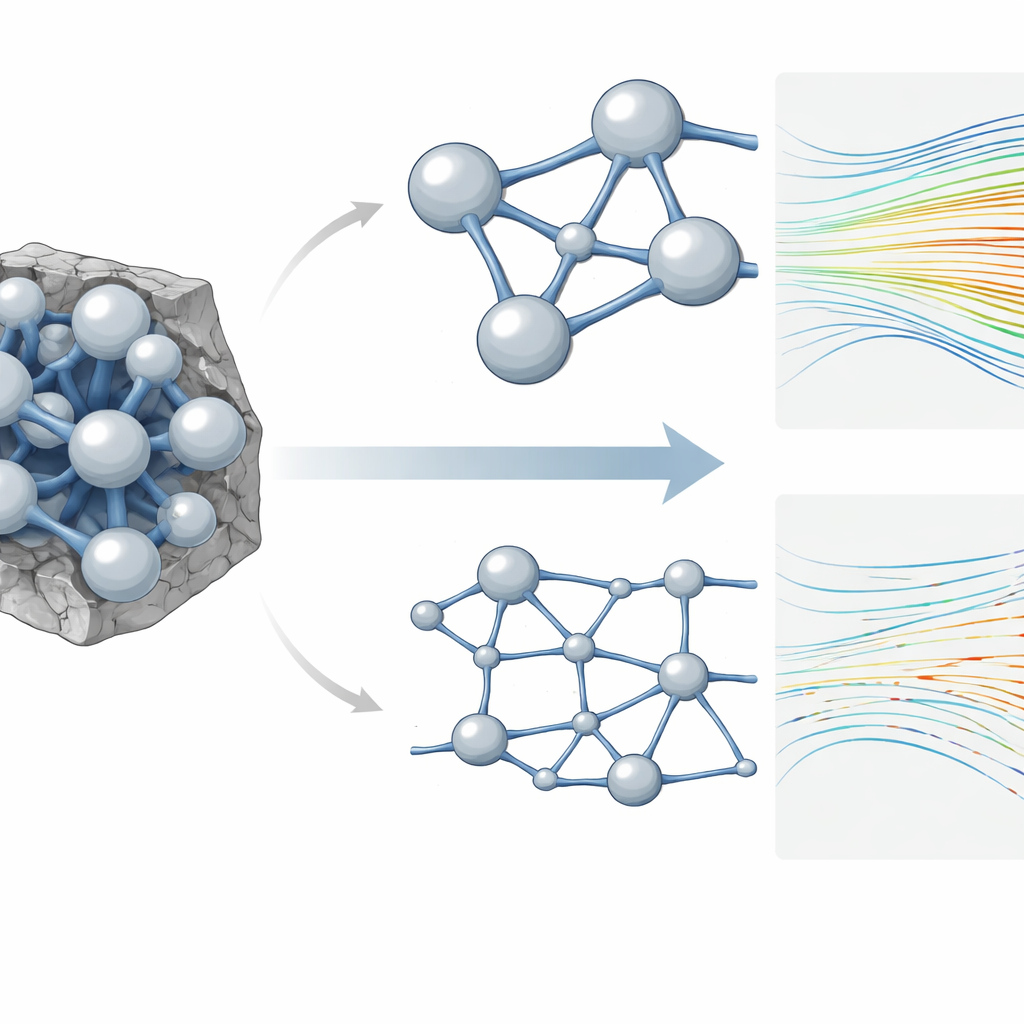
Once the fractures were cleanly separated, the team turned the segmented images into full 3D digital rock models. They removed tiny isolated specks, measured which cracks were actually connected, and distilled the complex fracture systems into networks of “pores” linked by narrow “throats.” This pore–throat model captures how much void space exists, how wide the channels are, and how many connections each pore has. Across the four samples, they found striking differences: some rocks had larger, well‑connected fracture networks that spanned the entire sample, while others contained many tiny, disconnected cracks that did not form continuous pathways.
How crack networks control gas flow
Using these digital rocks, the researchers simulated how natural gas would seep through each sample under a pressure difference, based on Darcy’s law for flow in porous media. In the best‑connected rocks, fractures formed near‑vertical “highways” with side branches, and the simulated gas streamlines were dense, continuous, and extended from inlet to outlet. These samples showed higher permeability and faster flow, even when their overall porosity was modest. In contrast, rocks with slender, scattered fractures produced sparse and broken streamlines; gas penetrated only short distances before pathways pinched out. Notably, one sample with relatively high porosity still behaved poorly because its fracture network was fragmented, underscoring that connectivity and throat width matter more than simple pore volume alone.
What this means for future energy and modeling
To a non‑specialist, the key message is that in tight volcanic gas reservoirs, the pattern of tiny cracks—not just how much empty space the rock contains—largely governs whether gas can be produced efficiently. The study delivers both a practical workflow for turning fuzzy X‑ray scans into reliable 3D maps of micro‑fractures and a clear physical picture: well‑developed fracture networks act as main roads and side streets for gas, boosting flow even in otherwise tight rock, while poorly connected cracks leave gas stranded. These insights can help improve digital rock analysis, guide reservoir evaluation, and support better forecasts of how much gas such complex rocks can realistically deliver.
Citation: Zhang, J., Yu, Y., Cai, H. et al. Multiscale characterization of micro fracture connectivity and gas migration in volcanic reservoirs using µCT and hybrid learning segmentation. Sci Rep 16, 8442 (2026). https://doi.org/10.1038/s41598-026-39657-3
Keywords: volcanic reservoir, micro fractures, digital rock, gas migration, deep learning segmentation