Clear Sky Science · en
Fractional dynamics and optical soliton propagation in mono-mode fibers via the Fokas system
Light Pulses That Refuse to Spread Out
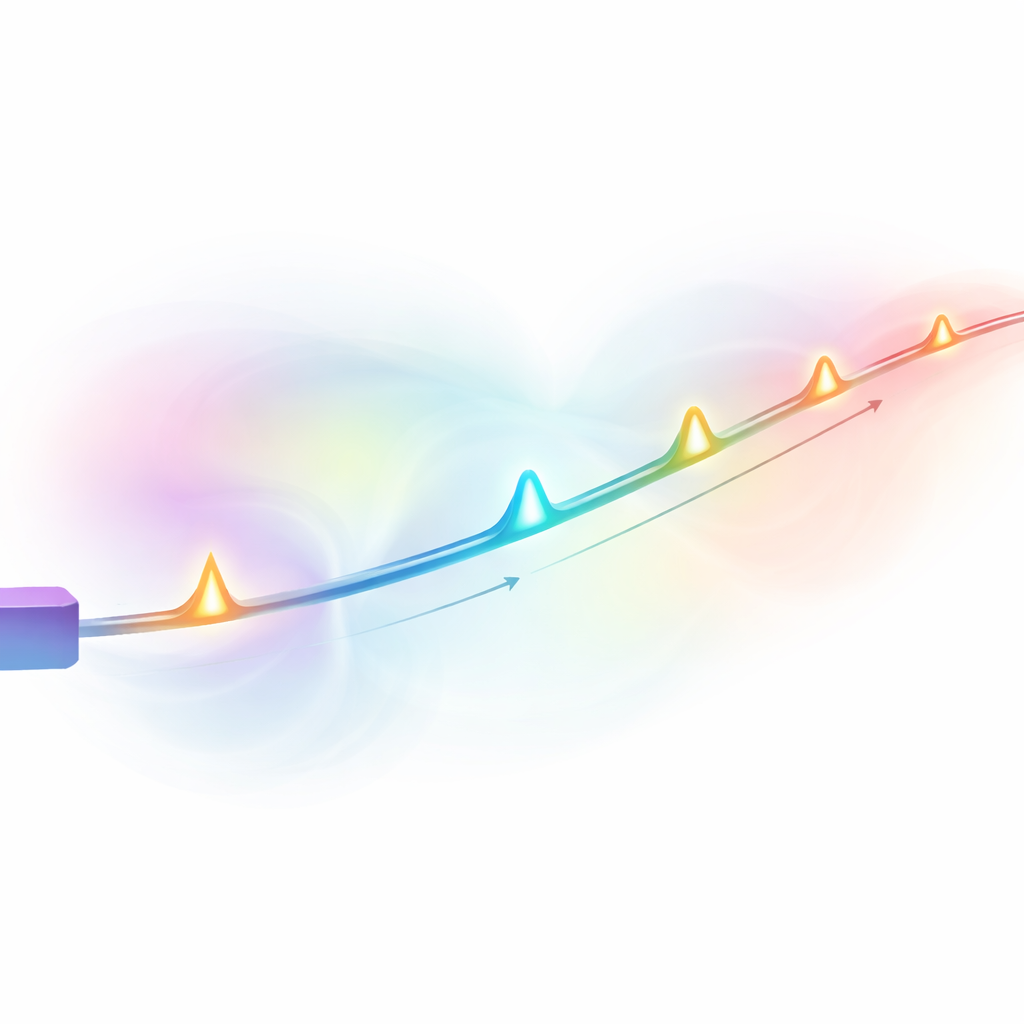
High‑speed internet, transoceanic cables, and data centers all rely on tiny flashes of light racing through glass fibers. Normally, these flashes tend to spread and distort as they travel, which limits how far and how fast we can send information. This paper explores a special kind of self‑shaping light pulse, called a soliton, in realistic optical fibers that have "memory" of what happened a moment before. By understanding and taming these stubborn pulses, engineers can design more reliable and higher‑capacity communication systems.
A New Look at Light in Glass
When a burst of light travels down a fiber, two competing effects shape it: dispersion, which makes it spread out, and nonlinearity, which lets strong parts of the pulse change the fiber’s behavior. Under the right balance of these effects, a soliton forms—a compact, stable pulse that holds its shape over long distances. The authors focus on a mathematical description known as the Fokas system, a powerful model that extends the well‑known nonlinear Schrödinger equation used widely in optics. Unlike standard models that treat space and time in a more limited way, this system captures richer behavior relevant to mono‑mode fibers, the workhorses of long‑distance communication.
When the Medium Has a Memory
Real materials do not always respond instantly; their current state can depend on what happened in the recent past. To capture this “memory,” the authors use a framework called fractional calculus. Instead of ordinary derivatives that measure simple rates of change, fractional derivatives encode how the system responds over an extended history. In this work, the team uses a particular version, the conformable fractional derivative, which retains familiar mathematical rules while building in memory and long‑range effects. A key knob in their model is a parameter, denoted by α, that tunes how strong these memory and nonlocal effects are.
Solving the Puzzle of Stable Pulses
Finding exact expressions for solitons in such a complex setting is challenging. The authors combine several advanced tools—a wave transformation, the generalized Riccati–Bernoulli sub‑equation method, and Bäcklund transformations—to reduce the original, intricate equations to more manageable forms. This strategy lets them write down families of exact traveling‑wave solutions instead of relying only on numerical simulations. They identify three major classes of waves based on how a key parameter is chosen: localized kink‑like solitons described by smooth, step‑shaped curves; periodic wave trains that repeat in space; and algebraic solitons that decay more slowly. These different shapes correspond to different ways energy can be packed and moved through the fiber.
Turning a Dial to Shape Light
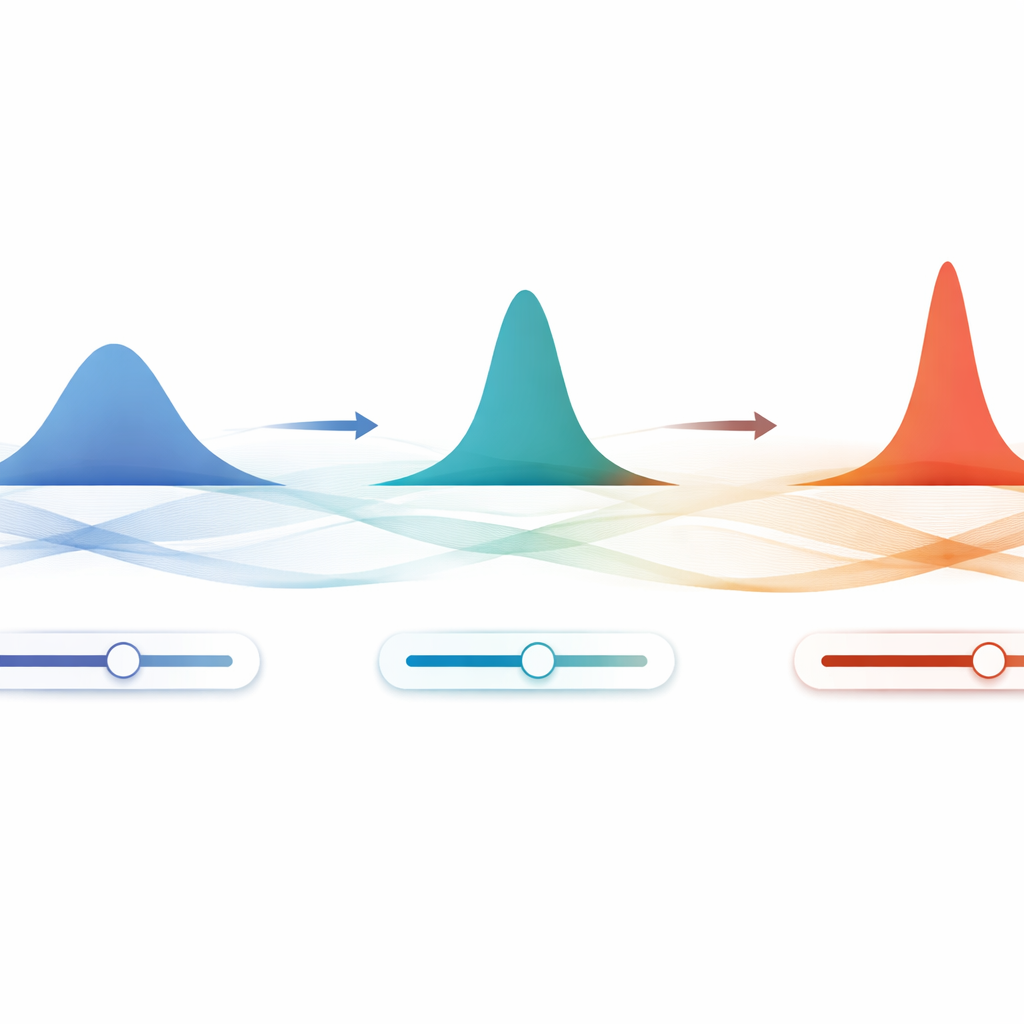
With explicit formulas in hand, the researchers explore how changing the fractional‑order parameter α reshapes the pulses. Their two‑ and three‑dimensional plots show that as α increases, solitons tend to become sharper and more strongly localized, concentrating energy in narrower regions of the fiber. For some soliton families, the height of the pulse grows and its edges steepen; for others, such as certain lump‑type waves, the overall shape is much less sensitive. At the special value α = 1, their fractional model smoothly reduces to the classical, memory‑free Fokas system, confirming that the new approach is consistent with established theory while extending it to more realistic materials.
Why These Results Matter for Future Networks
To a non‑specialist, the main message is that the authors have built a flexible mathematical “control panel” for light pulses in complex optical fibers. By adjusting a single fractional parameter that captures memory and dispersion effects, they can predict how tightly energy can be confined, how robust the pulses will be, and how they might be tuned for different applications. This deeper understanding of fractional dynamics and optical solitons could help guide the design of next‑generation fiber links and other wave‑based technologies—from advanced sensors to plasma systems—where stable, shape‑preserving pulses are crucial.
Citation: Iqbal, N., Aldhabani, M.S., Alam, N. et al. Fractional dynamics and optical soliton propagation in mono-mode fibers via the Fokas system. Sci Rep 16, 9280 (2026). https://doi.org/10.1038/s41598-026-39656-4
Keywords: optical solitons, fiber optics, fractional calculus, nonlinear waves, optical communication