Clear Sky Science · en
Real-time monitoring and closed-loop control system for multi-jet electrospinning with coaxial laser
Making Tiny Fibers More Reliable
From air filters and face masks to water treatment and wearable electronics, many emerging technologies rely on sheets of ultrathin fibers called nanofibers. These fibers are often made by a technique known as electrospinning, which pulls liquid into hair-like strands using electricity. While the method is powerful, it can be temperamental: small disturbances can turn a smooth process into a messy one, leading to uneven fiber quality. This study presents a way to watch and automatically correct a multi-nozzle electrospinning process in real time, paving the way for more reliable and scalable production of high-quality nanofiber materials.
How Electric Jets Spin Webs
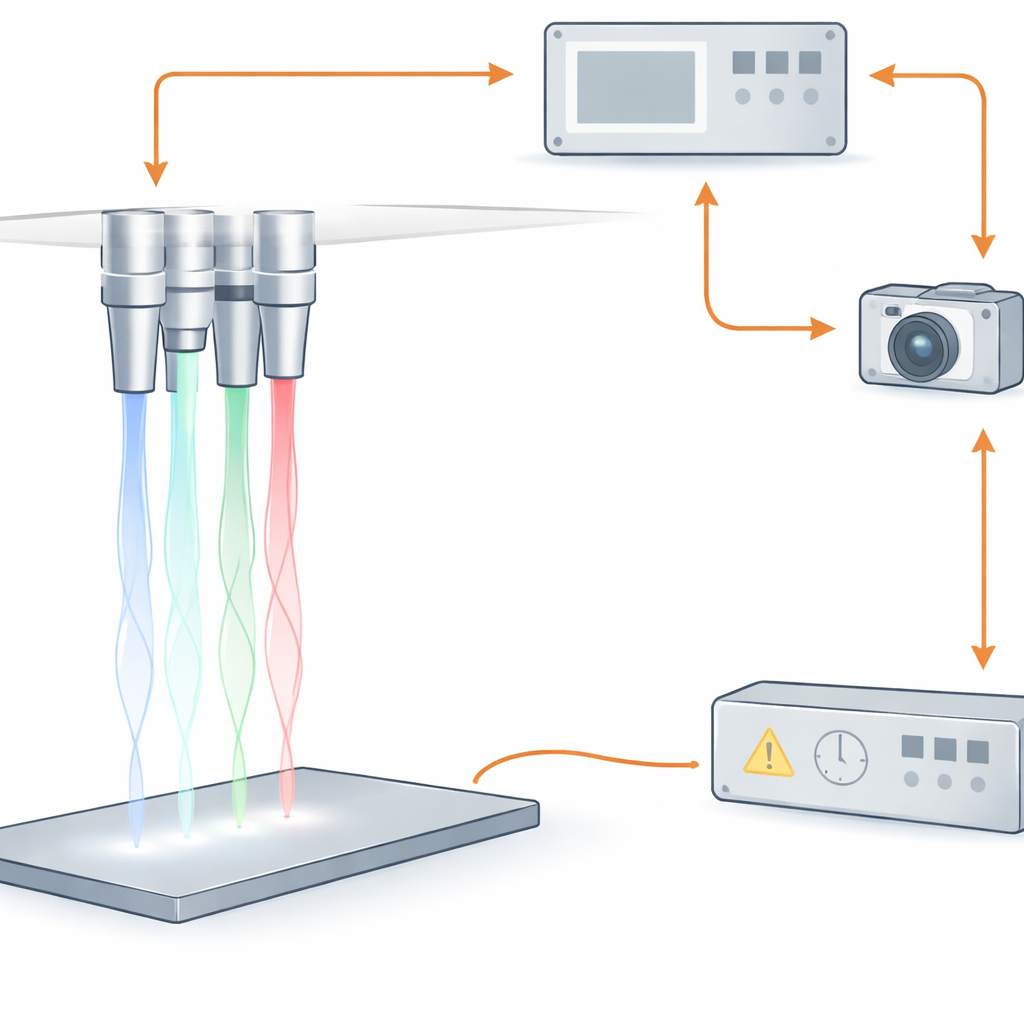
In electrospinning, a liquid containing dissolved polymer is pushed through fine needles toward a metal plate. A strong electric field stretches the liquid droplet at each needle tip into a pointed shape and then into a jet, which thins and dries into a solid fiber before it lands on the collector plate. To boost production, manufacturers prefer using several needles at once, creating multiple jets and building up nanofiber sheets more quickly. But each jet behaves slightly differently, and gusts of air, vibration, or minor changes in the liquid flow can cause some jets to drip, others to vanish, and still others to behave erratically. Because the fibers are so small and the jets are faint, especially when many needles are used, it is hard to monitor all jets at once and adjust the process before defects appear.
Lighting Up Invisible Jets
The researchers tackled this visibility problem by building a multi-jet electrospinning setup with three special coaxial needles, each carrying both the polymer solution and a narrow laser beam. The laser runs inside the inner needle and couples into the emerging jet, making the droplet and jet region glow brightly on camera without disturbing the spinning itself. A high-speed industrial camera points at the region where the jets form, while a computer receives the images and a high-voltage power supply drives the electric field. This arrangement allows the system to watch the shape of the droplet at each needle tip (the so-called cone) and the straight visible length of each jet, which are key indicators of whether the process is producing good fibers.
Teaching a Computer to Read Jet Behavior
To turn raw images into useful information, the team designed an image-processing algorithm tailored for multiple jets. First, it cleans and simplifies each frame, converting it to black and white so that glowing jets stand out clearly from the background. Then it automatically finds and boxes the region around every jet, avoiding the need for manual selection. Within each box, the algorithm separates the droplet-like cone from the thin jet below, using digital filtering to remove noise and to distinguish the broader cone from the narrow jet. It then traces the centerline of each jet to measure its visible length and fits the cone shape to simple geometric forms such as triangles, circles, or ellipses in order to calculate its area. All of this happens in under 40 milliseconds per frame, fast enough to follow the constantly changing behavior of multiple jets in real time.
From Watching to Correcting in Real Time
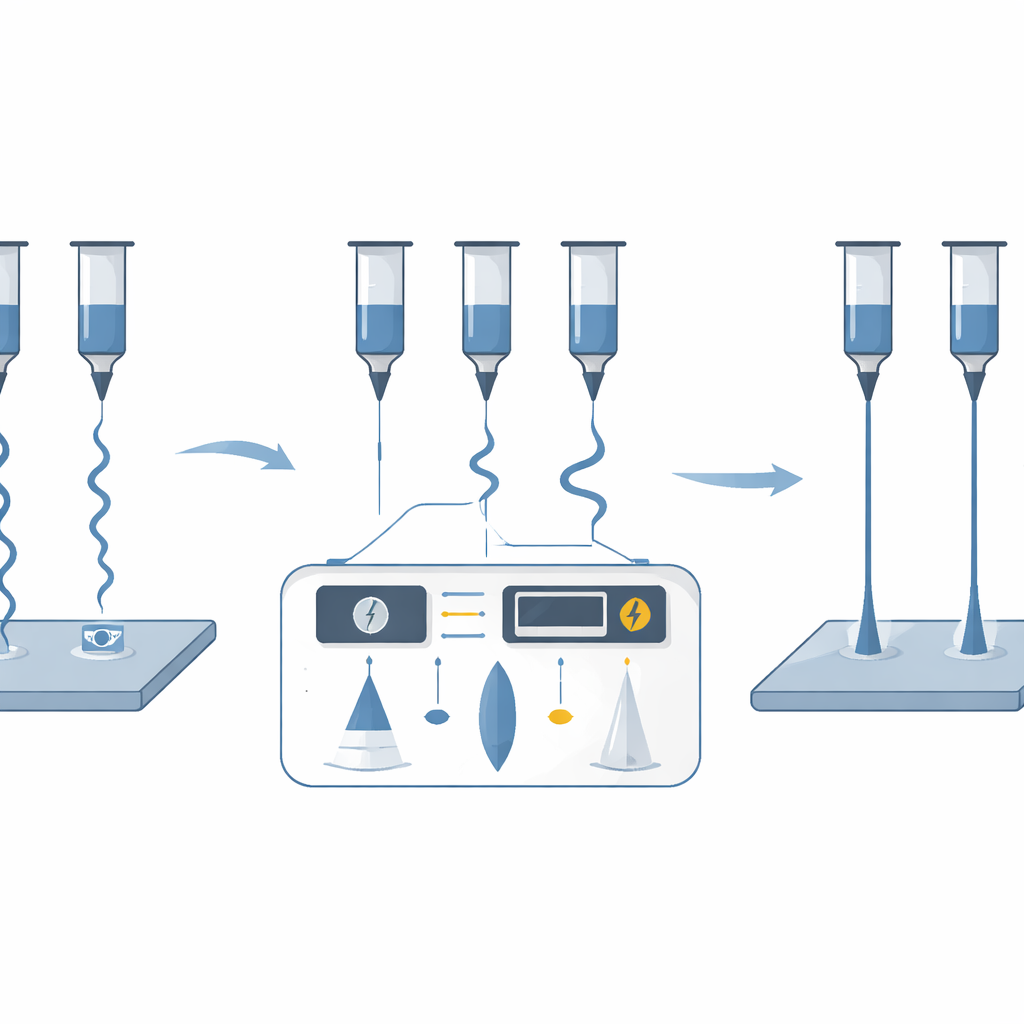
Measuring the jets is only half the story; the real advance is using those measurements to correct the process automatically. Based on experiments, the authors defined four basic jet states: a hanging droplet with no jet, a very thin and unstable jet, a normal stable jet that produces uniform fibers, and a retreating jet pulled back into the needle. By combining cone area and jet length, the computer can classify each jet into one of these states. It then follows a simple rule set: whenever a jet becomes too short, too large, or retreats, the system nudges the applied voltage up or down in small steps until all jets return to the normal state. Because voltage changes act almost instantly on the liquid, this feedback loop can respond quickly to disturbances without relying on slower adjustments to the liquid feed.
Sharper Control, Better Nanofibers
When the researchers compared nanofiber membranes produced with and without this closed-loop control system, the difference was clear. Without automatic correction, droplets periodically fell onto the collector, breaking and bunching the fibers and causing a wide spread in fiber diameter. With real-time monitoring and voltage adjustment, the jets stayed in their stable state, dripping was largely suppressed, and the resulting nanofibers had a much more uniform thickness. For non-specialists, the takeaway is that combining smart imaging, fast algorithms, and simple feedback rules can turn a delicate, hard-to-control lab process into a more robust manufacturing tool, helping future filters, medical materials, and energy devices become more consistent and easier to produce at scale.
Citation: Jiang, J., Sun, Z., Chen, J. et al. Real-time monitoring and closed-loop control system for multi-jet electrospinning with coaxial laser. Sci Rep 16, 8225 (2026). https://doi.org/10.1038/s41598-026-39655-5
Keywords: electrospinning, nanofiber membranes, process monitoring, closed-loop control, image-based sensing