Clear Sky Science · en
Calibration of the Karagozian & Case model for compression and tensile tests of a 3,4-dinitropyrazole-based melt-cast explosive
Why Tougher Explosives Matter
Modern militaries rely on powerful melt-cast explosives that can be poured into shells and warheads like hot wax, then solidify into dense, energy-packed fillings. These materials are cheap and efficient, but they can also be fragile: bumps, drops, or blasts may crack them or even set them off. This study asks a practical question with big safety implications: can a mathematical model originally built for concrete help us predict how a new melt-cast explosive holds up under real-world mechanical abuse?
From Building Material to Battlefield Material
The explosive examined here is based on 3,4-dinitropyrazole (DNP), mixed with another high explosive called HMX. Although explosives and concrete seem worlds apart, they share key traits: both are brittle, crack under load, and behave differently when squeezed slowly, hit quickly, or confined on all sides. Engineers have spent decades perfecting models for concrete that can track how it stiffens, cracks, and finally fails. The authors reasoned that if one of these concrete models could be adapted to DNP-based explosives, it would give designers a powerful new tool to forecast how warheads survive storage, transport, and impact without dangerous surprises. 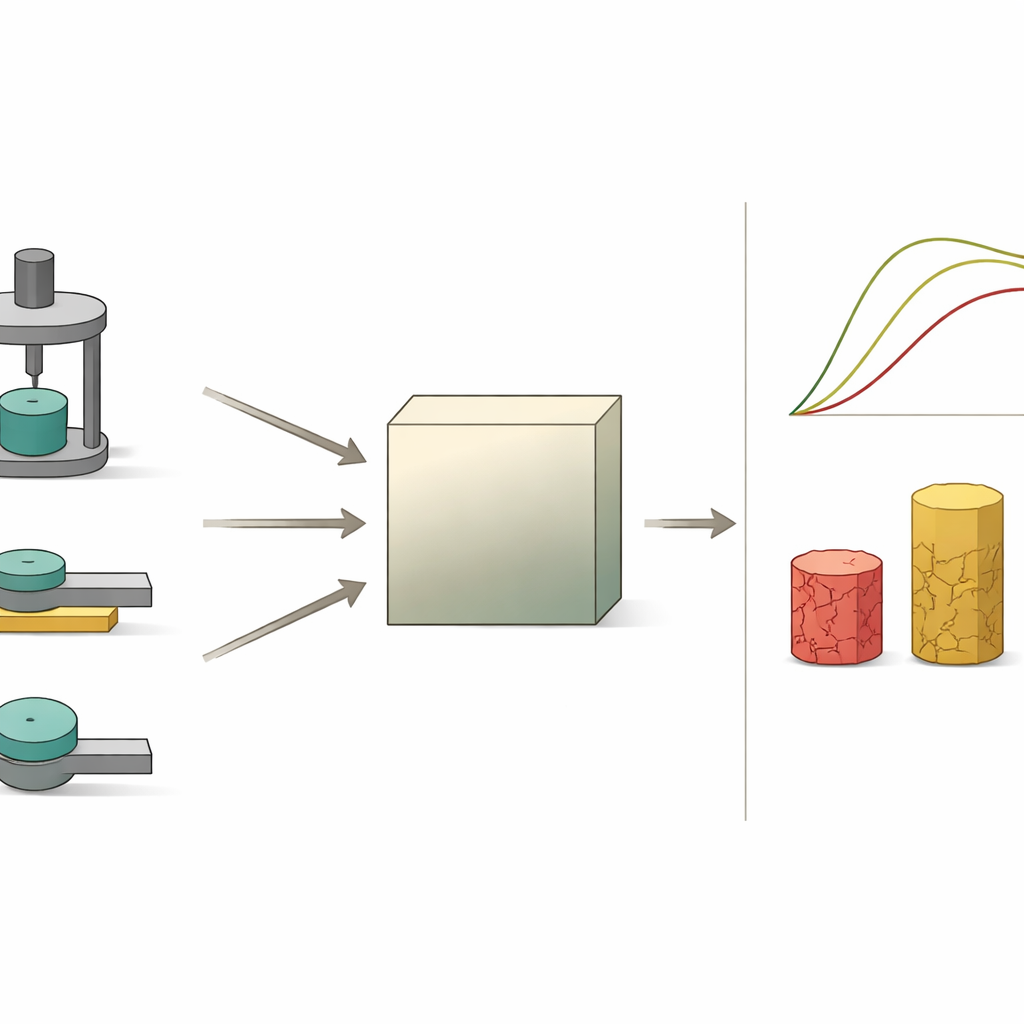
Putting the Explosive to the Test
To explore this idea, the team first had to measure how the DNP-based explosive behaves in the laboratory. They cast small cylinders and discs and tested them in three ways. In slow compression tests, a universal testing machine gently squeezed the samples at two very low loading speeds, revealing how stiff the material is and when it starts to crack. In high-speed compression tests, a split Hopkinson pressure bar fired a projectile to deliver a rapid impact, mimicking what the explosive might experience in blasts or collisions. Finally, special “Brazilian disc” tests pulled the material apart indirectly, allowing the researchers to estimate its tensile strength and fracture toughness—how easily cracks start and grow. Together, these experiments painted a detailed picture of the explosive’s behavior across a wide range of loading conditions.
A Concrete Model Learns a New Trick
Armed with this data, the authors turned to the Karagozian & Case (K&C) model, a sophisticated description of how brittle materials respond when pushed, pulled, and confined. The model tracks how a material transitions from an initial elastic stage, where it springs back, through hardening as microcracks form, and finally into softening and failure as damage spreads. It also accounts for how behavior changes when loads are applied faster and when pressure is applied from all sides. The researchers fed in the measured properties of the DNP-based explosive, then carefully tuned the model’s many internal settings so that its predicted stress–strain curves lined up with the experimental ones. They adjusted how quickly damage accumulates, how the material stiffens at high loading rates, and how its bulk response changes under compression.
Seeing Inside the Material’s Response
Once calibrated, the K&C model was used like a virtual test bench. It accurately reproduced how the explosive grows stronger and stiffer when compressed faster, with errors in peak strength under 7% for the tested impact speeds. It also captured the complete journey from initial loading, through crack growth, to final failure. When the team simulated slow compression, they slightly adjusted the way the material volume responds so that the model also agreed well with quasi-static tests. Perhaps most strikingly, virtual tests under different surrounding pressures showed the explosive changing personality: with little or no confinement, it behaved in a brittle way, losing strength quickly after cracking; under higher confinement, it deformed more like a ductile material, holding substantial strength even at large strains and approaching an almost perfectly plastic response. 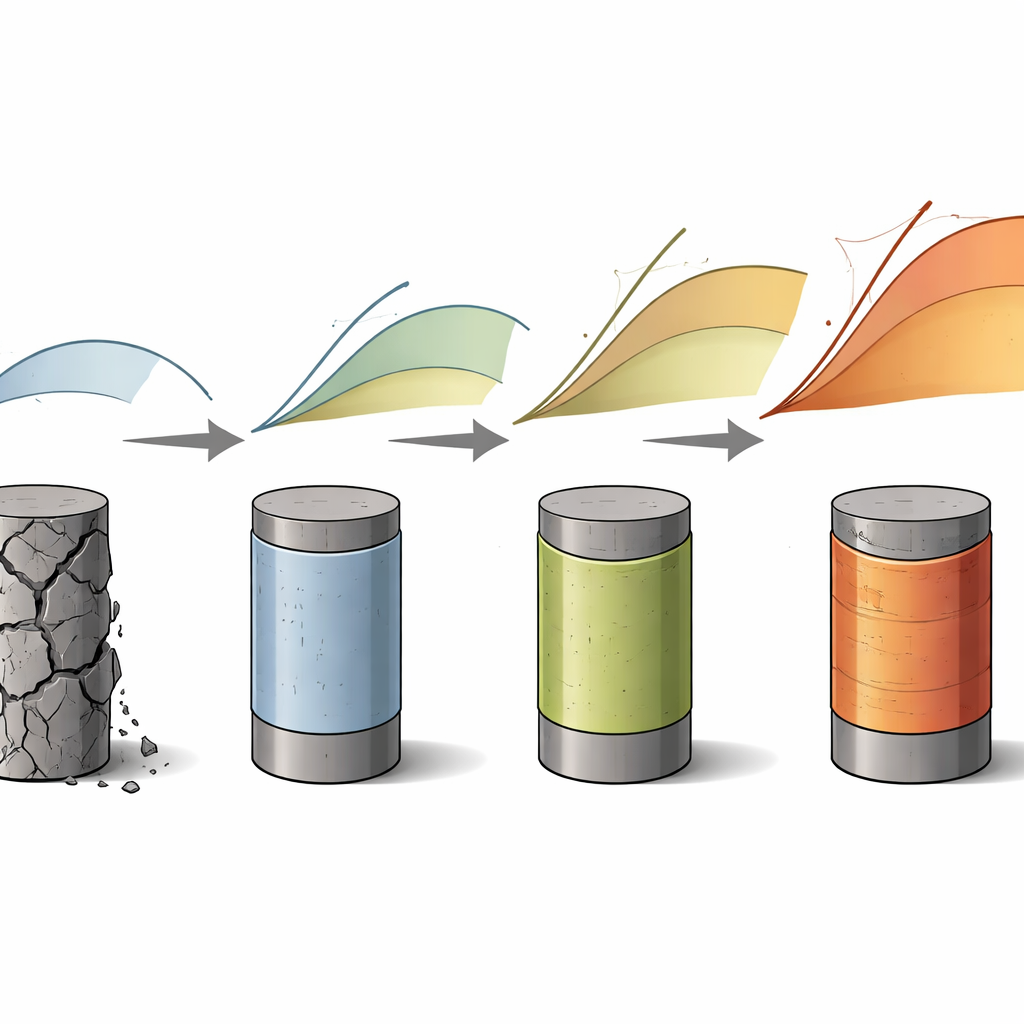
What This Means for Safer Designs
For non-specialists, the bottom line is that the authors successfully repurposed a proven concrete model to describe a modern melt-cast explosive in realistic detail. By matching both slow and fast tests, in tension and compression, and by capturing the shift from brittle cracking to ductile-like behavior under pressure, the K&C model becomes a reliable crystal ball for how this explosive will behave inside real munitions. Designers can now simulate how charges respond to shocks, impacts, and confinement without relying solely on costly and hazardous experiments. In the long term, this kind of modeling can guide safer explosive formulations, more robust warhead structures, and more accurate risk assessments wherever melt-cast explosives are used.
Citation: Xu, Y., Gao, J., Fu, P. et al. Calibration of the Karagozian & Case model for compression and tensile tests of a 3,4-dinitropyrazole-based melt-cast explosive. Sci Rep 16, 8391 (2026). https://doi.org/10.1038/s41598-026-39651-9
Keywords: melt-cast explosives, mechanical behavior, constitutive modeling, dynamic loading, material safety