Clear Sky Science · en
A reliable and holistic approach to evaluating hearing and cognitive auditory processing in adult and aged companion dogs
Why your dog’s hearing and mind matter
Many dog owners notice that their pets seem to “tune out” as they age—failing to come when called or startling more easily. Is this stubbornness, fading hearing, or changes in memory and attention? This study introduces a pair of simple, play-based tests designed specifically for pet dogs that can tease apart those possibilities. By better measuring how dogs hear and how they use sound to learn, veterinarians and owners may detect age-related hearing loss earlier and understand how it links to brain health and quality of life.
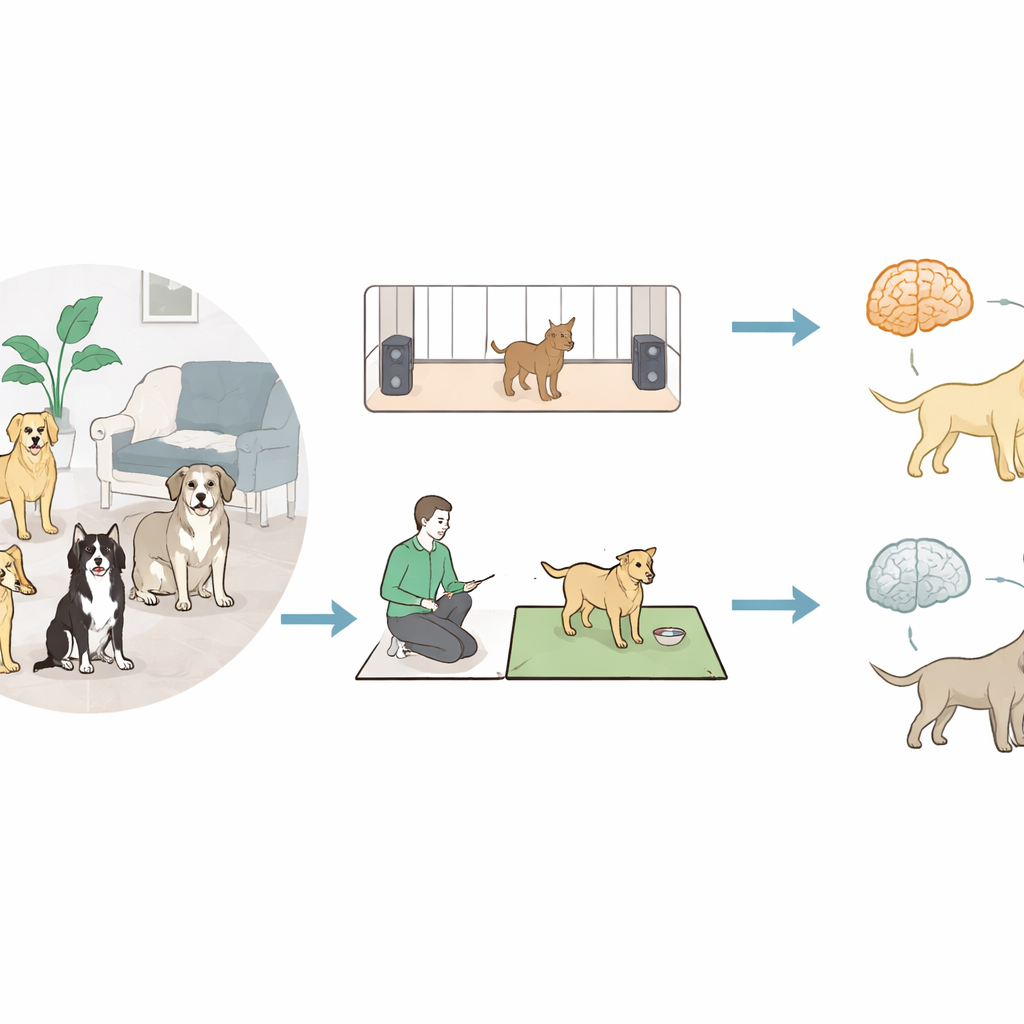
Two new sound games for dogs
The researchers created two behavioral tests that work with a dog’s natural reactions and love of treats. The first, called the Enclosed Canine Hearing Observation (ECHO) test, checks whether a dog can hear and react to sounds in a small pen. The second, the Evaluation of Auditory Reward Response (EARR) test, goes a step further by asking whether a dog can learn that a particular sound means a reward is waiting. Together, these tests are meant to capture not only whether sound reaches the ear, but also how the brain uses that sound to guide behavior, offering a fuller picture of hearing and thinking in dogs.
How the sound-detection test works
In the ECHO test, each dog is placed in a low-stress, fenced area with speakers at either end. The room is kept quiet, and a safety monitor stands by without interacting. The researchers play different sounds—simple tones, door knocking, and a whistle—at various loudness levels. They watch through a camera for natural reactions such as turning the head or body toward the sound, tilting the head, moving the ears, or walking toward the source. These visible responses indicate that the dog noticed the sound, which depends on both the ear and parts of the brain that connect hearing to movement. Dogs that do not respond even to loud sounds are likely to have serious hearing loss.
How the sound-and-reward game works
The EARR test adds a memory and learning challenge. On a long mat, a dog starts beside its handler while a bowl is placed farther away. Sometimes the bowl contains a treat; other times it is empty. During “baited” trials, the researchers briefly play a sound just before the dog is released to run to the bowl; during “unbaited” trials, no sound is played. Over many trials, a hearing dog can learn that the sound predicts a treat and will run more quickly on trials with sound than on silent ones. The team also uses a control phase where treats are given without any sound to confirm that faster running really depends on hearing the cue and not just on smell, chance, or guessing.
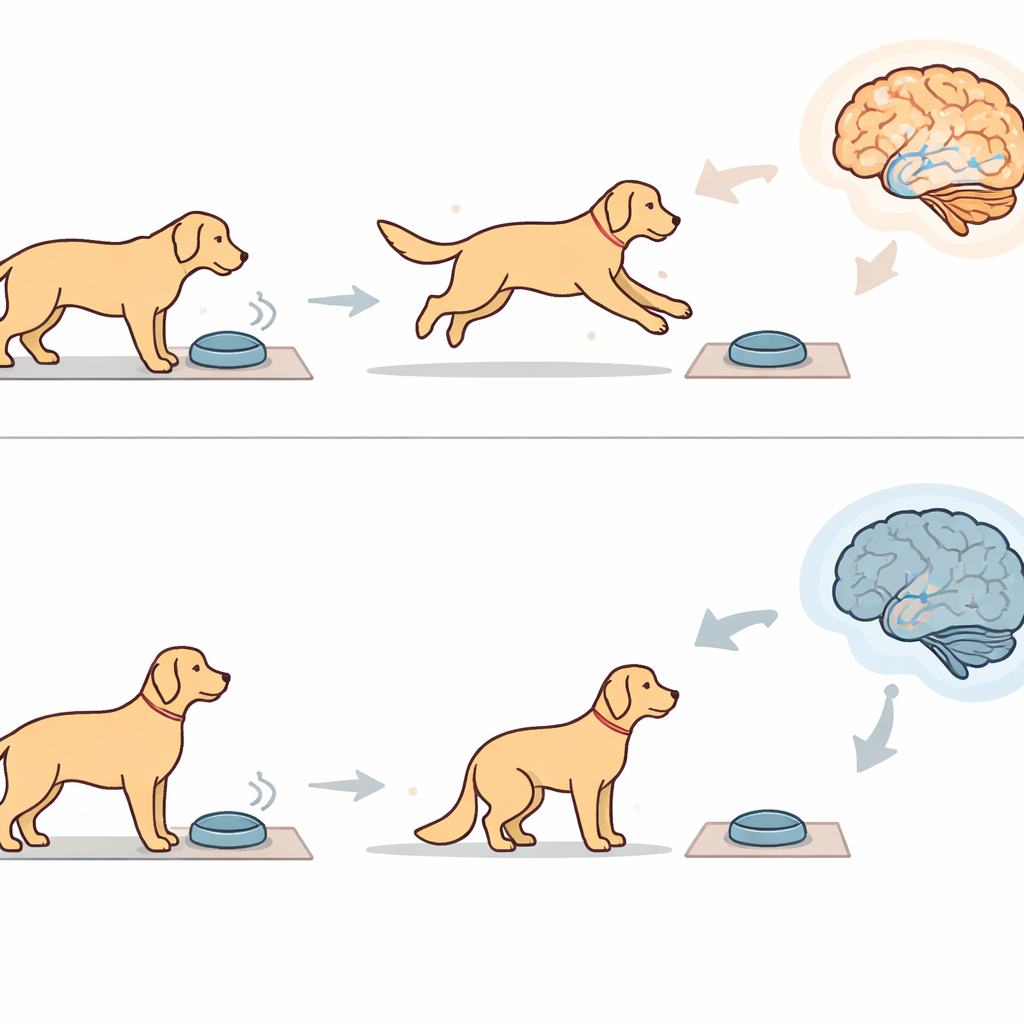
What the tests revealed in real dogs
The study involved three groups of companion dogs: young adults with normal hearing, young dogs reported as deaf by their owners, and senior dogs of various hearing abilities. All of the hearing dogs reacted to sounds in the ECHO test at relatively low loudness levels, while none of the deaf dogs reacted even to much louder sounds. In the EARR test, both young and older dogs with usable hearing successfully learned the sound–reward link and ran faster when the sound signaled a treat. Deaf dogs, however, could not pass the learning phase because the sound cue meant nothing to them. Repeating the tests weeks later gave very similar results, and different observers agreed closely on how to score the videos, showing that the methods are reliable.
What this means for aging pets and their people
The authors conclude that these two simple, behavior-based tests can reliably tell apart dogs with normal hearing from those with serious hearing problems, while also revealing how well dogs use sound to guide their actions. When combined with existing tools like brain-wave recordings and brain scans, ECHO and EARR could help veterinarians map out how age-related hearing loss and cognitive decline are linked in dogs. For owners, earlier and clearer detection of hearing changes could prompt practical adjustments—such as using more visual cues and modifying training—helping older dogs stay engaged, safer, and more connected to their human families.
Citation: Yang, CC., Ruggeri, M., Simon, K.E. et al. A reliable and holistic approach to evaluating hearing and cognitive auditory processing in adult and aged companion dogs. Sci Rep 16, 8192 (2026). https://doi.org/10.1038/s41598-026-39648-4
Keywords: dog hearing, age-related hearing loss, canine cognition, behavioral testing in dogs, senior pets