Clear Sky Science · en
Himalayan sub-Moho earthquakes suggest crustal faults trigger eclogitized-drip tectonics
Why Deep Himalayan Quakes Matter
Most earthquakes we hear about happen in the brittle outer shell of the Earth, just a few tens of kilometers down. But beneath the Himalaya, some quakes strike far deeper, more than 100 kilometers below the surface, under the very boundary between crust and mantle. This study asks a deceptively simple question—what exactly is breaking down there? The answer turns out to challenge classic textbook views of how continents are built, and reveals an unexpected link between surface faults, hidden rock transformations, and strange “dripping” of dense crust into the mantle.
Mysterious Quakes Below the Usual Limit
Along the 2,000‑kilometer Himalayan arc, scientists have now identified more than 100 earthquakes that occur beneath the Moho, the seismic boundary that usually marks the base of the crust. These deep quakes cluster strongly in two short segments, especially beneath a roughly 300‑kilometer stretch of southern Tibet where events reach about 110 kilometers depth. That tight clustering, confirmed by several different seismic techniques, rules out simple, one‑size‑fits‑all explanations such as a uniformly cold, bending plate beneath the entire range. Instead, the pattern points to something highly localized happening beneath specific parts of the Himalaya.
Two Competing Ideas: Faults Versus Drips
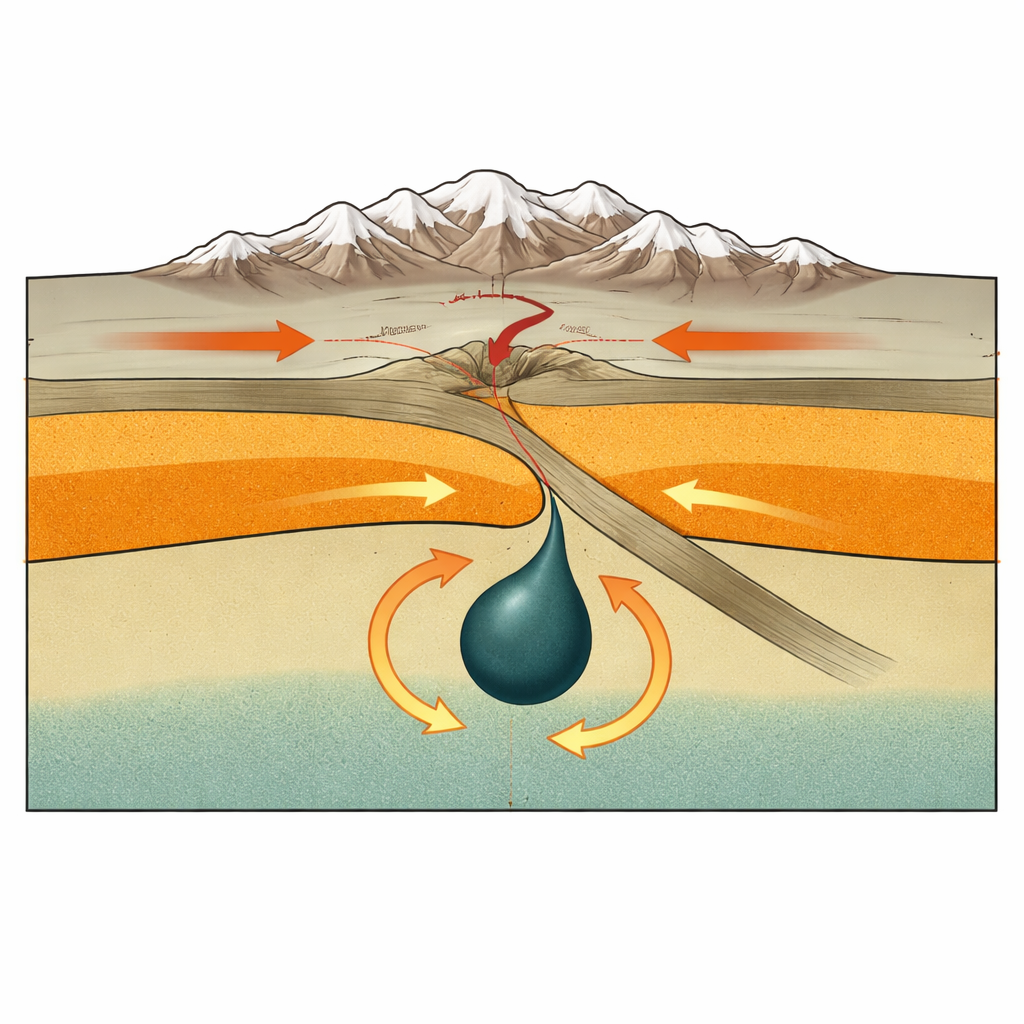
The authors weigh two main possibilities. One is that a major surface fault cuts straight down through the Moho into the mantle, so that slipping along this deep extension produces earthquakes. In southern Tibet, the Dhubri–Chungtang fault and a nearby rift, the Pumqu–Xainza graben, line up with the deep cluster and have similar sideways‑slip motion. However, to make the mantle rocks there break in a brittle way, they would need to be comparatively cool and strong. Using realistic temperatures and measured fault slip rates, the authors build strength–depth profiles and show that the dominant mantle mineral, olivine, should already be too hot and weak for brittle failure much below about 70 kilometers. Even special deformation mechanisms or unusually low friction cannot push mantle earthquakes down to 110 kilometers under typical Himalayan conditions.
A Hidden Layer That Turns Heavy and Falls
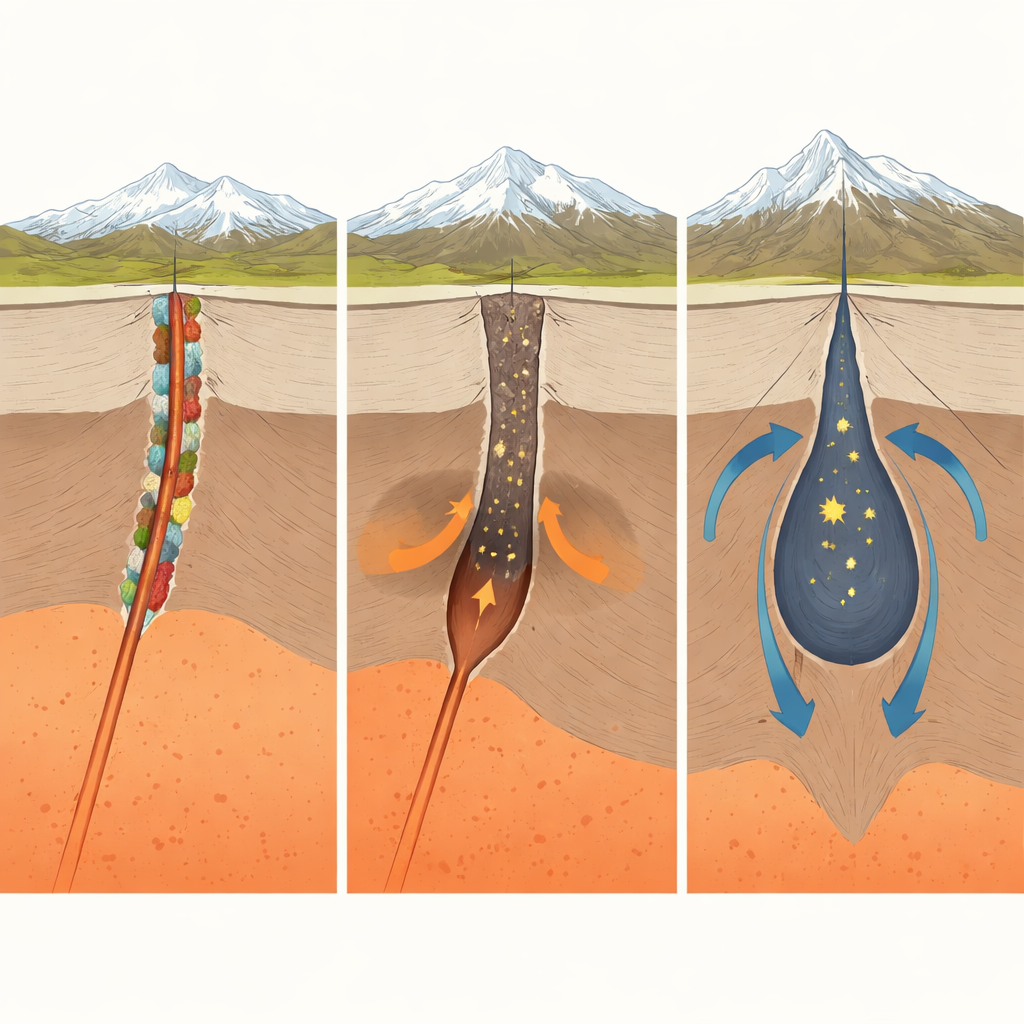
The second idea keeps the action within crustal material, even though it now resides at mantle depths. Seismic studies beneath southern Tibet reveal a layer at the base of the crust that has unusually high wave speeds, consistent with eclogite—a dense rock formed when mafic lower crust is squeezed and transformed at high pressure. Eclogite is not only heavier than the underlying upper mantle; it can also stay strong and brittle at higher temperatures than both its parent crust and the mantle rocks beneath. The authors propose that parts of this eclogite layer have become gravitationally unstable and started to “drip” downward into the mantle, like a dense syrup sinking into a lighter fluid. As this drip stretches and thickens, high internal stresses trigger earthquakes within what is compositionally still crust, but now located well below the Moho.
Testing the Drip Idea With Physics
To see whether such a drip can grow fast enough and still generate earthquakes at ∼110 kilometers depth, the study combines geological timing, plate motion, and computer models of a process called Rayleigh–Taylor instability. India has been sliding beneath Tibet for tens of millions of years, but the lower crust beneath today’s deep quakes could only have entered the right pressure conditions for eclogite formation within the last 5–10 million years. The authors simulate how a dense eclogite layer at the base of the crust would evolve over that time if it has different viscosities (a measure of how stiff it is). They find that for a drip to lengthen by at least 40 kilometers—enough to reach the observed earthquake depths—its viscosity must be relatively modest, on the order of 10²¹ pascal‑seconds, and the surrounding mantle must not be dramatically stronger. Prior delamination or break‑off of deeper Indian lithosphere, imaged by seismic tomography, helps by stirring mantle flow that “tugs” on the eclogite and speeds its descent.
How Surface Faults Help Build a Drip
The drip model alone, however, does not explain why many of the deep earthquakes show sideways (strike‑slip) motion, or why the seismicity is so narrowly focused. Here the authors bring the faults back into the story in a new way. They suggest that crust‑spanning faults act as highways for water and other fluids to reach the deep lower crust. That infiltration speeds up the transformation of mafic rocks into eclogite, rapidly creating the dense patch that will begin to sink. At the same time, these faults impose lateral shear within the growing drip, favoring strike‑slip and normal‑fault earthquakes rather than pure vertical stretching. In this picture, the rare overlap of an active, through‑going fault, a freshly thickened lower crust, and a recently disturbed mantle creates ideal conditions for a localized eclogite drip and the deep, cluster‑like seismicity seen beneath parts of the Himalaya.
What This Means for Our Picture of Continents
For a non‑specialist, the key message is that not all deep continental earthquakes are telling us about the mantle. In the Himalaya, the evidence points to pieces of the lower crust that have transformed into a denser rock, then sunk into the mantle while still able to break in brittle fashion. Crustal‑scale faults do not simply cut the crust; they may help re‑engineer it by feeding fluids downward and triggering this hidden dripping. The result is a dynamic, three‑dimensional view of Earth’s outer shell, where strength and behavior can change sharply over just a few hundred kilometers, rather than following simple layered “jelly‑sandwich” or “crème‑brûlée” recipes.
Citation: Song, X., Klemperer, S.L. Himalayan sub-Moho earthquakes suggest crustal faults trigger eclogitized-drip tectonics. Sci Rep 16, 9101 (2026). https://doi.org/10.1038/s41598-026-39647-5
Keywords: Himalayan earthquakes, lower crust dripping, eclogite, Tibet tectonics, continental lithosphere