Clear Sky Science · en
Evaluating the spatiotemporal skill of bias-corrected NMME forecasts against climatological forecasts for seasonal precipitation in China
Why better rain forecasts matter
From city reservoirs to rice paddies, life in China depends on knowing when the rains will come. Seasonal rainfall forecasts, which look one to three months ahead, can help farmers plan planting, power companies manage hydropower, and governments prepare for floods or droughts. But there is a catch: advanced computer climate models do not always beat a simple rule of thumb based on past average rainfall. This study asks a practical question with big consequences: after modern statistical tuning, do today’s climate models really give more useful seasonal rain forecasts for China than just relying on history?
Two ways to peer into the rainy future
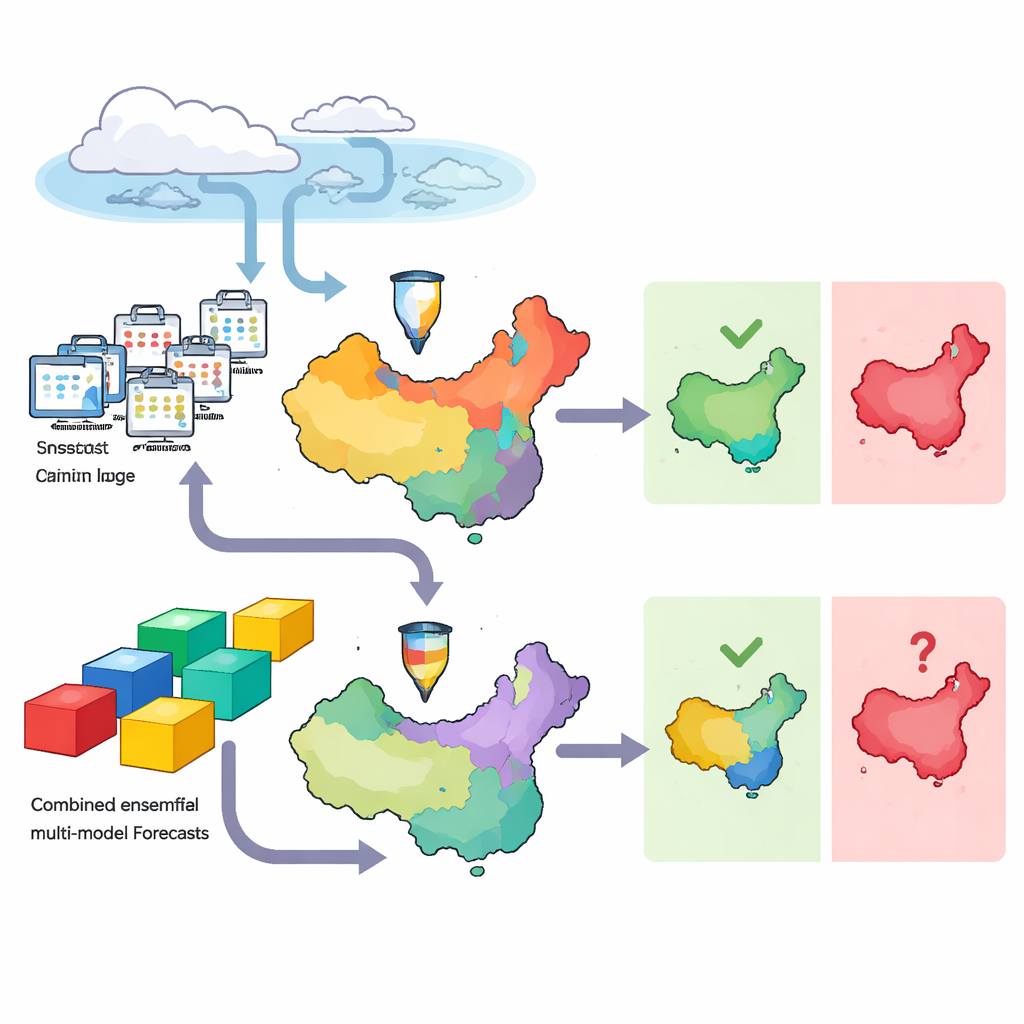
The researchers compare two main forecasting approaches. The first is the traditional “climatological” forecast, which uses decades of past observations to say what rainfall is most typical for a given place and season. The second approach uses global climate models, which simulate how oceans, atmosphere, and land interact to produce future rainfall. These models come from the North American Multi-Model Ensemble, a collection of six forecasting systems. Because raw model output often has strong errors, the team first applies a bias-correction method called a Gamma–Gaussian model to clean up each model’s rainfall estimates, then combines them with a technique known as Bayesian Model Averaging. This creates tuned multi-model forecasts that, in theory, should better match reality.
Testing skill across China’s many climates
China spans frigid plains, humid coasts, arid deserts, and the towering Tibetan Plateau, so no single model performs best everywhere. The authors divide the country into nine broad climate zones and evaluate each model month by month over nearly three decades (1982–2010). For every grid cell on the map, they compare how closely corrected model forecasts match observed seasonal rainfall versus how well simple climatology performs. They examine not only average error but also how trustworthy the forecast ranges are. For each zone and start month, they select whichever model (or model blend) most often beats climatology, building an “optimal” set tailored to China’s varied landscapes.
Where models win, and where history still rules
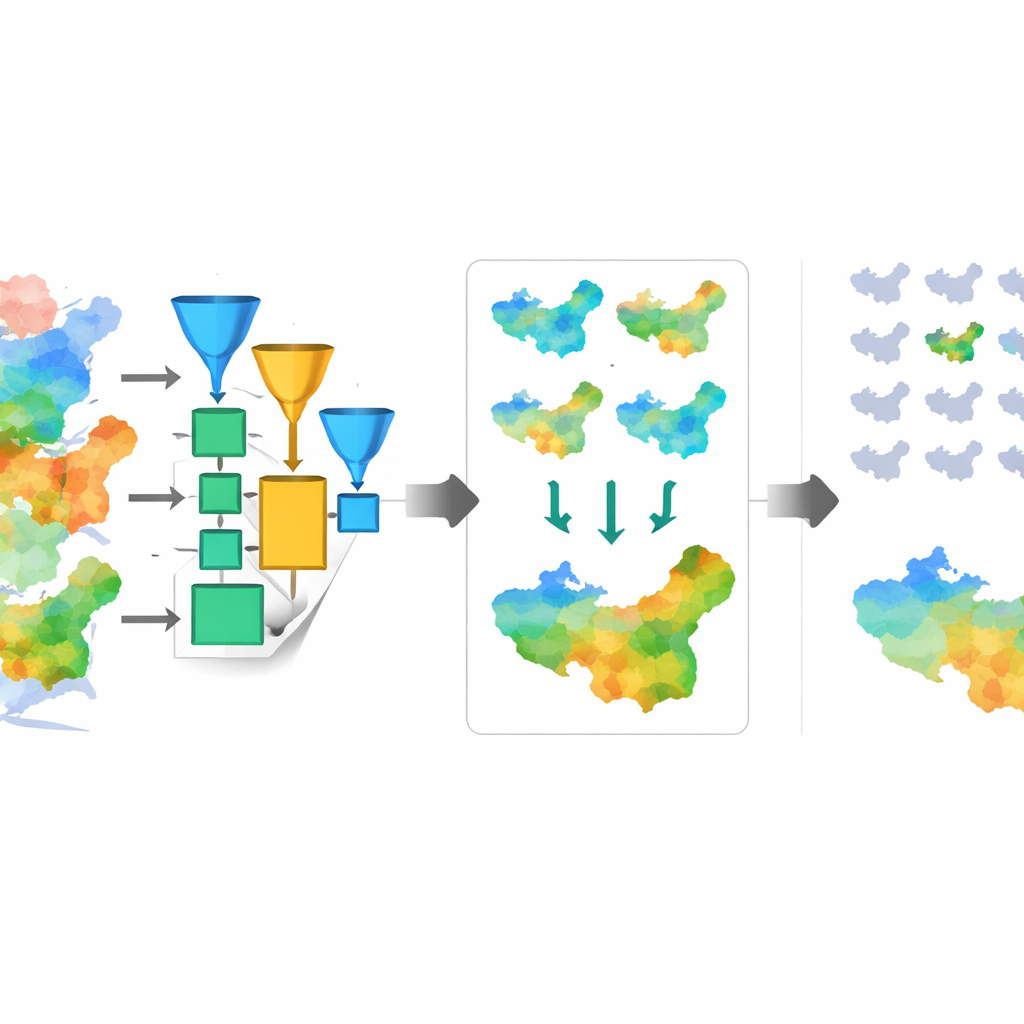
The results paint a mixed picture. For forecasts looking one month ahead, the optimized model set outperforms climatology in about one third of locations across China. As the lead time stretches to two and three months, that advantage shrinks, with only about one quarter and one fifth of locations, respectively, doing better than climatology. Skill is not spread evenly. Coastal and southern regions—especially the northern subtropical belt—benefit most, while the Tibetan Plateau and parts of north-central China see little or no gain over the historical baseline. Season also matters: during the calmer, cooler non-flood months from September to March, nearly half of grid cells show a clear model advantage at one-month lead, but during the turbulent April–August flood season, that share drops to roughly one third or less.
Why season and landscape shape predictability
These patterns reflect how nature itself behaves. In the non-flood season, rainfall is influenced more by large-scale and relatively stable drivers such as ocean temperatures and broad wind patterns, which climate models can track months ahead. During the flood season, China’s rains are steered by the highly variable East Asian summer monsoon and many localized storms, including typhoons and intense thunderstorms, which are much harder to predict at seasonal lead times. Rugged regions like the Tibetan Plateau add another layer of difficulty: steep terrain and complex local weather processes are not fully captured by current models, limiting their added value over simple historical averages.
What this means for using seasonal forecasts
In plain terms, the study shows that carefully tuned climate-model forecasts can outperform traditional history-based forecasts—but not everywhere, not all year, and not very far into the future. Shorter lead times, quieter seasons, and coastal or subtropical zones see the clearest gains, while long lead times, stormy summer months, and mountainous or inland regions remain stubbornly hard to predict. By mapping where and when model forecasts truly add value, the authors offer a practical roadmap: water managers and planners in China can lean more confidently on model-based seasonal forecasts in certain regions and seasons, while treating climatology as a safer guide where models still struggle.
Citation: Yu, B., Cong, H., Xu, B. et al. Evaluating the spatiotemporal skill of bias-corrected NMME forecasts against climatological forecasts for seasonal precipitation in China. Sci Rep 16, 8010 (2026). https://doi.org/10.1038/s41598-026-39636-8
Keywords: seasonal rainfall, climate forecasting, China monsoon, bias correction, hydrology