Clear Sky Science · en
Sedimentary environment evolution and organic matter enrichment mechanisms of the cambrian Qiongzhusi Formation in the southwestern Yangtze Block
Ancient Seas and Modern Energy
The rocks of southwest China hold a double secret: they capture a turning point in Earth’s early oceans and, at the same time, store large volumes of shale gas. This study looks at a thick package of dark Cambrian mudrocks called the Qiongzhusi Formation, deposited over 500 million years ago along the margin of the Yangtze Block. By decoding the minerals and chemical fingerprints locked in these rocks, the authors show how shifts in climate, underwater geography, and seafloor chemistry worked together to bury and preserve organic matter — the raw material of today’s shale gas resources.
A Layered Story Beneath the Seafloor
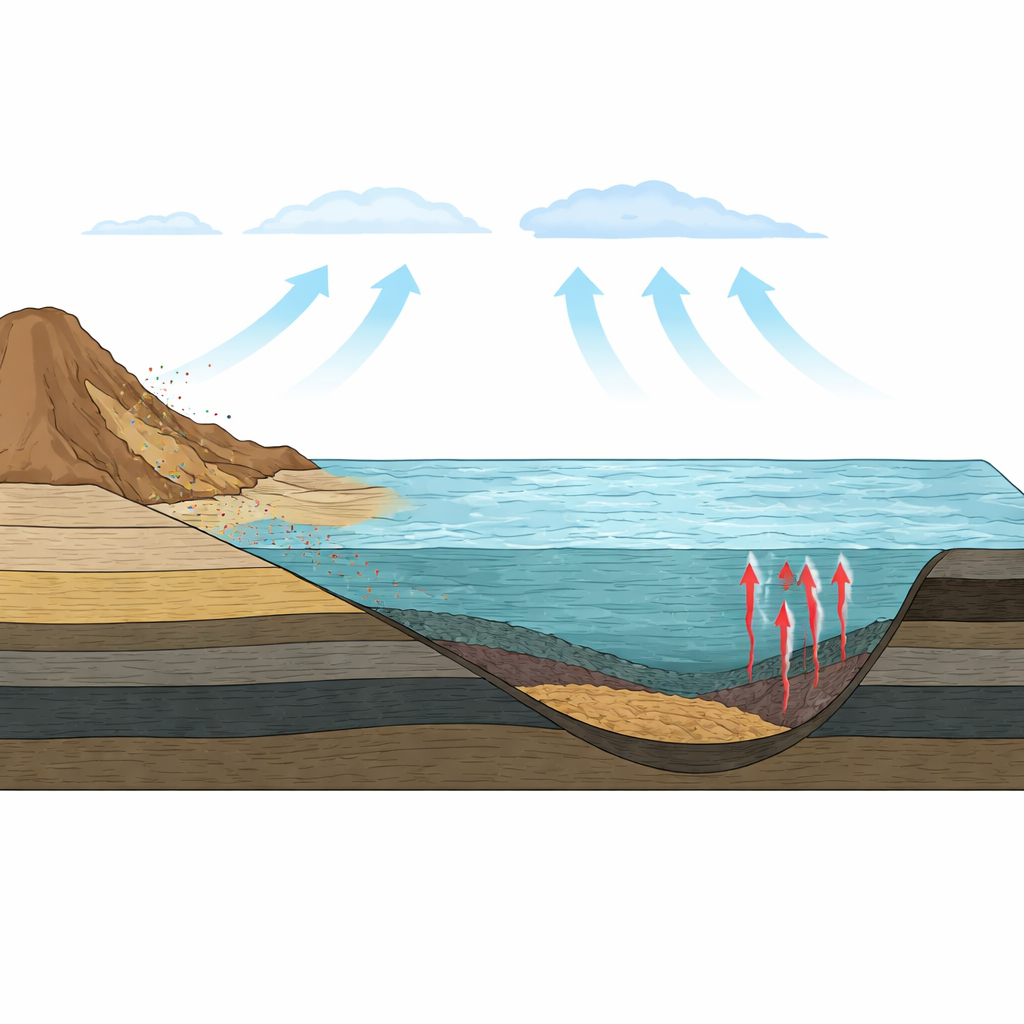
The Qiongzhusi Formation formed in an ancient inland sea that deepened from west to east. Near an old landmass in the west, rivers carried sand and mud into shallow waters. Farther offshore, a deep trough and an open shelf accumulated finer muds and black shales. The team studied outcrops and drill cores from three key areas along this west–east transect, measuring minerals, organic carbon, and a suite of major, trace, and rare-earth elements. These data reveal that the formation can be split into two main parts: an older, darker lower member (Q1), rich in organic matter, and a younger upper member (Q2), dominated by lighter, more oxygen-exposed mudstones with much lower organic content.
Climate Change and Fiery Seafloor Inputs
Chemical indices based on aluminum, sodium, potassium, and other elements show that the landscape feeding sediment to the sea shifted from relatively cold and dry conditions to a warmer, more humid climate over time. This enhanced chemical weathering on land, steadily increasing the delivery of fine material and nutrients to the basin. At the same time, the geochemical fingerprints of iron, titanium, and europium reveal that parts of the basin — especially the eastern slope and shelf — were affected by submarine hydrothermal activity during the early, Q1 stage. These warm, mineral-rich fluids did not simply add ash and silica; they also injected nutrients such as phosphorus, which can boost biological productivity in surface waters when brought upward by upwelling currents.
Oxygen, Water Circulation, and Buried Carbon
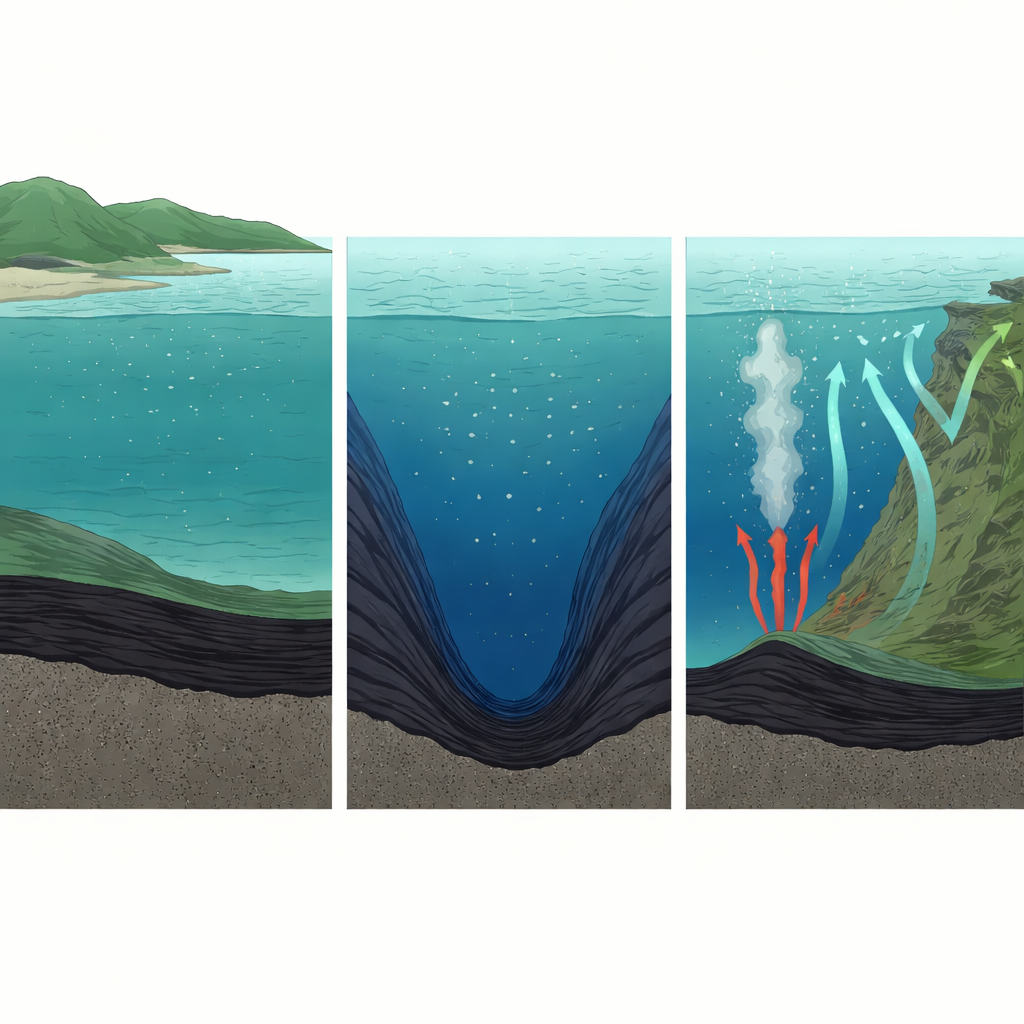
Whether organic matter survives burial depends strongly on how much oxygen is present in bottom waters and how well the basin exchanges with the open ocean. Ratios and enrichment factors of elements like uranium and molybdenum show that, during Q1, the western margin was a strongly restricted pocket of the sea with poorly ventilated, oxygen-poor bottom waters. The central trough and eastern shelf were generally less restricted, but still largely anoxic, with the far east occasionally crossing into sulfidic conditions — where dissolved sulfide is abundant. By Q2, sea level had fallen and the basin had filled in. Water became shallower and better mixed, with oxygenated conditions dominating and only brief, local returns to low-oxygen states in the deepest parts of the trough. This shift is mirrored by a sharp drop in total organic carbon across the region.
Different Paths to Rich Organic Layers
The authors compare organic carbon to multiple “productivity” and “preservation” indicators to work out why some zones became especially rich in organic matter. In the western, land-proximal area, organic content tracks redox indicators more than productivity proxies, suggesting a “preservation” mode: modest biological production, but excellent survival of what was produced thanks to stagnant, oxygen-poor bottom waters. In the eastern slope and shelf, by contrast, high organic carbon correlates best with signs of nutrient input and hydrothermal influence. Here, a “productivity” mode dominates: strong upwelling and seafloor vents fed blooms of microscopic life, whose remains sank and consumed oxygen as they decayed, creating and maintaining low-oxygen conditions. The central trough combines both influences — relatively deep water, sustained but not extreme nutrient input, and long-lived anoxia — yielding some of the thickest and highest-quality organic-rich shales.
From Ancient Seas to Today’s Shale Gas
Overall, the study shows that the most promising shale gas targets formed where productivity and preservation aligned: in deep, partially restricted parts of the basin during the early, transgressive Q1 stage, especially within and around the central trough and hydrothermally influenced eastern slope. Later, as the sea shallowed and oxygen returned in Q2, organic matter accumulation waned and the rocks became much poorer in carbon. For non-specialists, the message is straightforward: by reading subtle chemical clues in very old mudrocks, geoscientists can reconstruct how ancient seas breathed, circulated, and fed microscopic life — and this, in turn, explains why some layers became rich natural gas reservoirs while others remained ordinary mudstone.
Citation: Luo, J., Zhang, T., Min, H. et al. Sedimentary environment evolution and organic matter enrichment mechanisms of the cambrian Qiongzhusi Formation in the southwestern Yangtze Block. Sci Rep 16, 9294 (2026). https://doi.org/10.1038/s41598-026-39633-x
Keywords: Cambrian black shale, organic matter enrichment, paleoenvironment, hydrothermal upwelling, shale gas exploration