Clear Sky Science · en
Optimizing solar and wind forecasting with iHow optimization algorithm and multi-scale attention networks
Why better energy forecasts matter
As more homes and cities draw their electricity from the sun and wind, keeping the lights on becomes a forecasting challenge. Solar panels and wind turbines produce clean power, but their output swings with every passing cloud and gust. This paper explores a new way to predict those swings more accurately and efficiently, helping grid operators balance supply and demand, reduce reliance on fossil-fuel backups, and plan maintenance before problems cause blackouts.
The problem with guessing tomorrow’s sunshine and wind
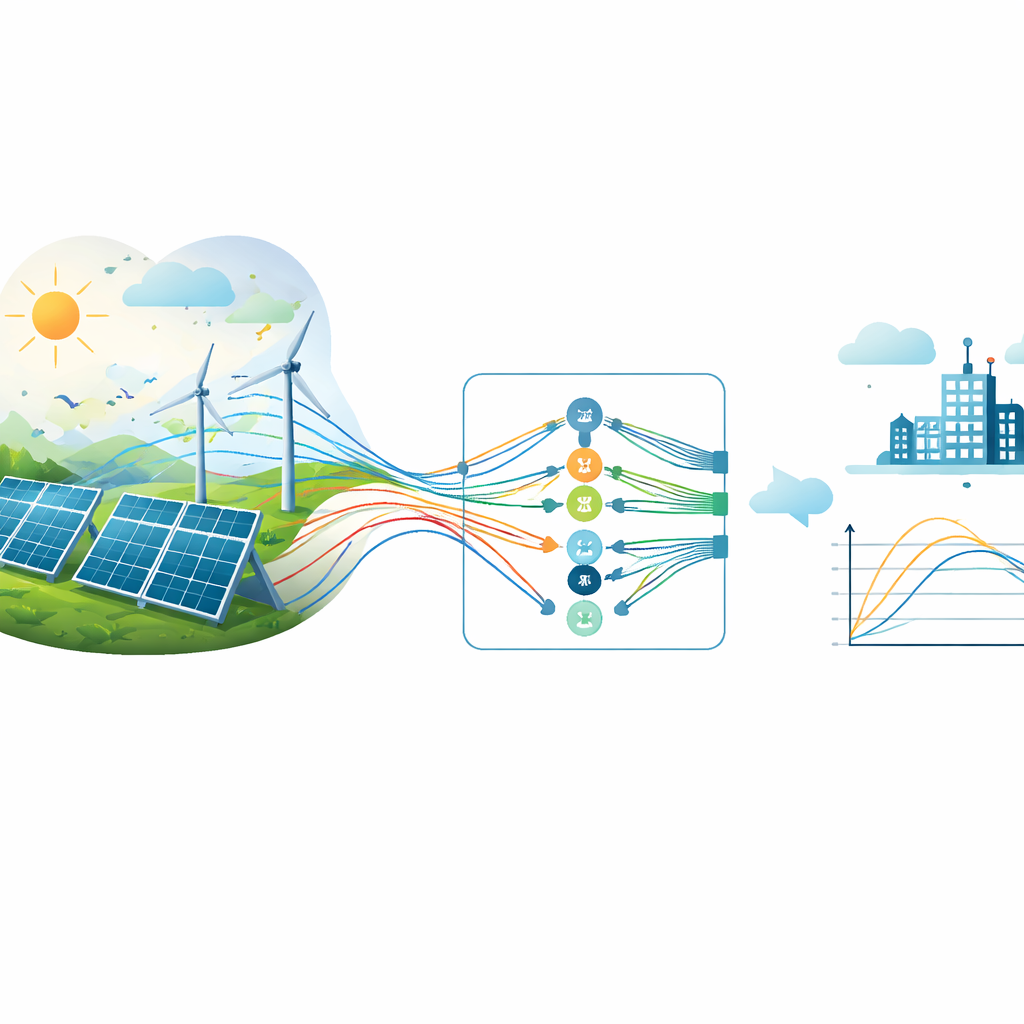
Modern solar and wind farms are packed with sensors that log weather, power output, and operating conditions hour by hour. While this rich data can in theory feed very accurate predictions, in practice it overwhelms many computer models. Too many overlapping measurements make learning slow and error‑prone, and fine‑tuning the many settings of deep learning networks is often a time‑consuming art. Existing approaches tend to treat “which inputs to use” and “how to configure the model” as separate steps, and many optimization tricks get stuck in sub‑optimal solutions when the search space is large and tangled.
A smarter brain for solar and wind prediction
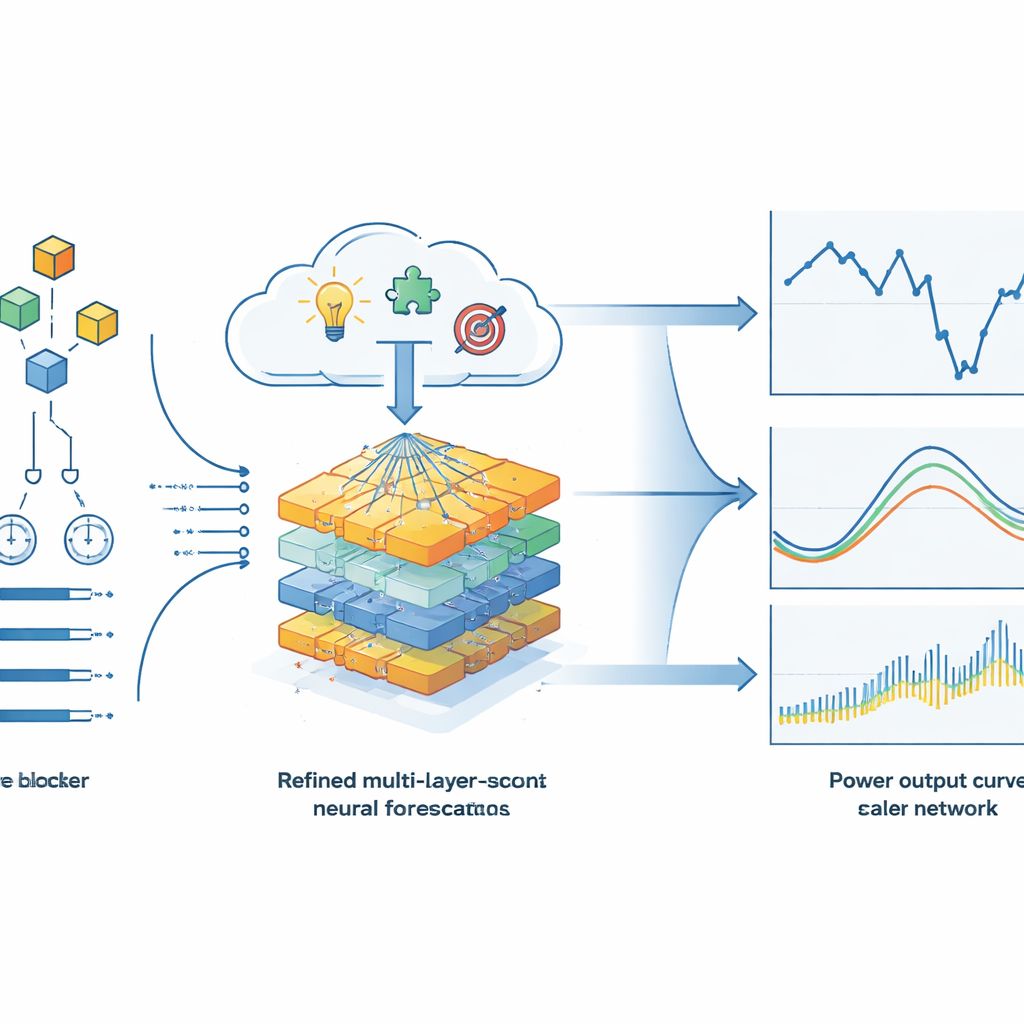
The authors build their framework around a Multi‑Scale Attention Network, a deep learning model designed to look at power data over several time horizons at once—capturing quick fluctuations, daily cycles and longer seasonal patterns in parallel. Attention mechanisms inside the network help it focus on the most relevant moments in the past when making a forecast. On its own, this architecture already beats popular alternatives such as long short‑term memory networks, gated recurrent units, adversarial time‑series models, and residual networks on both wind and solar datasets from the French national grid.
Learning like a human to prune and tune
To further improve performance, the team employs a human‑inspired optimization algorithm called iHOW. Instead of mimicking animals or physical processes, iHOW borrows ideas from how people learn: first absorbing raw information, then processing it, building knowledge, and finally applying expertise. In its binary form, biHOW, the algorithm acts as an automatic editor of the input space, selecting compact sets of the most informative features from dozens of time stamps, calendar tags, and production records. In its continuous form, iHOW adjusts the deep network’s critical settings—such as layer counts, attention heads, and dropout strengths—so that training is both stable and efficient.
What the experiments reveal
Using several years of hourly French solar and wind production, the researchers carefully clean and restructure the data, engineer helpful indicators such as rolling averages and solar‑to‑wind ratios, and then compare many learning strategies under identical conditions. Before optimization, the multi‑scale attention model already delivers smaller errors and stronger correlation with actual power than its rivals. After biHOW trims away redundant inputs, all models improve, but the attention network benefits the most. Finally, when iHOW is used to fine‑tune its training settings, the forecasting errors fall by several orders of magnitude, and the model’s ability to explain variations in power approaches perfection, clearly outperforming a suite of well‑known optimization schemes including particle swarms, grey wolves, hawks, whales and others.
Implications for future smart grids
To a lay observer, the key message is that a well‑designed combination of a capable forecasting engine and a “learning to learn” optimizer can turn messy streams of weather and power data into remarkably precise predictions. By automatically deciding which signals matter and how the model should be configured, the proposed framework achieves both higher accuracy and lower computational cost. This kind of intelligent forecasting could help future smart grids rely more confidently on wind and solar, schedule maintenance before failures occur, and eventually support real‑time control systems that keep clean electricity flowing even as the weather constantly changes.
Citation: Radwan, M., Ibrahim, A., Abdelsalam, M.M. et al. Optimizing solar and wind forecasting with iHow optimization algorithm and multi-scale attention networks. Sci Rep 16, 8597 (2026). https://doi.org/10.1038/s41598-026-39632-y
Keywords: renewable energy forecasting, solar power prediction, wind power prediction, deep learning optimization, smart grid management