Clear Sky Science · en
SPACE: A novel digital tool for assessing hippocampal structural integrity in older adults
Why finding your way matters for brain health
Getting lost more easily is a common worry as people grow older, and it can sometimes be an early sign of diseases that affect memory, such as Alzheimer’s. Doctors usually rely on short paper-and-pencil tests to check thinking skills, but these tools only lightly touch on our sense of direction. This study introduces a tablet-based game called the Spatial Performance Assessment for Cognitive Evaluation (SPACE), designed to test navigation abilities in a rich virtual world. The researchers asked whether performance in SPACE reflects the health of a key brain structure for memory and navigation—the hippocampus—better than traditional cognitive tests do.
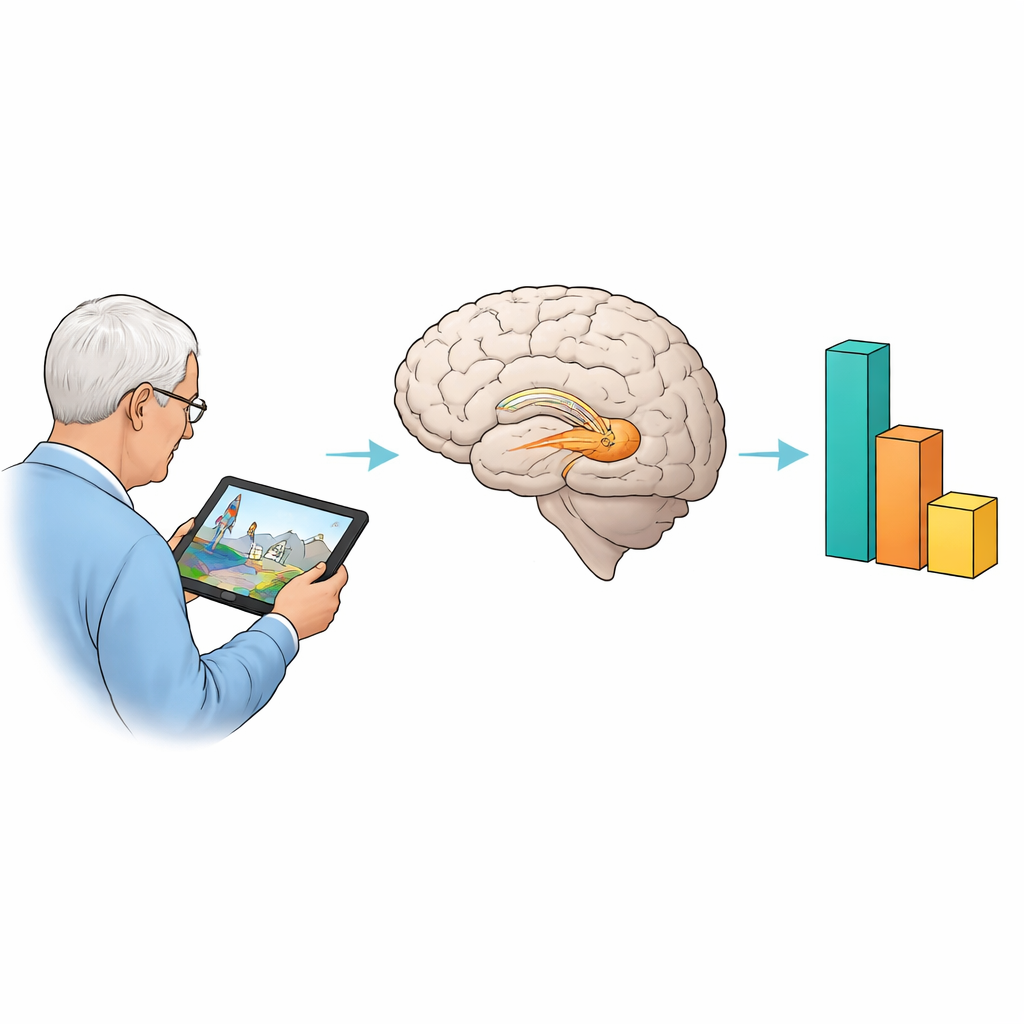
A tablet journey through an imaginary landscape
SPACE runs on an iPad and places players in a colorful virtual environment where they move around using simple touch controls. The experience starts with a training phase to help users practice turning, moving forward, and combining these movements comfortably. The core tasks then ask players to follow a robot from a rocket to different landmarks, such as trees or waterfalls, and later find their way back, point toward remembered locations, or rebuild the layout of the landmarks on a map. All of this is done in a game-like setting specifically designed to be accessible for older adults with little technology experience.
How navigation skills connect to the brain
The hippocampus, buried deep within the brain’s temporal lobes, is crucial for forming memories of places and routes. It shrinks noticeably in Alzheimer’s disease and also slowly with normal aging. The team recruited forty healthy older men, aged 55 to 79, who filled out health and lifestyle questionnaires, completed standard cognitive tests, played through the SPACE tasks, and then underwent a brain scan using magnetic resonance imaging. The scans were analyzed to measure the size of each participant’s left and right hippocampus, while statistical models took into account age and years of education.
Path following and map building as sensitive signals
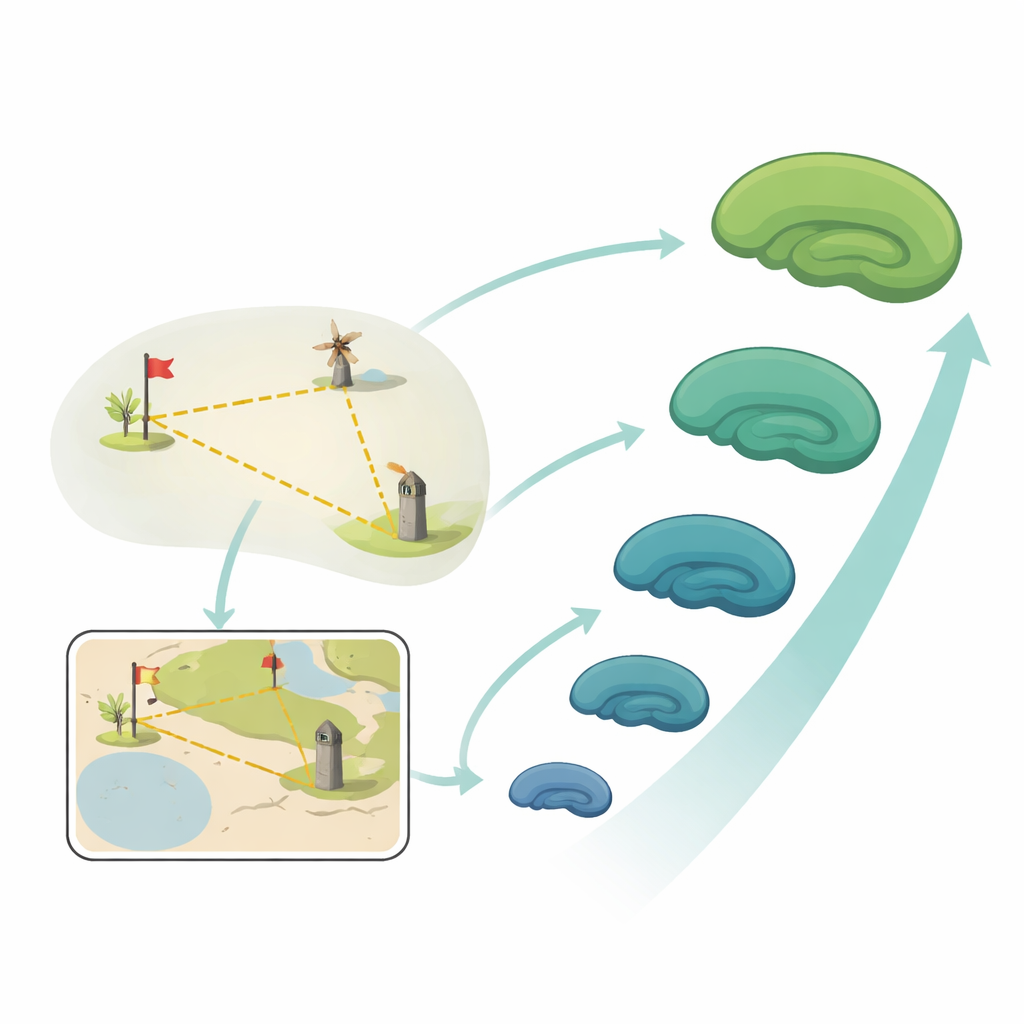
Among all the traditional tests, only a few small parts of a standard screening exam, the Montreal Cognitive Assessment, showed any link to hippocampal size, and the broader paper-and-pencil battery was not very informative. In contrast, performance on two SPACE tasks—path integration and mapping—stood out. Path integration measured how accurately players could return to the rocket after being guided along two legs of a triangle, relying on their sense of distance and direction. Mapping asked them to recreate the layout of the landmarks they had visited by dragging icons on a top-down map. People who were both good at finding their way back and at reconstructing the landmark layout tended to have larger hippocampi.
Looking inside the process, not just the score
The researchers went beyond looking at each task separately. They created a combined measure that captured how well a person encoded the environment during movement and then reused that information when building the map. This joint score explained a substantial portion of the differences in hippocampal volume, even after accounting for age, education, and the best-performing traditional test scores. Interestingly, some tasks that might seem similar on the surface—such as pointing to landmarks while still standing in front of them, or judging directions from a map that was supplied on-screen—did not relate clearly to hippocampal size. These activities can often be solved using simpler strategies that do not rely as heavily on the brain’s internal map-building systems.
What this means for everyday brain checks
The study suggests that carefully designed navigation games like SPACE can reveal subtle changes in the brain’s navigation machinery that ordinary clinic tests may miss, even in older adults who are not yet showing obvious memory problems. By focusing on how people explore, remember, and reconstruct a virtual environment, SPACE seems to tap directly into processes supported by the hippocampus. In the long run, tools of this kind could become low-cost, non-invasive additions to routine check-ups, helping doctors identify early changes in brain structure and monitor who might benefit most from closer follow-up or preventive strategies. Larger and more diverse studies will be needed, but this work offers a promising glimpse of how digital navigation tests might strengthen future brain health screening.
Citation: Minta, K., Colombo, G., Tee, M. et al. SPACE: A novel digital tool for assessing hippocampal structural integrity in older adults. Sci Rep 16, 8587 (2026). https://doi.org/10.1038/s41598-026-39628-8
Keywords: spatial navigation, hippocampus, digital cognitive assessment, aging brain, Alzheimer’s disease