Clear Sky Science · en
An innovative power converter based technique for on-site photovoltaic I-V characterization under natural irradiance
Measuring How Solar Panels Really Behave
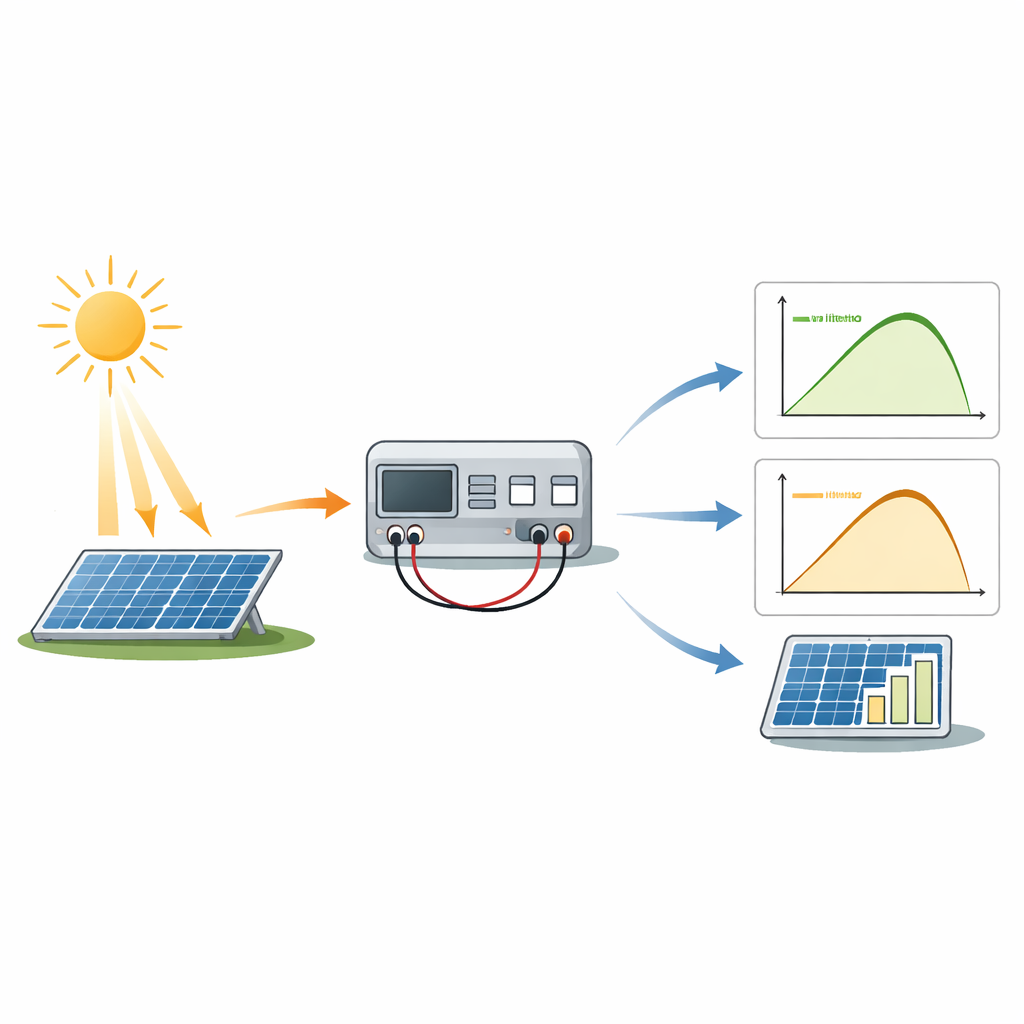
Solar panels are often sold with neat numbers on a label—how many watts they can deliver under “standard” test conditions. But real roofs and fields are rarely standard. Sunlight and temperature change minute by minute, and panels slowly age. This study presents a low-cost, stand‑alone tool that can test a solar panel outdoors in real time, revealing how it truly performs and how its health evolves over the years.
Why Knowing the Full Power Curve Matters
A solar panel does not produce a single, fixed amount of power. Instead, for every level of sunlight and temperature, it follows a curved relationship between voltage, current and power. From these “I–V” and “P–V” curves, engineers can find the point where the panel delivers maximum power and can detect losses or damage. Commercial instruments that trace these curves exist, but they are costly and usually confined to laboratories, which makes it difficult for smaller projects, field technicians or educators to access high‑quality measurements under real outdoor conditions.
Turning a Power Converter into a Smart Tester
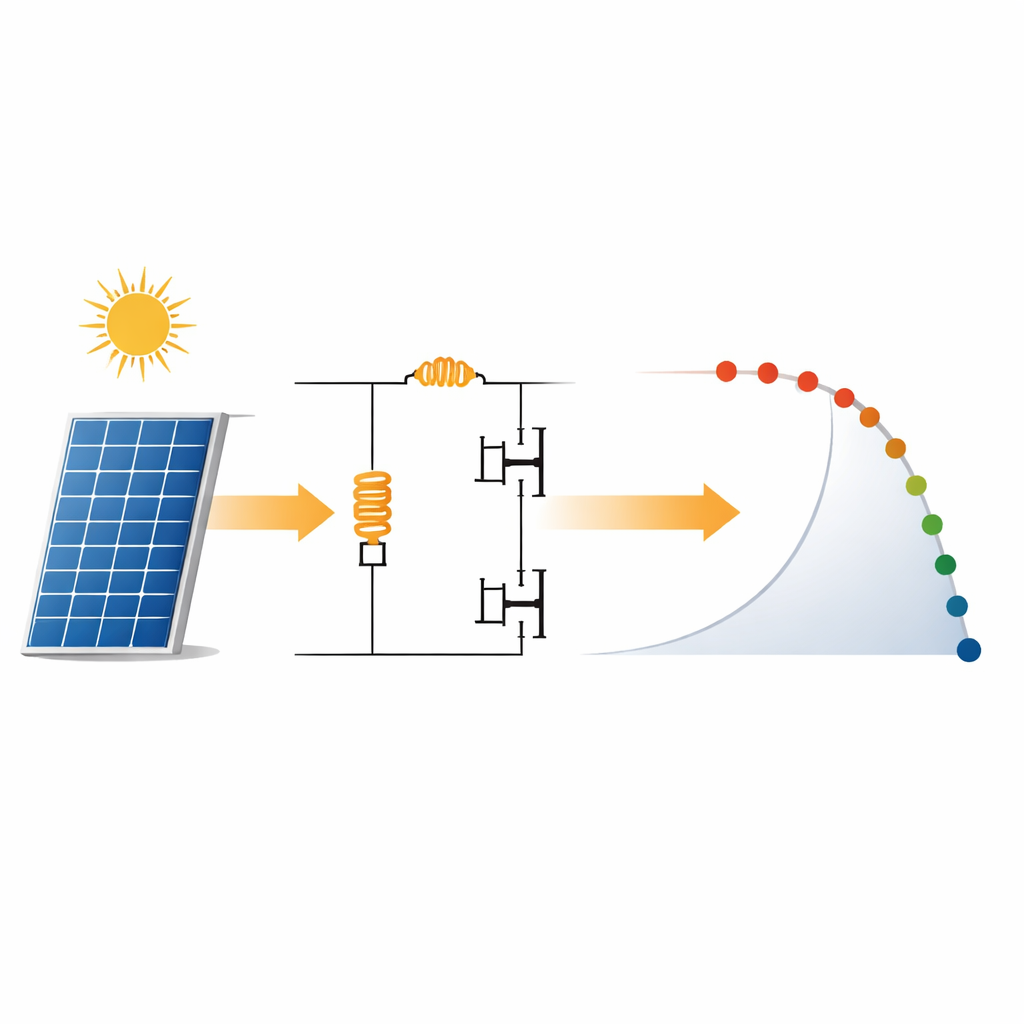
The authors built a compact electronic system that doubles as a power converter and a smart testing tool. At its heart is a synchronous boost converter, a type of circuit that can make the panel “see” different electrical loads simply by changing a control signal. An inexpensive microcontroller adjusts this signal step by step, forcing the panel to sweep through a wide range of operating points—from nearly short‑circuited to nearly open‑circuited—within a few seconds. At each step, the system records the panel’s voltage and current, along with sunlight level and temperature measured by dedicated sensors.
Reading the Hidden Fingerprints of a Panel
Collecting curves is only half the story; the other half is interpreting them. The researchers use a well‑established mathematical description of a solar panel that depends on five key electrical parameters related to how the cells generate current, lose energy as heat, and leak current through defects. A computer receives thousands of measured points from many different weather conditions and runs an iterative fitting routine that adjusts those five parameters until the model’s curves align with the measured ones. Because the method explicitly incorporates real sunlight and temperature in its equations, it avoids a common shortcut—assuming ideal “standard” conditions that are almost never met in practice.
Testing Under Real Sunlight
To prove the idea, the team installed a 30‑watt panel on a rooftop in Oujda and let the system run from early morning to early afternoon on a clear day. Every five minutes the converter swept the panel, building up 55 complete sets of curves that captured more than 5000 operating points under a broad range of sunlight and temperature. When the fitted model was used to reconstruct the curves, the match with the measurements was striking: the biggest current difference was only about forty thousandths of an ampere, and summary error measures stayed low across most conditions. The researchers then used their extracted parameters to predict how the panel should behave under the official reference conditions and compared this to the manufacturer’s data sheet.
What the Results Reveal About Panel Health
The reconstructed “standard condition” curve predicted a maximum power of about 27 watts, slightly below the label value of 30 watts. The open‑circuit voltage and short‑circuit current were also close but not identical to the catalog numbers. Because the measurements were made on an older panel that had been in service for several years, this shortfall likely reflects natural aging rather than flaws in the method. In other words, the panel may have quietly lost roughly ten percent of its original punch—something that ordinary meters would struggle to quantify.
Practical Uses and Future Directions
By combining an affordable power converter, simple sensors and smart data analysis, this work delivers a practical field tool for characterizing solar panels under everyday conditions. It can help installers verify performance after installation, researchers monitor long‑term degradation, and educators give students hands‑on insight into how sunlight and temperature shape solar output. The authors suggest that future versions could be extended to newer kinds of panels and more complex situations, such as partial shading, and might even feed data to cloud platforms for large‑scale monitoring and predictive maintenance.
Citation: Rhiat, M., Latrache, F., Melhaoui, M. et al. An innovative power converter based technique for on-site photovoltaic I-V characterization under natural irradiance. Sci Rep 16, 7902 (2026). https://doi.org/10.1038/s41598-026-39626-w
Keywords: solar photovoltaics, PV performance testing, power converters, field diagnostics, renewable energy monitoring