Clear Sky Science · en
Parametric anti-phase excitation of resonant MEMS mirrors for fast start-up
Faster tiny mirrors for everyday tech
Many modern gadgets—from augmented reality glasses to car-mounted laser scanners—rely on tiny moving mirrors to sweep laser beams back and forth. These mirrors must start up quickly and reliably every time a device is switched on. This paper presents a new way to drive such miniature mirrors so they begin oscillating much faster, making future displays and sensors more responsive and robust.
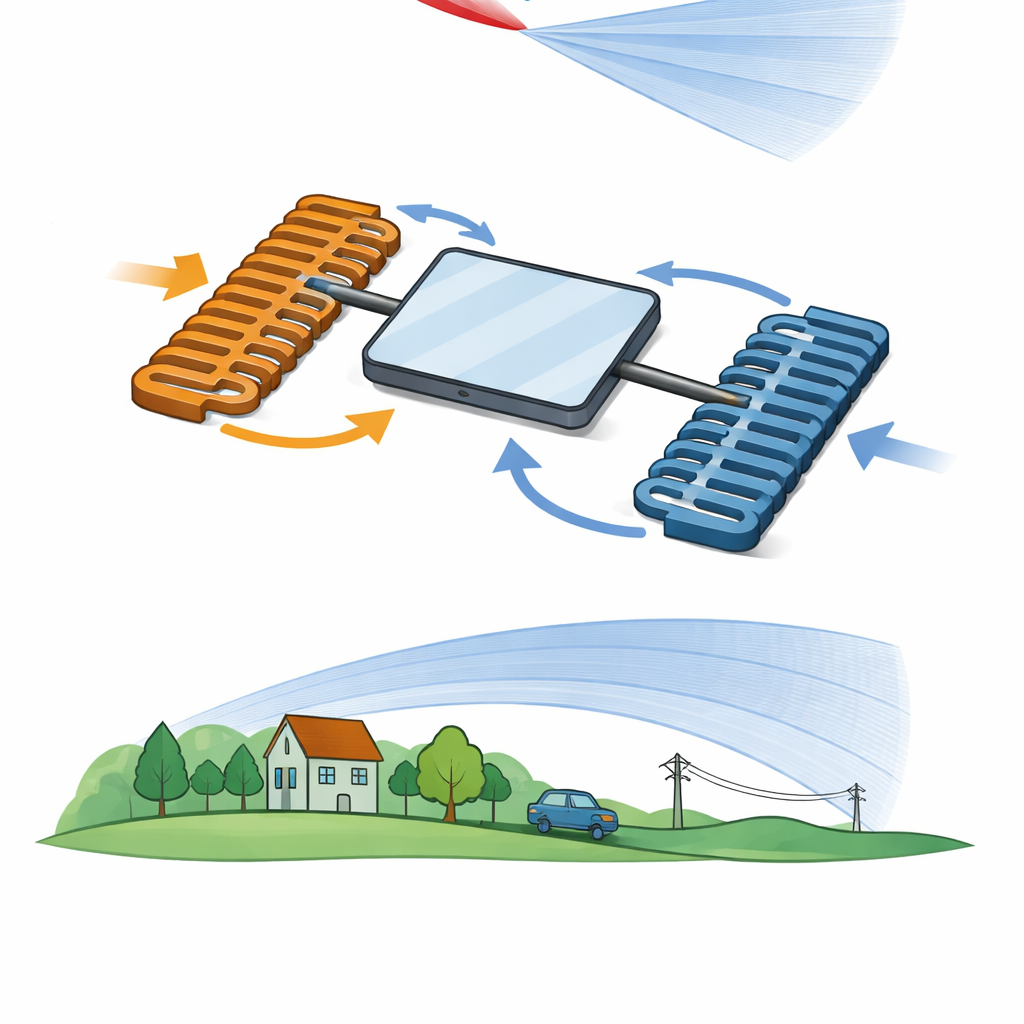
How tiny moving mirrors steer light
The study focuses on micro-electromechanical systems (MEMS) mirrors, millimeter-scale mirrors that pivot back and forth to scan a laser beam. They are attractive for applications like LiDAR, projection displays for augmented reality, and medical imaging because they can swing at very high speeds with low power consumption and little wear. The mirror used here is mounted on slender torsion bars and leaf springs, and is driven by interlocking comb-shaped electrodes on its left and right sides. When a voltage is applied, electrostatic forces twist the mirror, causing it to oscillate at a natural resonant frequency.
Two ways to push the mirror
Traditionally, both comb drives on either side of the mirror are powered by the same square-wave voltage, a method known as in-phase excitation. This approach is easy to generate electronically, but it has drawbacks: from a standstill, the mirror often needs a favorable combination of small imperfections, vibrations, and exact frequency tuning before it starts moving significantly. As a result, the start-up time can be long and unpredictable. The authors propose an alternative, called anti-phase excitation, in which the left and right comb drives are powered in alternation: when one side pulls, the other rests, and they swap roles every half-oscillation. This alternating scheme injects energy more directly from the very first motion, regardless of subtle manufacturing variations.
From complex math to practical insight
To understand and optimize this behavior, the researchers built a detailed mathematical model of the mirror. They described how the electrostatic torque and the driving voltages vary with angle and time using compact Fourier series, then separated the rapid vibration from the slow growth of the oscillation’s amplitude and phase. This produced a simplified “slow-flow” description that predicts how the mirror builds up motion under different drive patterns. By examining how energy is injected by the comb drives and lost to damping in each cycle, they could see why anti-phase driving reliably pushes the mirror away from rest, while in-phase driving leaves the zero-amplitude state as a delicate, hard-to-escape equilibrium.
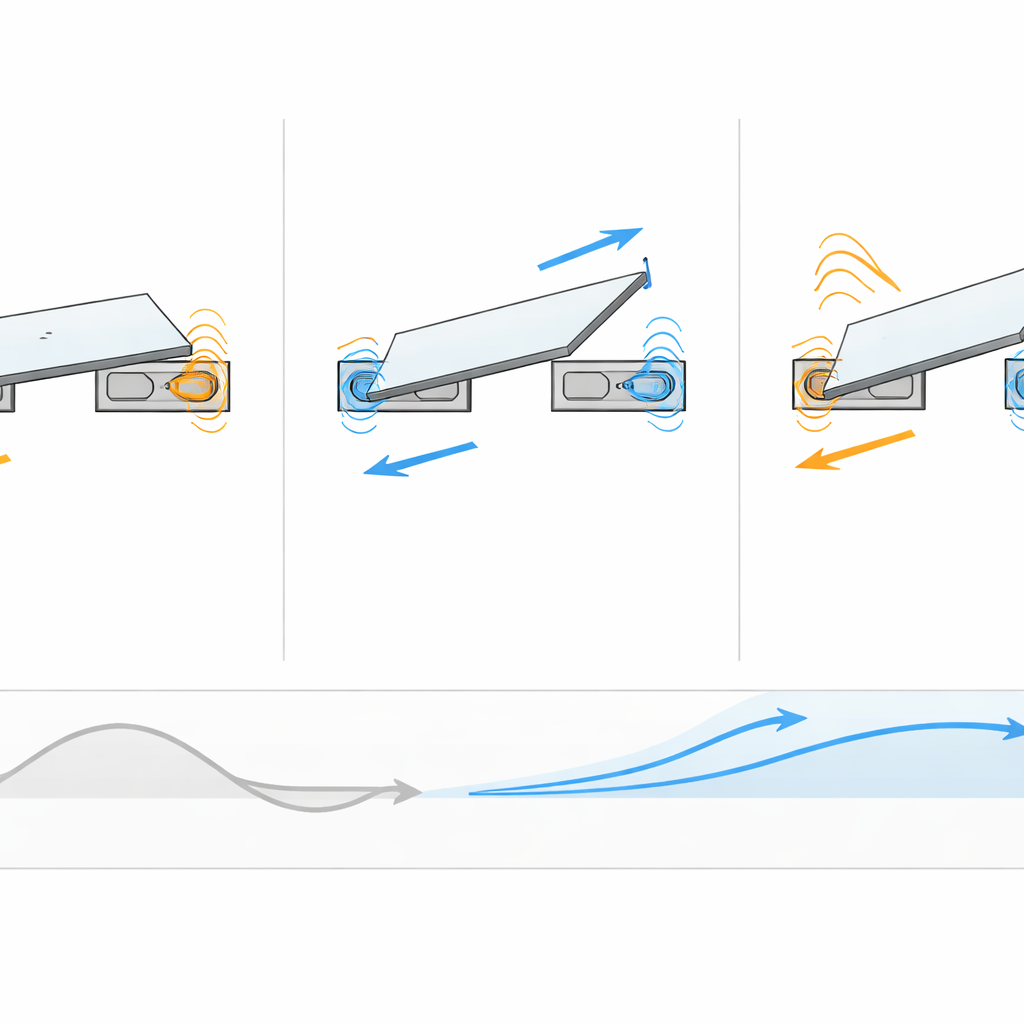
What experiments reveal about start-up
The team tested their theory on a high-quality MEMS mirror designed for laser displays. Measurements of the response curves—how oscillation amplitude depends on drive frequency—matched the model closely for both in-phase and anti-phase modes. When they compared start-up behavior, the difference was striking. With conventional in-phase drive, the mirror could take hundreds of milliseconds to reach its first large swing, and the time varied widely depending on external vibrations and tiny initial offsets. Under anti-phase drive, the mirror began oscillating strongly and predictably almost immediately, across a wide range of frequencies and duty cycles. Depending on the operating conditions, start-up time improved by a factor of 8 to 50.
Combining speed and strength
Although in-phase driving can ultimately achieve larger scan angles—useful for wide field-of-view displays or sensors—anti-phase driving clearly excels at getting the mirror moving quickly and consistently. The authors show that, with their model in hand, it is possible to switch smoothly from anti-phase to in-phase operation while the mirror is running. By choosing a point where both modes yield similar amplitude and adjusting the timing of the drive signals, they demonstrate a transition that barely disturbs the mirror’s motion. This opens the door to smart driving schemes that start fast in anti-phase, then switch to in-phase for maximum scanning range.
Why this matters for future devices
For a lay reader, the key takeaway is that the way we “push” a tiny mirror can make a big difference to how quickly and reliably it starts moving. By alternating the drive between the left and right sides, engineers can dramatically shorten the time it takes for scanning mirrors to reach useful amplitudes, without adding extra hardware. The flexible mathematical framework introduced here also applies to other tiny resonant devices, suggesting that similar tricks could speed up and stabilize a range of sensors and oscillators in next-generation electronics, vehicles, and medical instruments.
Citation: Reier, F., Yoo, H.W., Brunner, D. et al. Parametric anti-phase excitation of resonant MEMS mirrors for fast start-up. Sci Rep 16, 8555 (2026). https://doi.org/10.1038/s41598-026-39623-z
Keywords: MEMS mirrors, laser scanning, parametric excitation, anti-phase drive, fast start-up