Clear Sky Science · en
Efficiency of floating treatment wetlands planted with Iris pseudacorus and Glyceria maxima
Cleaning Water with Floating Gardens
Across the world, communities are searching for affordable, low-energy ways to clean up polluted water. This study explores one such approach that looks almost like a floating garden: small rafts covered with wetland plants that drift on the surface of wastewater ponds. The researchers asked a practical question with big implications for towns and farms alike: how well can these floating plant islands strip excess nutrients and organic pollution from treated sewage, and does the plant species growing on them really matter? 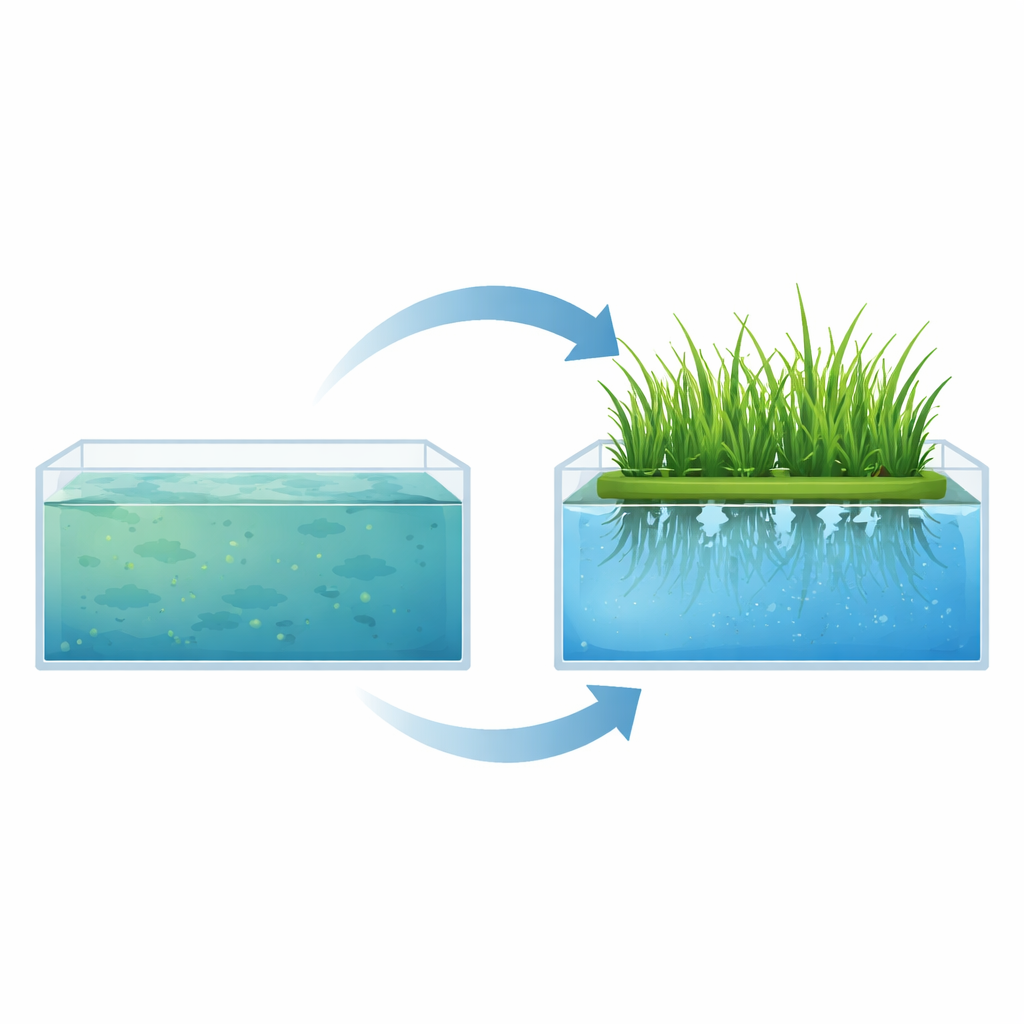
Why Floating Islands Matter for Everyday Water
Rising water demand and declining water quality mean that many treatment plants need an extra “polishing” step after standard processes. When wastewater still carries too much nitrogen and phosphorus, these nutrients can feed harmful algal blooms and cause fish kills downstream. Floating treatment wetlands offer a nature-based option: instead of relying on steel tanks and high energy use, they use plant roots and helpful microbes to soak up and transform pollutants. These systems are especially attractive as a final, or tertiary, treatment step for small towns, farms, and industrial ponds because they can be added to existing basins without major rebuilding.
Testing Miniature Wetlands Indoors
To see how well floating islands work under controlled conditions, the team set up six indoor tanks filled with already-treated municipal wastewater. Two tanks had no plants and served as controls. The others held rafts built from plastic pipes and coconut mats, planted with one of two common wetland species: yellow flag iris (Iris pseudacorus) and reed sweet-grass (Glyceria maxima). The scientists ran two back-to-back experiments: a 35-day phase while the plants and their root zones were still developing, and a 21-day phase after the root systems and microbial films were more fully established. Throughout, they tracked key indicators such as nitrogen and phosphorus levels, organic carbon, dissolved oxygen, acidity (pH), and the water’s redox state, which together reveal how actively biological processes are cleaning the water.
How the Floating Roots Changed the Water
The presence of floating wetlands clearly changed what was happening in the tanks. Compared with bare-water controls, planted systems showed very different oxygen, pH, and redox patterns, signaling that microbial communities on the roots were hard at work. In the control tanks, algae thrived, driving up oxygen and pH and converting some nitrogen, but also leaving high levels of nitrate behind. In contrast, tanks with plant rafts had much lower nitrate and nitrite levels and more evidence of complete nitrogen removal, as microbes in the root zone converted dissolved nitrogen into harmless nitrogen gas. The study also found that the systems with rafts could achieve strong overall nitrogen reduction in as little as five days, whereas the bare tanks needed about three weeks to reach similar performance.
Plant Choice: Iris vs. Reed Sweet-Grass
Although both plant species improved water quality, they did so to different degrees and through slightly different pathways. Tanks planted with Iris pseudacorus were generally more effective at removing total nitrogen and phosphate than those with Glyceria maxima. The iris systems fostered a root and biofilm environment where zones with and without oxygen sat side by side, ideal for the stepwise transformations that strip nitrogen and store or release phosphorus. Statistical analyses suggested that phosphate removal there was linked to specialized microbes that can stockpile phosphorus inside their cells, helped along by nutrient uptake into plant tissues. The reed sweet-grass systems still removed pollutants but relied more on general breakdown of organic matter in the open water, and were less effective at cutting phosphorus levels. In all planted tanks, shading and nutrient competition suppressed algae, preventing the green scums that appeared in the control tanks. 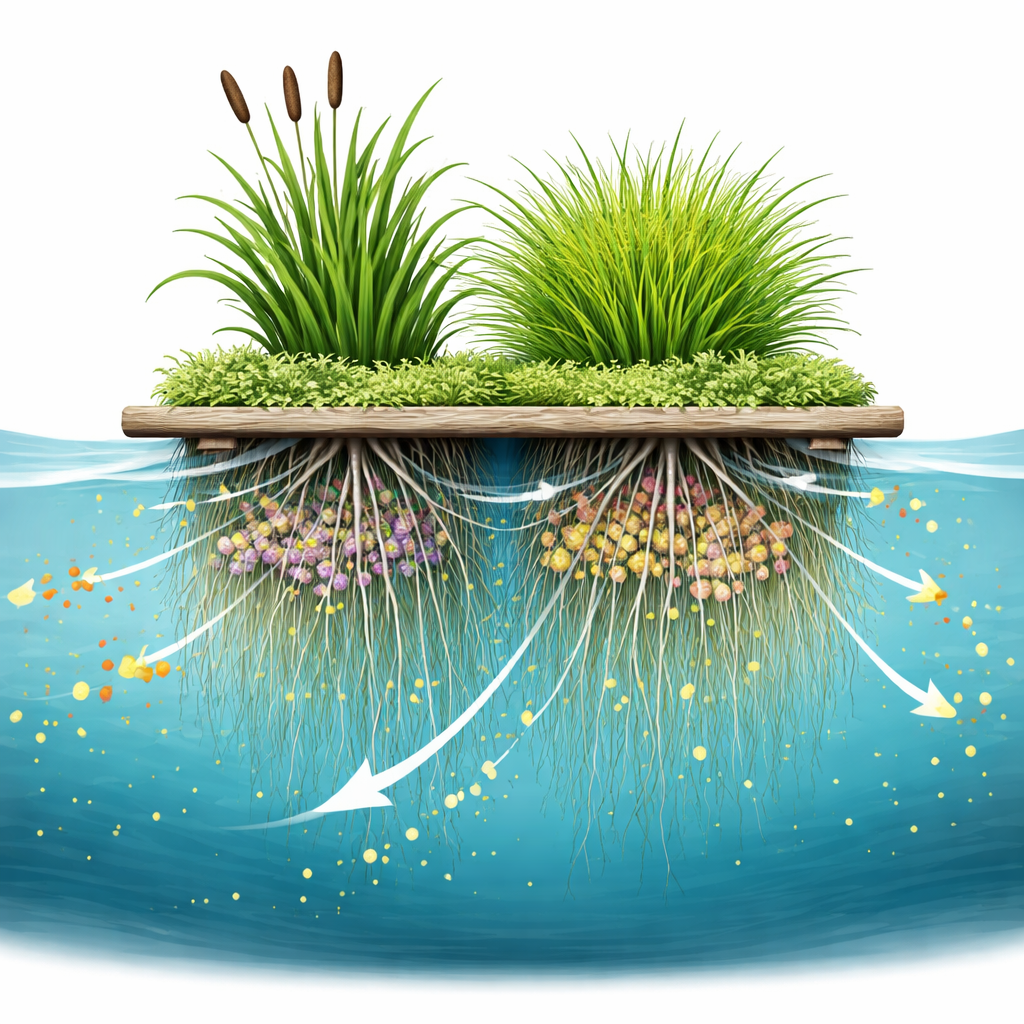
What This Means for Cleaner Ponds and Rivers
For a non-specialist, the bottom line is straightforward: simple floating plant rafts can noticeably improve the quality of already-treated wastewater before it flows back to nature. By hosting dense root mats and microbial films, these mini-wetlands speed up the removal of nitrogen and help lock away phosphorus, while also blocking nuisance algae. The study shows that design choices matter—especially which plant species is used and how well the root zone is allowed to develop. Iris pseudacorus, in this setup, delivered stronger nutrient reduction than Glyceria maxima. Overall, the work supports floating treatment wetlands as a realistic, nature-based add-on for wastewater ponds and small treatment plants, helping to curb algae-fueling pollution and protect downstream lakes and rivers.
Citation: Kilian, S., Pawęska, K., Bawiec, A. et al. Efficiency of floating treatment wetlands planted with Iris pseudacorus and Glyceria maxima. Sci Rep 16, 9351 (2026). https://doi.org/10.1038/s41598-026-39622-0
Keywords: floating treatment wetlands, wastewater polishing, nutrient removal, nature-based treatment, eutrophication control