Clear Sky Science · en
Balancing environmental benefits and accessibility for national park buffer zones in China
Why cooler, cleaner air around parks matters to people
On sweltering summer days, forested mountains can feel like natural air conditioners, offering cooler temperatures and clearer skies than nearby cities. This study asks how far those benefits spread beyond the boundaries of a national park—and whether people can actually reach and enjoy them. Focusing on Baishanzu National Park in eastern China, the researchers show that the park cools and cleans the air over a wide surrounding area, and then examine how easy it is for nearby residents to access these healthier environments. Their work suggests new ways to plan the lands around parks so that nature conservation and local livelihoods can thrive together.
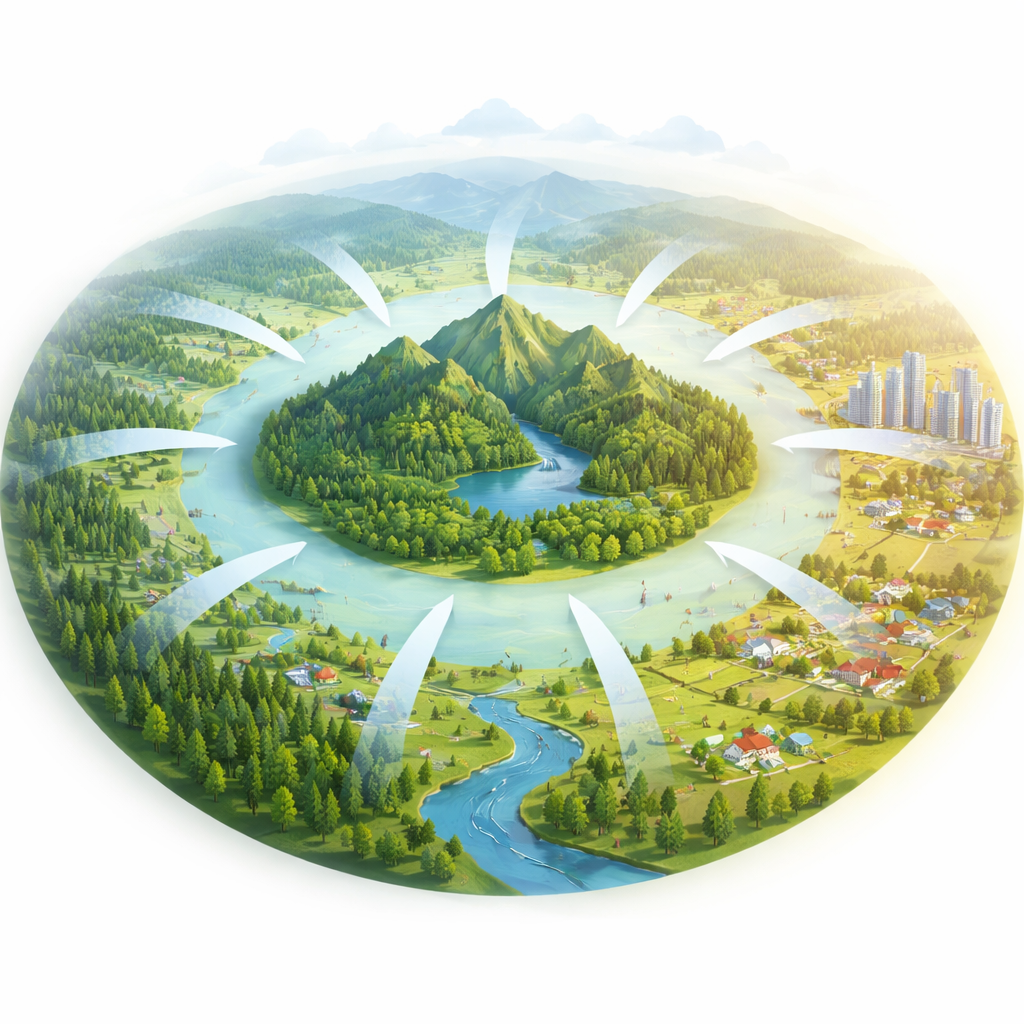
Nature’s comfort zone around a mountain park
Baishanzu National Park lies in a hot, humid region where summer heat can be intense and demand for outdoor relief is high. The team defined a 30-kilometer ring around the park as its “buffer zone,” where towns, farms, and rural communities sit between the wild core and the more urban landscape beyond. Using satellite images, they measured land surface temperature and fine particle pollution (PM2.5) inside the park, in the buffer zone, and farther away. They found a clear gradient: the park was coolest and cleanest, the buffer zone somewhat warmer and more polluted, and the outer areas warmest and most polluted. In effect, the park acts as a large regional cooler and air filter whose influence spills well beyond its official borders.
How far the cool, clean influence extends
To put numbers on this invisible comfort zone, the researchers sliced the landscape around the park into a series of rings and examined how temperature and particle levels changed with distance. They modeled these changes with a curve and identified the distances where the park’s influence faded. The park’s cooling effect remained noticeable out to about 10.5 kilometers from its boundary, covering roughly 2,474 square kilometers, and reduced average surface temperatures by about 2.6 degrees Celsius compared with nearby areas. The air-cleaning effect stretched even farther, to about 13.8 kilometers and over 3,000 square kilometers, cutting PM2.5 levels by nearly 1 microgram per cubic meter. Within the buffer zone, more than half the area enjoyed relatively low heat and cleaner air, especially in eastern counties with less intensive development.
Roads, travel time, and who can enjoy the benefits
Cooler, cleaner air only supports recreation if people can get to it. To assess this, the authors combined digital road maps with real driving-time data from a popular navigation service. They estimated how long it takes residents of nearby towns and city districts to reach different parts of the buffer zone by car on summer weekends, when visits peak. Travel times were generally stable over the day, suggesting few chronic traffic jams, but many places around the park still required 90 to 180 minutes of driving. After blending travel time with distance to roads, they created an index of accessibility. Areas with high accessibility clustered near well-connected roads and toll gates, especially in parts of Longquan and Jingning counties, while remote, mountainous areas lagged behind.
Where good nature and good access do—or do not—line up
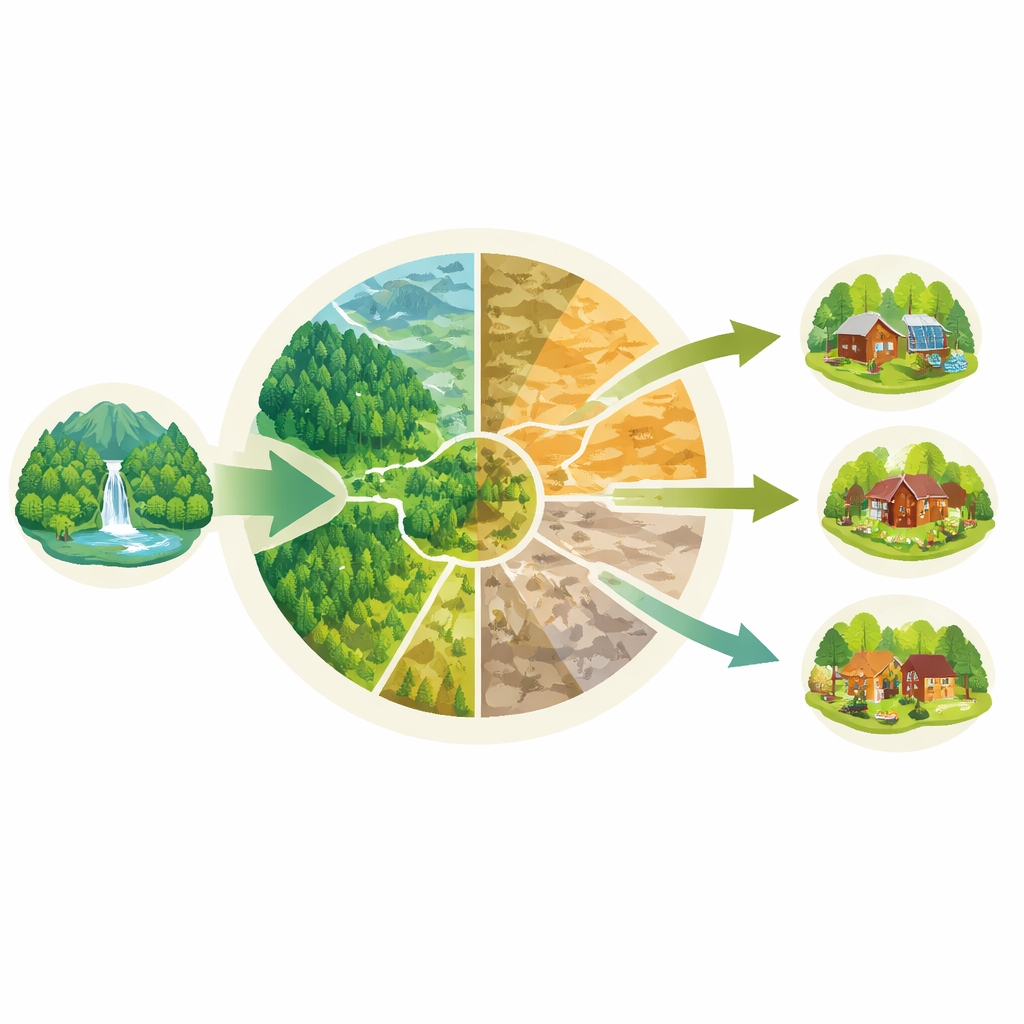
By overlaying the environmental and accessibility maps, the team looked for places where high-quality conditions and easy access coincide, as well as where they are out of sync. Statistically, the two measures showed a strong negative relationship: places that were coolest and cleanest were often harder to reach, and vice versa. Still, some “win–win” clusters emerged, particularly near the northern entrance of the park, where good roads intersect favorable climate and air. These hotspots already host guesthouses and other visitor services and are prime areas for carefully managed eco-tourism. In contrast, some regions had excellent natural conditions but poor access; the authors estimate that improving accessibility there by about one-fifth could unlock their recreational potential. Other areas had good roads but middling environmental quality, and would benefit from more trees, cleaner industry, and other greening measures to raise their environmental score by nearly one-fifth.
Planning for parks that serve both nature and neighbors
The study concludes that buffer zones around national parks can be powerful “bridges” between strict conservation areas and surrounding communities. Baishanzu’s forests not only safeguard biodiversity but also provide broad cooling and air purification services that could support summer tourism, health retreats, and other nature-based livelihoods—if planners pay attention to how people travel. By jointly mapping environmental benefits and accessibility, the authors offer a practical tool for deciding where to build or improve roads, where to concentrate eco-lodges and visitor centers, and where to prioritize restoration over development. For lay readers, the key message is that well-designed lands around national parks can turn clean air and cooler temperatures into shared local benefits, without sacrificing the wild heart of the park itself.
Citation: Cai, Y., Ma, Y., Wu, Y. et al. Balancing environmental benefits and accessibility for national park buffer zones in China. Sci Rep 16, 8096 (2026). https://doi.org/10.1038/s41598-026-39615-z
Keywords: national parks, buffer zones, cooling and air quality, accessibility, eco-tourism planning