Clear Sky Science · en
Optimization of the composition of temperature-responsive polymers for spin columns
Why cleaning up blood samples matters
When doctors measure the amount of medicine in a patient’s blood, they are looking for a precise number to guide safe dosing. But blood is a crowded mixture: bulky proteins and tiny drug molecules are tangled together, and separating them often requires messy organic solvents that are not ideal in hospital labs. This study introduces a new kind of miniature filter, called a temperature‑responsive spin column, that can remove blood proteins and recover several important medicines using only water and simple temperature changes.
A smart filter that responds to temperature
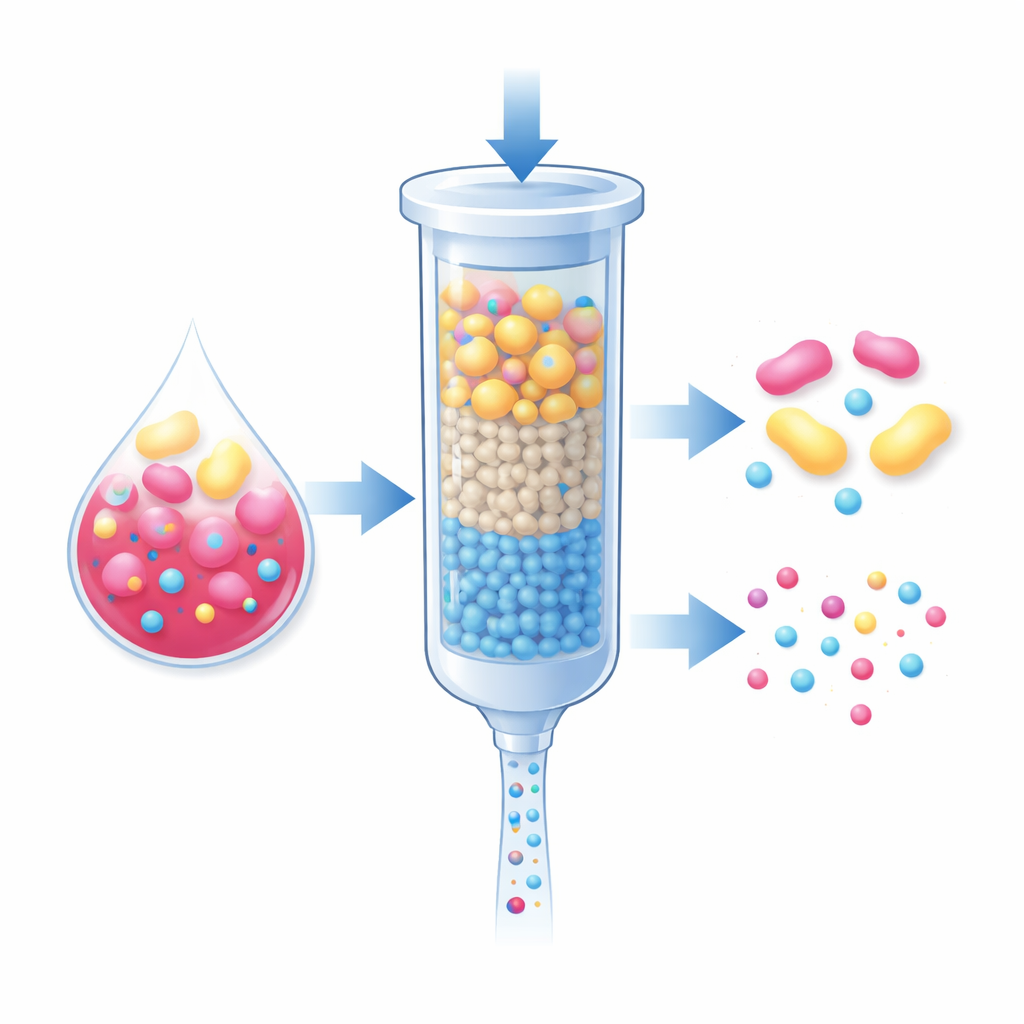
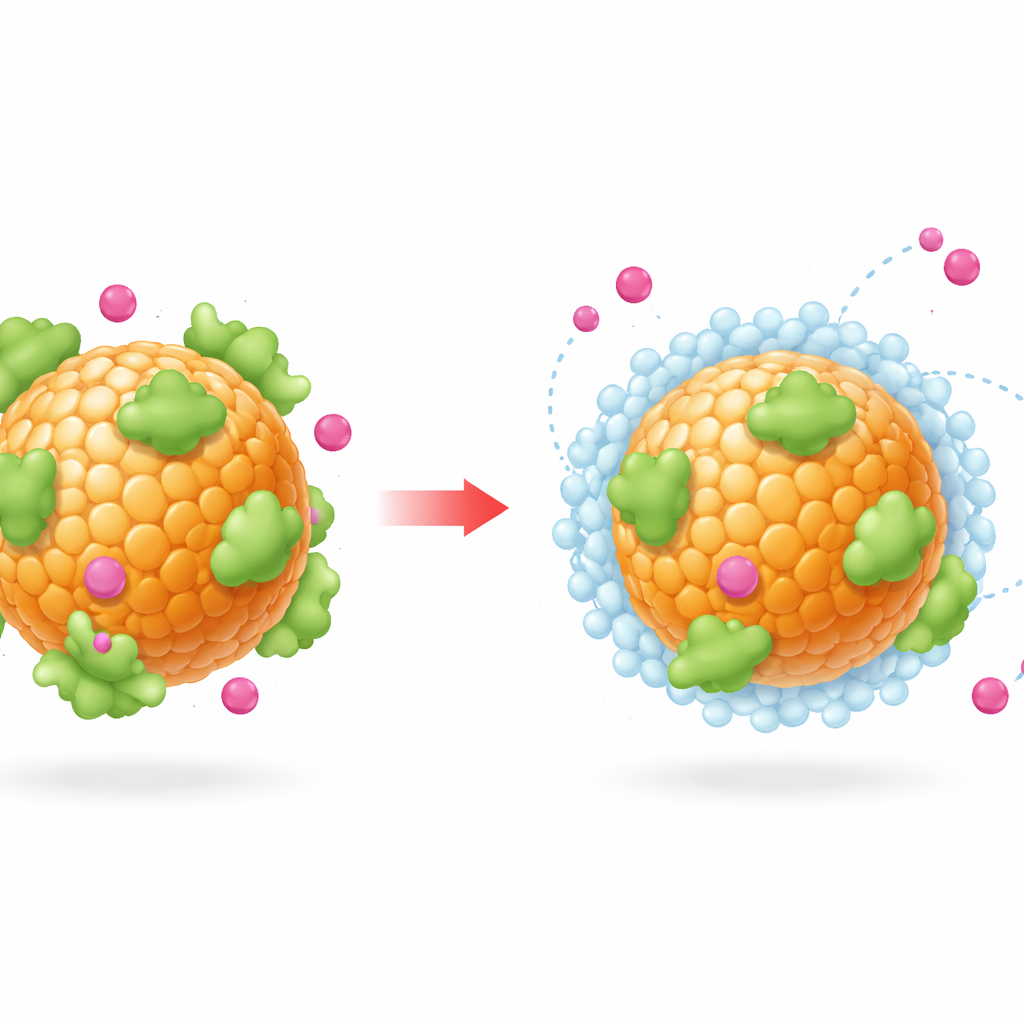
The heart of this work is a small plastic column packed with tiny silica beads coated in special polymers—long chains of molecules that change their behavior with temperature. At warmer temperatures, these coatings become more water‑repelling and grab onto passing molecules; when cooled, they become more water‑loving and let go. By exploiting this switch, the authors designed a column that can temporarily trap both blood proteins and drugs at body‑like temperatures and then release the drugs when the column is chilled, all while using an entirely water‑based liquid.
Two layers, two jobs
The column is built like a layered filter. The upper layer contains larger beads coated with a temperature‑responsive polymer that also carries electrical charge. This layer is tuned to latch onto blood proteins, which carry their own charges in water. The lower layer contains smaller beads coated with a more strongly water‑repelling polymer that primarily grabs the drug molecules themselves. When a blood sample containing a drug is spun through the column at about 40 °C, proteins stick mostly in the upper layer and drugs interact with the lower layer. Almost none of the drug passes straight through at this stage, which is important for capturing as much as possible for later measurement.
Tuning the recipe for different medicines
Not all drugs behave the same way in water. The team focused on three medicines that require careful monitoring in patients: voriconazole (an antifungal), lamotrigine, and carbamazepine (both used to treat epilepsy). By changing how much of two extra building blocks they mixed into the polymer coatings—one that adds electrical attraction and another that increases water‑repelling character—the researchers could fine‑tune how strongly each drug stuck to the beads at warm and cold temperatures. They found that voriconazole and lamotrigine were best recovered when the upper protein‑catching layer was made less water‑repelling, which encouraged these drugs to let go when the column was cooled. In contrast, highly water‑repelling coatings containing a small amount of a hydrophobic monomer were better for releasing carbamazepine, which is naturally more water‑shy than the other two drugs.
How the process actually runs
In practice, a lab worker would mix a patient’s serum sample with the drug of interest and load it into the warm spin column. A brief spin pulls the sample through the two bead layers while proteins and drugs are captured. A small volume of warm water wash removes loosely attached contaminants without disturbing the bound drugs. Then the column is cooled to 4 °C, and water is added again. At this lower temperature, the polymer coatings swell and become more friendly to water, so the trapped drug molecules are pushed back into the liquid and collected in a clean fraction. Throughout, the separation and analysis use only water‑based solutions, avoiding flammable and toxic organic solvents.
What this means for patient care
This study shows that by carefully choosing the ingredients in the temperature‑responsive coatings, one can build spin columns tailored to specific drugs. For voriconazole and lamotrigine, columns without the extra hydrophobic ingredient in the top layer gave the best drug recovery, while carbamazepine needed a more water‑repelling recipe. To a non‑specialist, the key message is that drug‑specific, water‑only preparation of blood samples is now within reach. With further optimization across a wider range of medicines and temperatures, these smart filters could simplify therapeutic drug monitoring, making it easier and safer for clinical laboratories to measure drug levels and adjust treatments for individual patients.
Citation: Nagase, K., Kokubun, M. & Kanazawa, H. Optimization of the composition of temperature-responsive polymers for spin columns. Sci Rep 16, 8550 (2026). https://doi.org/10.1038/s41598-026-39613-1
Keywords: therapeutic drug monitoring, temperature responsive polymers, spin columns, serum drug separation, polymer chromatography