Clear Sky Science · en
Comparing the performance of deep learning video-based models and trained veterinarians in cattle pain assessment
Why Reading Cow Faces Matters
Pain in farm animals is both a welfare issue and a business problem: animals that hurt eat less, grow more slowly, and may suffer in silence. Unlike people, cows cannot tell us where it hurts, and even skilled veterinarians can miss subtle signs. This study asks a striking question with real‑world consequences: can an artificial intelligence system, watching ordinary video of cattle, match or even outperform trained vets at telling which animals are in pain after surgery?
Hidden Pain in Quiet Herds
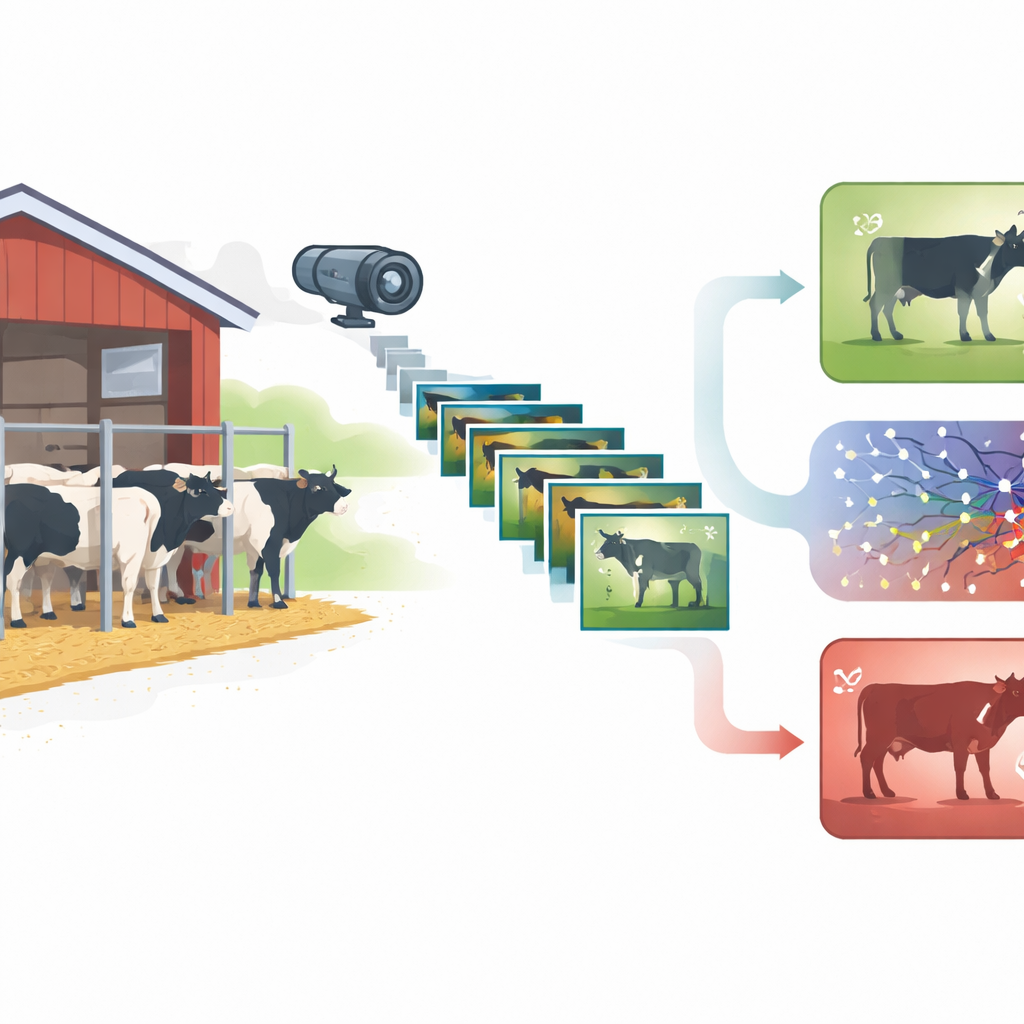
Cattle are prey animals, and over evolution they have learned to hide weakness. That makes pain hard to spot, even for experts, and existing scoring systems are time‑consuming and somewhat subjective. Veterinarians typically rate pain using checklists of behaviors and facial expressions, such as how a cow walks, whether it interacts with herdmates, or how its eyes, ears, and muzzle look. These tools improve consistency but still depend on human judgment, training, and the circumstances in which the animals are observed. In busy commercial farms, applying such detailed scales to every animal is often impractical.
Turning Barn Videos into Data
The researchers built on earlier work in other species—cats, dogs, rabbits, sheep, and horses—where computers have learned to recognize pain from images. Here, they focused on young bulls undergoing routine castration. Seventeen animals from two common beef breeds were filmed in their pens for about three minutes at several time points before and after surgery. For the AI, the key comparison was between a pre‑surgery moment taken as pain‑free and an early post‑surgery moment when acute pain was expected. From these recordings, the team extracted one frame per second and automatically cropped around each animal’s head, creating a streamlined set of close‑up views of bovine faces and upper bodies.
How the Computer Learns to Read a Cow
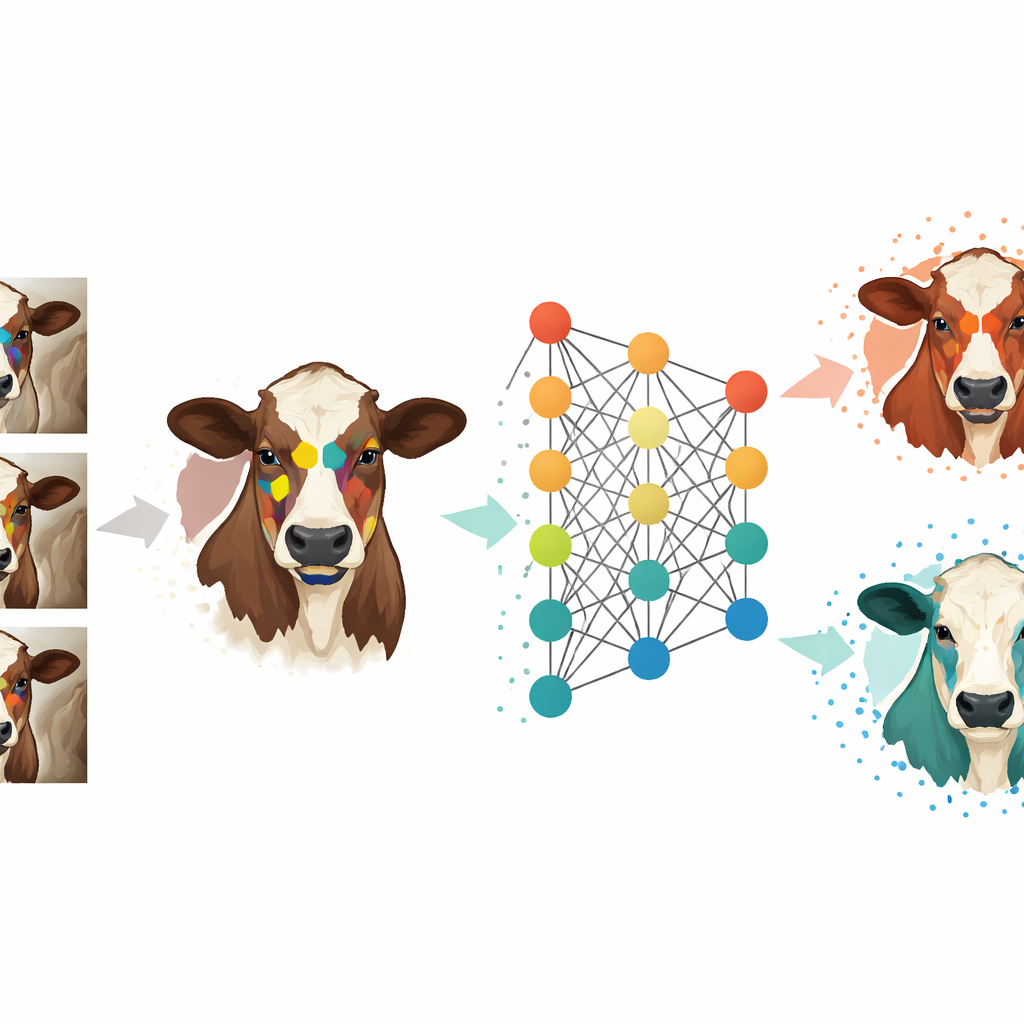
Each cropped frame was converted into a compact numerical description—a kind of visual fingerprint—using a modern vision transformer model originally trained on large image collections. These fingerprints were then fed into a simple classifier that learned to separate “pain” from “no pain” based on the labeled examples. Rather than relying on heavy pre‑processing or repeated retraining cycles, the authors kept the pipeline efficient, with an eye toward real‑world deployment on farms where computing resources and technical expertise may be limited. For each three‑minute video, the system made a decision by taking a majority vote over all frames, allowing it to pick up on fleeting changes in expression and posture that a single still image might miss.
Man vs. Machine in the Clinic
To judge how well the AI was doing, its performance was compared against that of two trained veterinary anesthetists using established pain scales. The UNESP‑Botucatu Cattle Pain Scale focuses on body behaviors like movement, appetite, and interaction, while the Bovine Grimace Scale concentrates on facial features such as eyelid tightening and ear position. The vets scored pain both in person during the surgical period and later from the recorded videos. The computer, using only the videos, reached an accuracy of about 97 percent and an F1 score—a balanced measure of correct pain and no‑pain calls—of nearly 97 percent. This was better than the video‑based human scores and statistically comparable to the vets’ real‑time assessments at the animals’ pens.
What This Means for Cows and Farmers
For a lay reader, the takeaway is straightforward: a carefully designed AI system watching ordinary video can spot pain in cattle about as well as experienced veterinarians, and sometimes more consistently. That does not mean replacing vets; rather, it points toward a future where cameras quietly monitor herds around the clock, flagging animals that likely hurt so that humans can intervene sooner. The study is still small and focused on one type of surgery, and it simplifies pain into a yes‑or‑no decision. But it offers a proof of concept that machines can help uncover the hidden suffering of farm animals, improving both their quality of life and the efficiency of livestock production.
Citation: Feighelstein, M., Tomacheuski, R.M., Elias, G. et al. Comparing the performance of deep learning video-based models and trained veterinarians in cattle pain assessment. Sci Rep 16, 9318 (2026). https://doi.org/10.1038/s41598-026-39604-2
Keywords: animal pain detection, cattle welfare, veterinary artificial intelligence, computer vision, livestock health monitoring