Clear Sky Science · en
Mechanical annealing in a soft granular layer under cyclic shear at varying frequencies
Why shaking soft beads can teach us about solid matter
Metals, glasses, and even piles of grains can be made stronger or more orderly by carefully controlled shaking and bending, a process often called mechanical annealing. This study uses a simple yet revealing model: a thin layer of soft hydrogel beads confined in a shallow box that is gently vibrated and rhythmically sheared. By changing how fast the box is sheared back and forth, the authors show how mechanical motion alone can drive the system from a disordered, glassy state toward a more crystal-like arrangement—and back again. Their results shed light on how to tune motion and stress to control the internal structure of soft, densely packed materials.
A table-top stand‑in for crowded materials
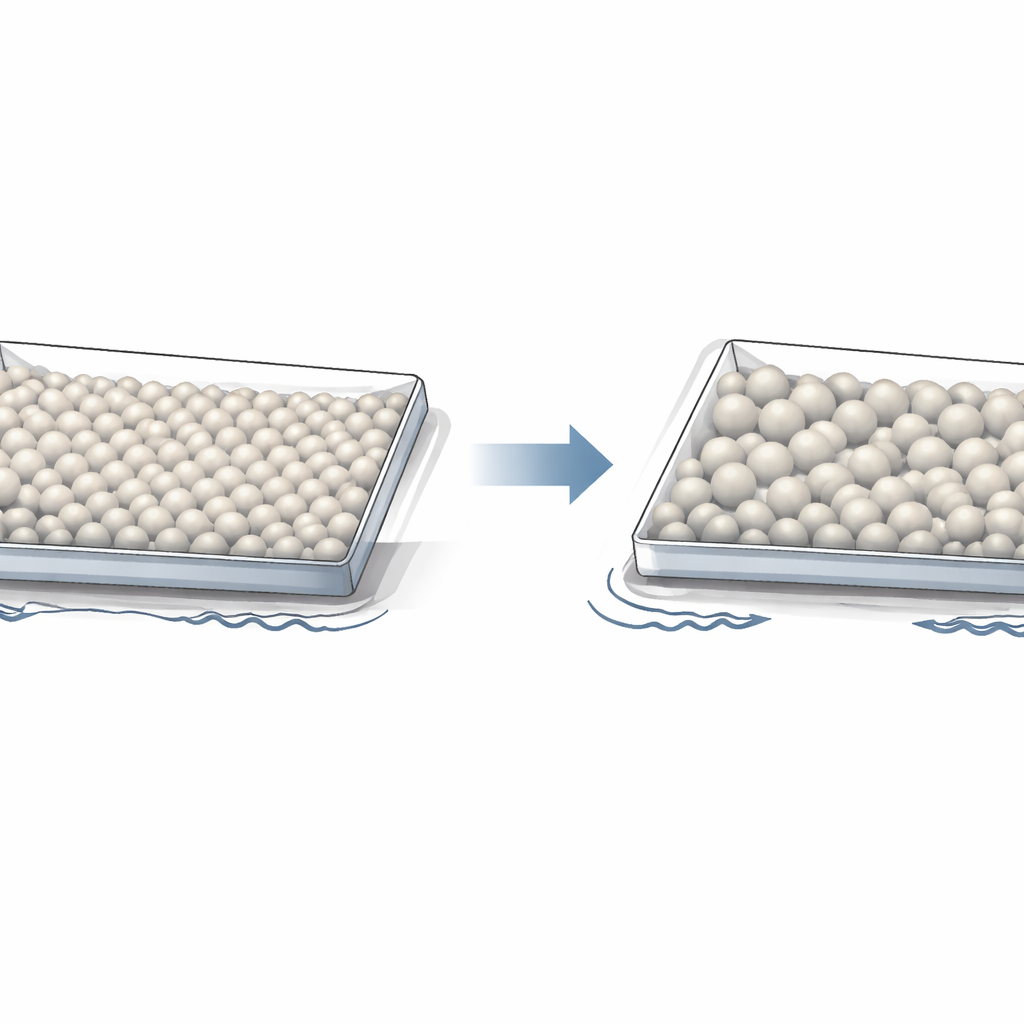
The researchers built a two-dimensional layer of hundreds of identical, millimeter-sized hydrogel spheres. These soft, water-filled beads rest on a slightly tilted vibrating plate inside a deformable rectangular frame. Vibration makes the beads jostle as if they had an effective temperature, while the tilt encourages them to settle and pack near the lower edge. A motorized actuator periodically distorts the frame, imposing slow, cyclic shear—akin to gently rocking and squashing the layer back and forth. High-speed video allows the team to track each bead and to quantify how ordered their arrangement becomes, focusing on how many local neighborhoods resemble a perfect hexagonal pattern, the densest way to pack equal circles in a plane.
Slow shear builds order, fast shear breaks it
First, the team examined what vibration alone can do. Without shear, the beads gradually relax toward a partially ordered state: compact hexagonal clusters grow, especially near the lower boundary, but never take over the entire layer. When cyclic shear is added, the picture changes. At very low shear frequencies—requiring many minutes for a few full cycles—the layer develops large, stable hexagonal grains. Disordered patches are slowly squeezed aside and pushed toward the edges, where they shrink from cycle to cycle. As the shear frequency increases, however, this mechanical annealing becomes less effective. The average degree of hexagonal order drops from about 0.86 at the slowest shear to around 0.80 at the fastest, and the structure becomes more fluctuating and patchy.
From tightly packed to loose and fluid‑like
To see how tightly the beads are packed, the authors estimated the fraction of area occupied by the spheres within the cluster they form. At low shear frequencies, the layer is highly compact: the beads are pressed together so strongly that, thanks to their softness, the packing can even exceed the ideal hard-disk hexagonal limit. As the shear frequency rises, the packing fraction steadily decreases toward values typical of random, loosely jammed states. Around intermediate frequencies, the system crosses a threshold where it is neither firmly jammed nor fully fluid: motion becomes easier, and the structure is more amorphous. This trend suggests a transition from a regime dominated by gentle compression and grain growth to one governed by continual rearrangement and disruption.
Hidden rhythms and glass‑like behavior
The team also treated the evolving degree of order as a time signal and analyzed it using Fourier methods that reveal long-range correlations. Under pure vibration, this signal behaves almost like white noise: fluctuations are uncorrelated in time. Once shear is applied at any nonzero frequency, the power spectra follow a characteristic power law, indicating history dependence and long-lived correlations in the rearrangements of the beads. Interpreting these results through a framework known as soft glassy rheology, the authors infer that the granular layer behaves like a soft glass: its response to motion is mostly dissipative, but with a slowly growing elastic component at higher driving rates. A broader phase diagram, mapping shear frequency against the size of each shear deformation, reveals an optimal “window” where intermediate strains and relatively low frequencies maximize hexagonal order.
What this means for tuning structure with motion
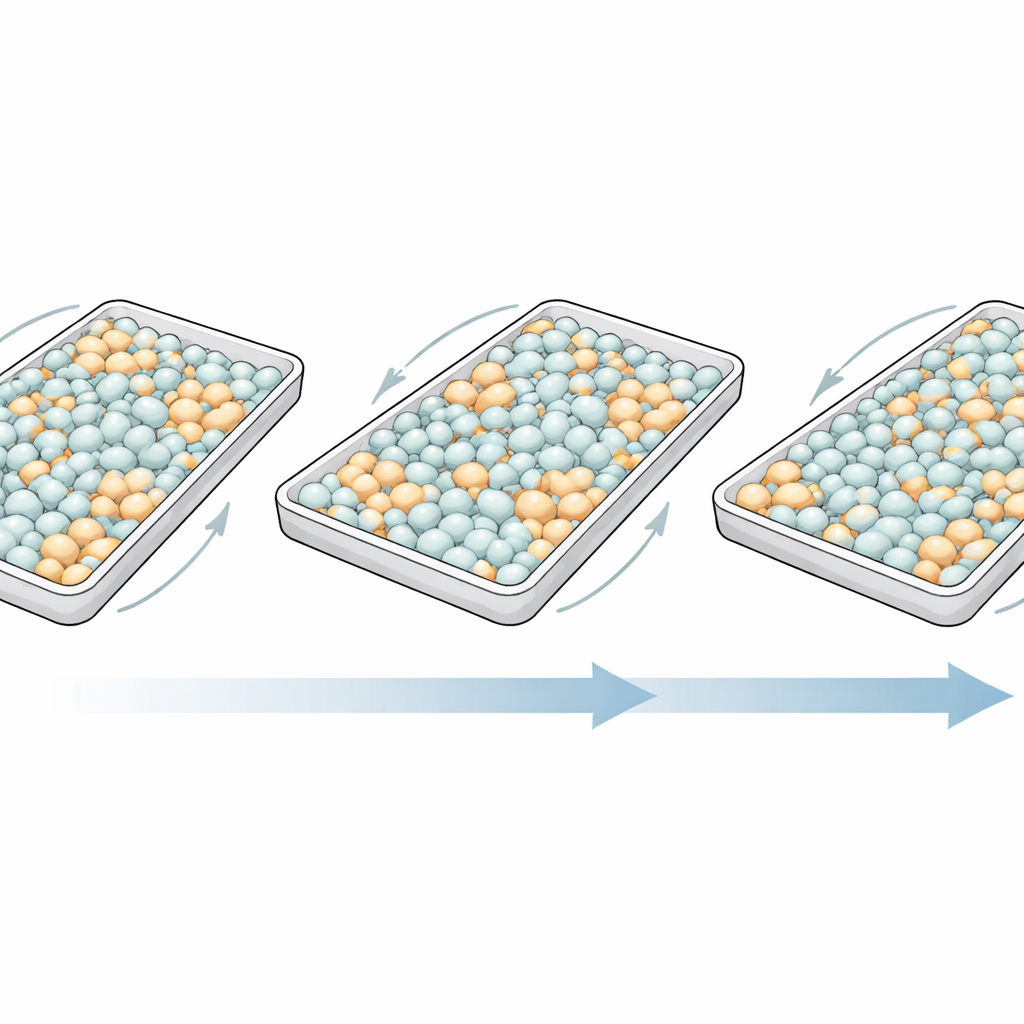
Overall, the study shows that there is no single “more shear is better” rule for organizing a crowded soft material. Instead, the rate and amplitude of cyclic deformation must be matched to how quickly individual particles can relax their shape and contacts. Slow, moderate shear lets the system explore configurations and settle into dense, crystal-like patches, while faster cycles stir the beads too vigorously, preventing ordered domains from stabilizing and driving the layer toward a looser, more fluid-like state. These insights, distilled from a deceptively simple bead experiment, may help guide how engineers use mechanical vibrations and oscillatory stresses to tune the internal structure—and thus the mechanical properties—of soft granular layers, dense suspensions, and other disordered materials.
Citation: Tapia-Ignacio, C., Fossion, R.Y.M. & López-González, F. Mechanical annealing in a soft granular layer under cyclic shear at varying frequencies. Sci Rep 16, 9067 (2026). https://doi.org/10.1038/s41598-026-39600-6
Keywords: mechanical annealing, granular materials, soft hydrogels, cyclic shear, jamming transition