Clear Sky Science · en
Subsurface plumbing system architecture in the South Makassar Basin, offshore Indonesia, and its implications for methane emissions and geological storage
Hidden Highways Beneath the Seafloor
Far below the waves of Indonesia’s Makassar Strait, natural “plumbing” systems quietly move methane-rich fluids through the seabed. These hidden pathways matter because they help control how much methane, a powerful greenhouse gas, escapes into the ocean and atmosphere, and how safely we can lock away carbon dioxide underground. This study peels back the seafloor to reveal how these fluid routes are organized and how they evolve over time in the South Makassar Basin.
Where Methane Hides and Escapes
The South Makassar Basin hosts deep, porous rock formations made of ancient carbonates that trap methane-rich gas. Above them lies more than a kilometer of fine-grained mud and clay that was long assumed to be a tight, reliable seal. Using a detailed three-dimensional seismic survey and data from two wells, the researchers mapped this overlying package in high resolution. They identified deep gas reservoirs, the overlying “seal” rocks, and a suite of features that betray where fluids have forced their way upward and where they remain stored as icy gas hydrates in the shallow seabed. 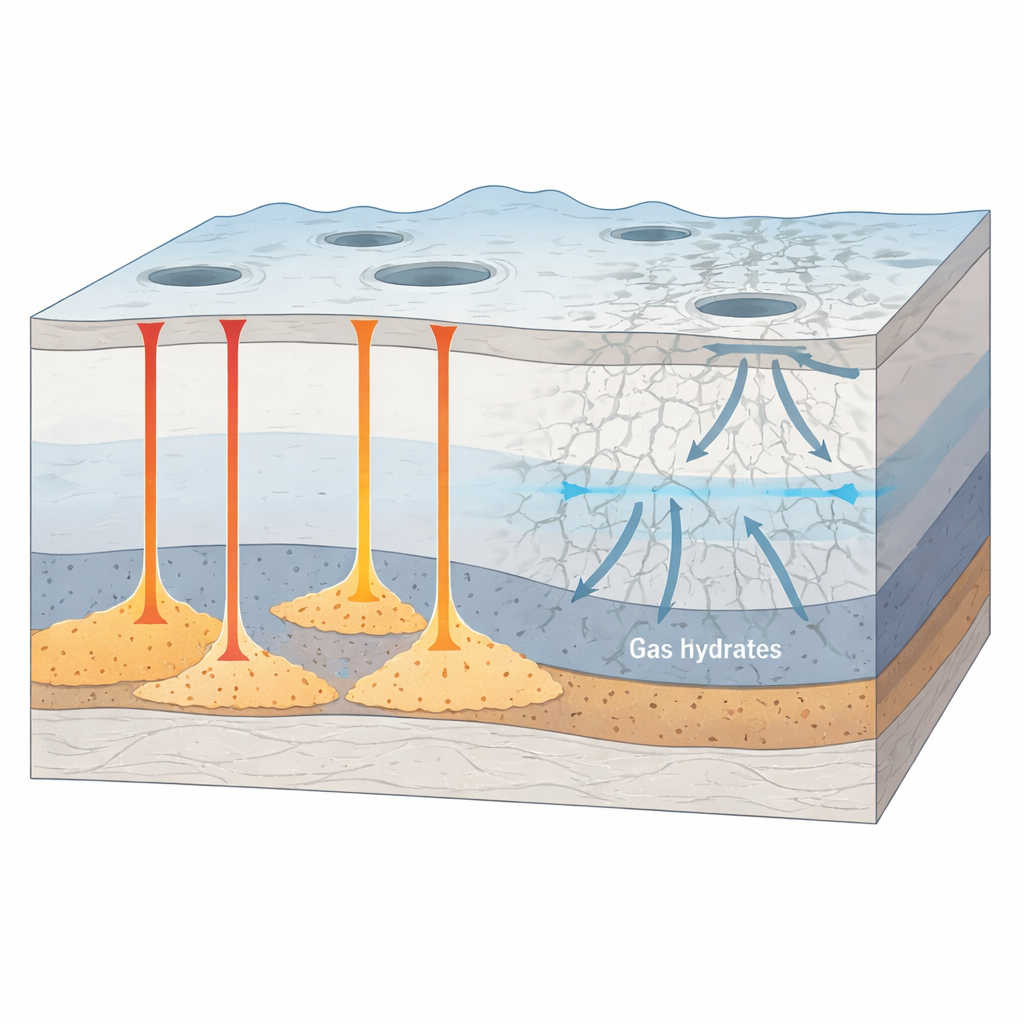
Two Very Different Underground Routes
The team found that fluids travel upward in two main ways. In a focused system, narrow vertical columns cut straight through the layered sediments. These “pipes” rise from the crests of buried carbonate highs and often connect directly to round depressions on the seafloor known as pockmarks, which mark spots of past or ongoing seepage. In contrast, an unfocused system spreads fluids slowly along dense networks of small, crisscrossing fractures and faults. These polygonal and radial faults do not form a single open chimney but instead act like a leaky mesh, guiding gas sideways and upward. In many places, these diffuse pathways line up with a distinctive seismic signal that marks the base of gas hydrate accumulations—frozen mixtures of water and methane within the sediments.
How Seafloor Vents Grow Up
By comparing many buried structures, the authors propose that focused vents grow through four stages. It begins with gentle deformation above a gas-charged reservoir, where stress concentrates over domed or steep reservoir tops and sparks small, outward-spreading fractures in the seal. As pressure builds, these fractures lengthen upward to form radial fault patterns that start to bypass the seal. Continued pressurization then narrows and concentrates the flow into a vertical column, creating a pipe that can stall partway up if the overlying rocks remain strong enough. Given enough pressure over time, the pipe finally punches through to the seabed, carving pockmarks and delivering methane and methane-derived carbonates, as well as nourishing chemosynthetic communities that thrive on the leaking gas. 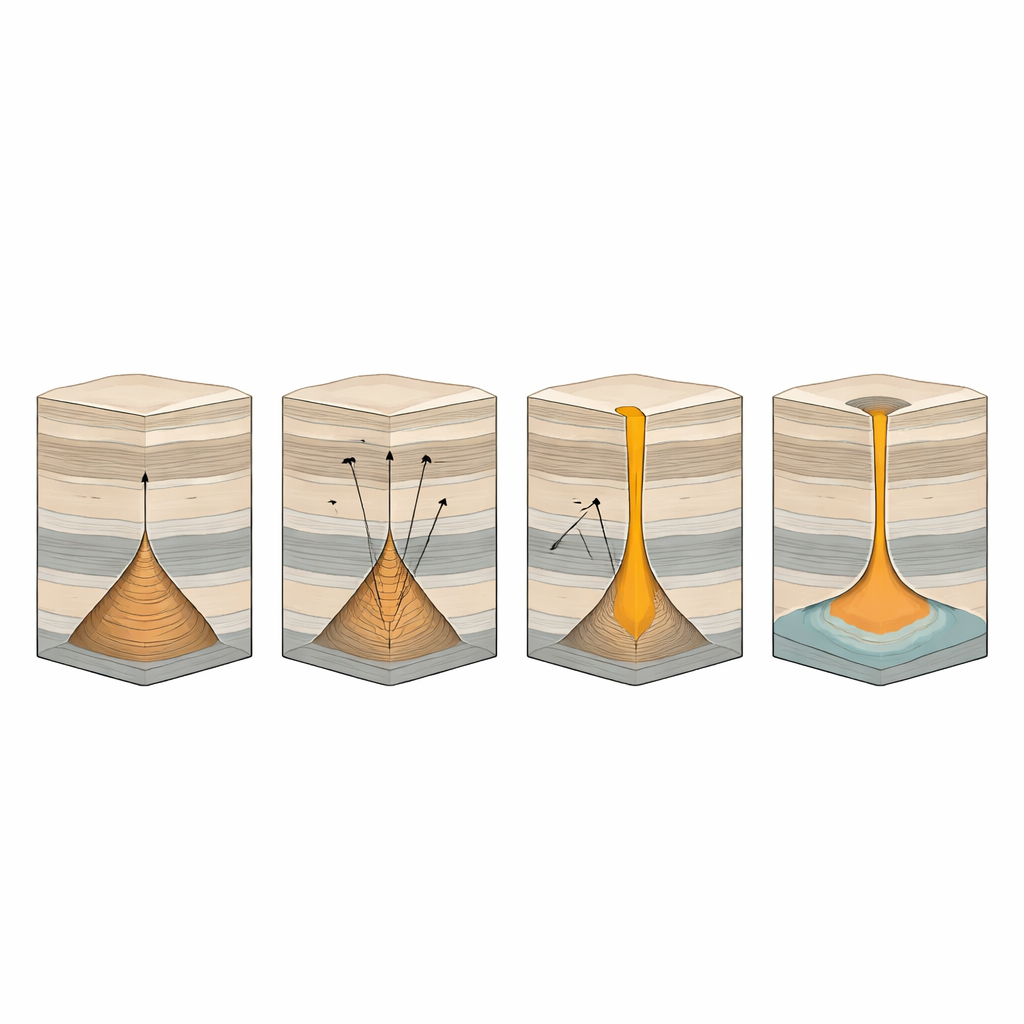
When Supposed Seals Give Way
The study also examines large underwater landslide deposits within the seal sequence. These bodies are often thought to act as especially tight barriers because they are compacted as they move downslope. In the South Makassar Basin, however, several vertical pipes pierce directly through them. This suggests that while these deposits can temporarily delay fluid movement and allow pressure to build, they are not fail-safe: once stressed beyond their limits, they can rupture and create broad conduits. At the same time, parts of these deposits still manage to trap gas laterally, encouraging methane to pool or move sideways beneath or within them before eventually finding a weakness.
Climate and Storage Stakes
The architecture revealed here has direct implications for both natural methane emissions and plans to store carbon dioxide deep underground. Slow seepage along fault networks and rapid bursts through pipes may both release methane over long timescales, and future warming of the Indonesian Throughflow current could destabilize gas hydrates, adding more methane to the system. For engineered storage, neither type of pathway is completely benign. Fault meshes may leak slowly over geological time, while vertical pipes can offer fast tracks from depth to the seabed. The authors argue that any future carbon storage projects in similar basins must carefully map and avoid such pre-existing bypass systems. Their work shows that what looks like a simple blanket of mud can in fact host a complex, evolving plumbing network that governs whether greenhouse gases stay locked away—or find their way back to the ocean and sky.
Citation: Nugraha, H.D., Jamaludin, S.N.F., Matsumoto, R. et al. Subsurface plumbing system architecture in the South Makassar Basin, offshore Indonesia, and its implications for methane emissions and geological storage. Sci Rep 16, 9239 (2026). https://doi.org/10.1038/s41598-026-39597-y
Keywords: methane seepage, gas hydrates, subsurface fluid flow, carbon storage, Makassar Basin