Clear Sky Science · en
Impact of treated wash water from ready mix concrete plants on concrete properties and durability
Why Concrete's Thirst Matters
Every new building, bridge, or road comes with an invisible cost: enormous amounts of clean drinking water. Concrete production alone uses an estimated 16% of the world’s freshwater, even as many regions struggle to supply safe water for people and farms. This study explores a simple but powerful idea—can the dirty water left over from washing concrete trucks be cleaned and reused to make new concrete—cutting waste, saving freshwater, and still keeping our structures safe and long-lasting?
Turning Wastewater into a Resource
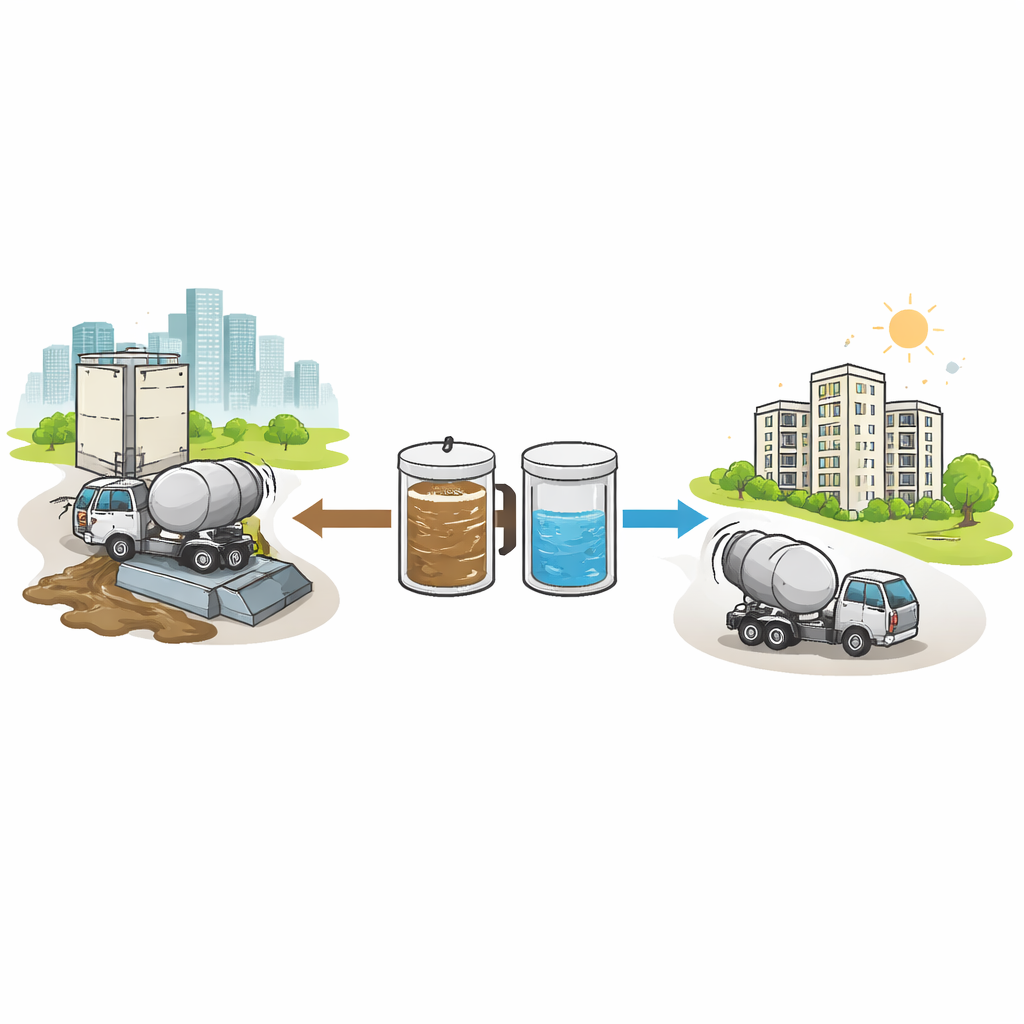
At ready-mix concrete plants, trucks and mixers must be washed out after each batch, producing highly alkaline, cloudy “wash water” full of cement and sand particles. Disposing of this water is costly and can harm soil and rivers if it is simply dumped. The researchers collected this wastewater from a plant in Egypt and first passed it through a fine sieve to remove coarse solids. After this basic treatment, the water turned from dark brown to a pale yellow, signaling a big drop in suspended particles. Chemical tests showed that, despite its high alkalinity, the treated water met key safety limits set by international standards for use as mixing water in concrete.
How the Tests Were Carried Out
To see how this treated wash water performs in practice, the team designed five concrete mixes. One used only regular drinking water, while the others replaced 25%, 50%, 75%, or 100% of that water with treated wash water. All mixes had the same cement, sand, stone, and no extra chemical additives beyond those already dissolved in the wash water. The researchers then measured how easy the concrete was to work with when fresh (using the familiar “slump” cone test), and how strong it became after hardening, by checking both compressive strength (how much squeezing it can bear) and splitting tensile strength (how it behaves under pulling or cracking forces). They also ran an electrical resistivity test, which sends a small current through the concrete to gauge how easily corrosive agents could move inside it—a quick indicator of long-term durability and steel corrosion risk.
Trade-Off Between Strength and Durability
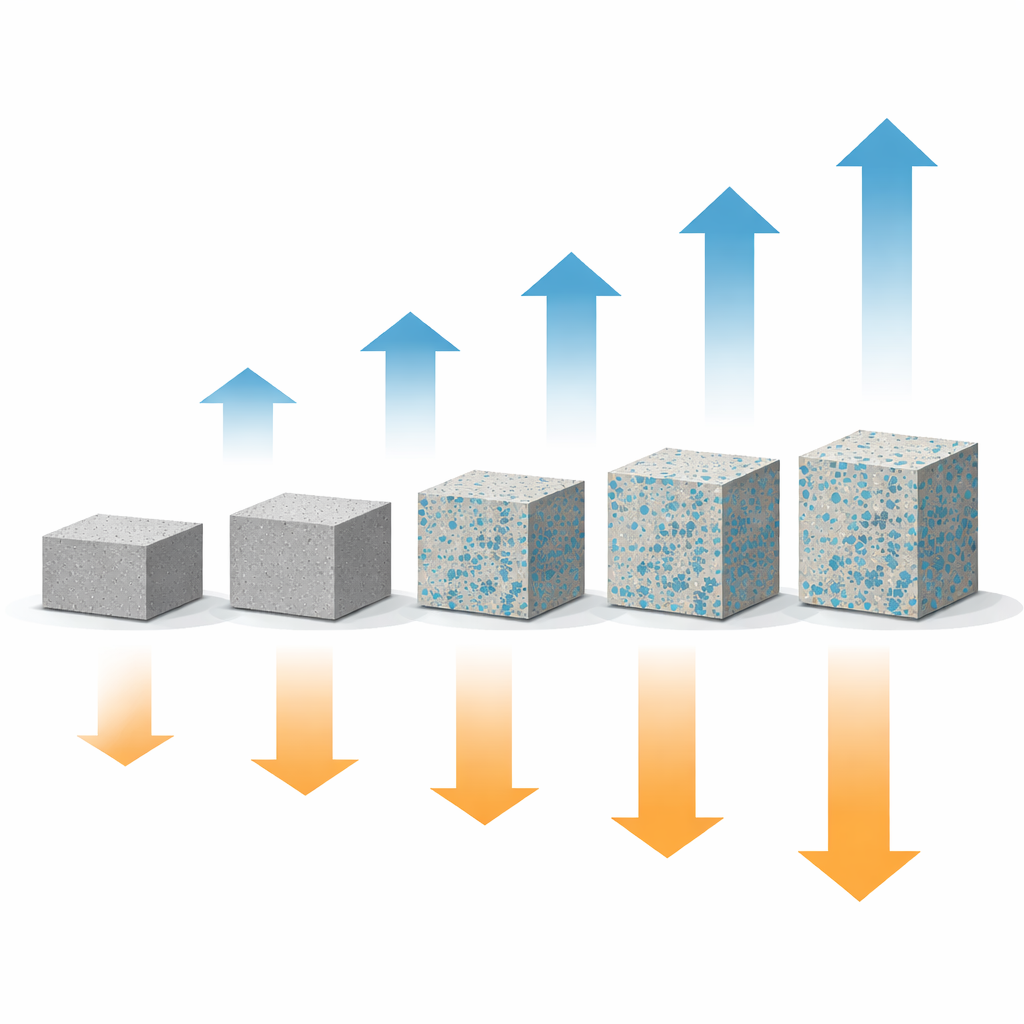
The tests revealed a clear pattern. As soon as wash water was introduced, the fresh concrete became less flowable: the slump dropped by about half compared with the mix made only with drinking water. This loss in ease of placing is linked to the many fine particles in the wash water, which soak up free water and make the mix stiffer. In terms of strength, moderate replacement levels performed surprisingly well. At 7 days, mixes with 25% and 50% wash water showed less than 10% loss in compressive strength, which is within the limits allowed by Egyptian building codes. At 28 days, the 50% mix was essentially as strong as the control, while 25%, 75%, and 100% replacement levels showed strength losses of up to about 18%. Tensile behavior followed a similar trend: up to 50% replacement, the concrete resisted cracking about as well as the control, but at 75% and 100% replacement, tensile strength dropped by roughly one fifth.
Unexpected Gain in Long-Term Protection
While strength fell slightly at higher replacement levels, durability indicators actually improved. Electrical resistivity rose as more treated wash water was used—by about 44% at 25% replacement, 60% at 50%, and up to sixfold at full replacement. Higher resistivity means it is harder for ions such as chlorides to move through the concrete, which generally slows down steel corrosion. The researchers attribute this to a “micro-filler” effect: very fine particles from the wash water help plug small pores and make the internal pathways more winding, blocking easy movement of water and salts. At the same time, the treated water remained alkaline with low chloride and sulfate content, creating a chemical environment that helps keep reinforcing steel in a protective state.
What This Means for Future Building
To help engineers apply these findings, the team developed simple mathematical formulas that predict how much compressive strength will drop for a given wash water replacement level. Within the tested range, these equations matched the experimental results closely. Overall, the study concludes that replacing up to half of the mixing water with treated wash water can be done safely in ready-mix plants without meaningful loss of structural performance, while actually improving resistance to corrosion. With only straightforward treatment steps such as sedimentation and fine sieving, plants could cut their freshwater use, reduce polluted discharges, and support global sustainability goals—all without major changes to existing concrete production methods.
Citation: Shamseldein, A., Amr, M. & Attia, F. Impact of treated wash water from ready mix concrete plants on concrete properties and durability. Sci Rep 16, 8493 (2026). https://doi.org/10.1038/s41598-026-39590-5
Keywords: sustainable concrete, recycled wash water, ready-mix plants, concrete durability, water conservation