Clear Sky Science · en
Integrative profiling of transcriptome and H3K27ac modification reveals changes associated with BCG-induced trained immunity in bovine immune cells
Why training the immune system matters
Vaccines are usually designed to train the body to fight one specific germ. But over the last decade, scientists have discovered that some vaccines also give the immune system a more general fitness boost, helping it react faster and stronger to many different threats. This study explores how the long-used tuberculosis vaccine, called BCG, reshapes the front-line immune defenses of young cattle, offering clues that could improve animal health, inform human vaccine design, and help us better understand how “innate immune memory” works.
A classic vaccine with a broader twist
BCG has been used for a century to prevent tuberculosis in people and is also given to cattle to protect against bovine TB. Surprisingly, children who receive BCG often show lower death rates from infections that have nothing to do with tuberculosis. This raised the idea that BCG might “train” innate immune cells—the rapid-response cells that react within hours, not days. In earlier work, the authors showed that calves given BCG produced more inflammatory messenger molecules, called cytokines, when their immune cells were later challenged. In the present study, they asked a deeper question: what changes inside those cells to make them respond differently weeks after vaccination?
How the team tested immune memory in calves
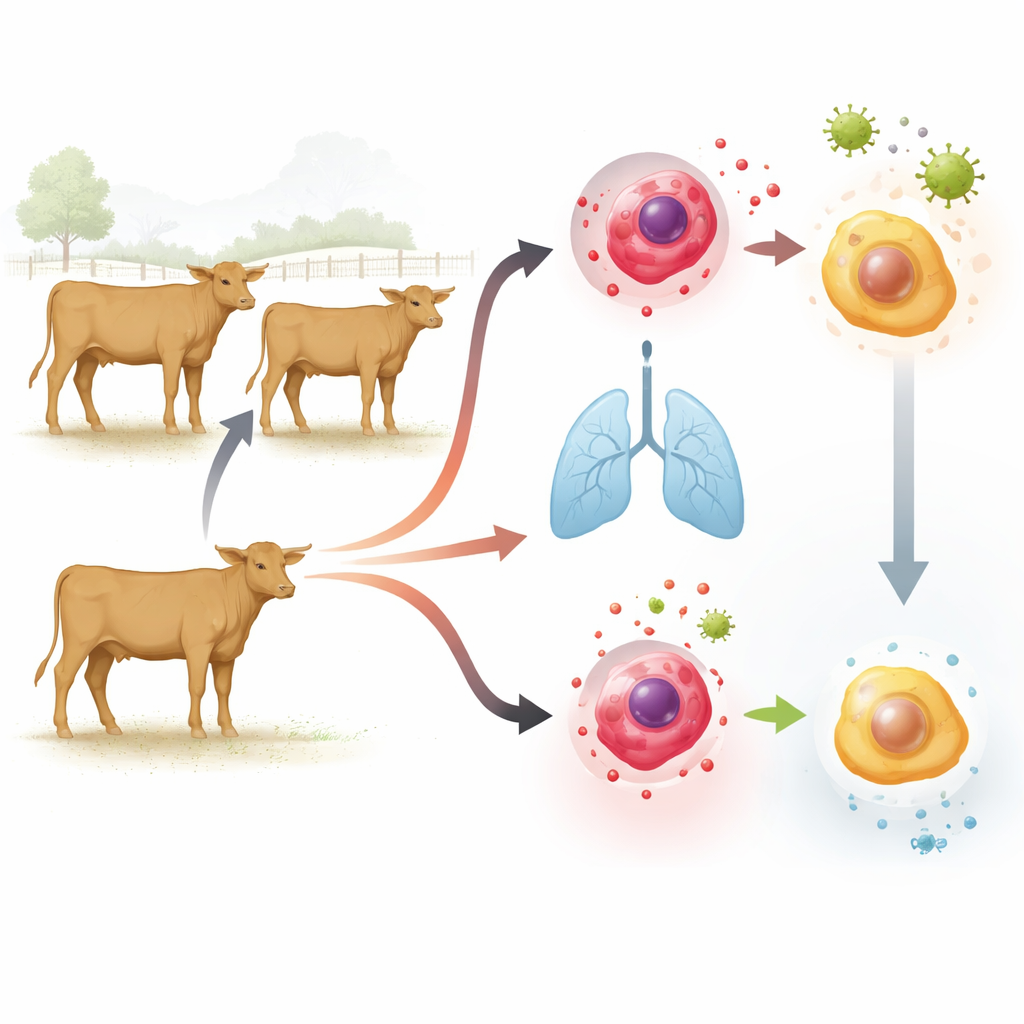
The researchers worked with twenty young Holstein–Angus heifers. Half received two doses of BCG under the skin, two weeks apart; the other half got saline as a control. Several weeks later, the team collected two types of immune cells: monocytes circulating in the blood and macrophages that live in the air sacs of the lungs. In the lab, they exposed these cells to different alarm signals that mimic viral and bacterial invaders and measured how much IL‑1β and IL‑6—two key inflammatory cytokines—the cells produced. They also used next-generation sequencing to profile which genes switched on or off and mapped chemical tags on DNA-packaging proteins (histones) that help control gene activity.
Stronger signals from trained front-line cells
Monocytes from BCG-vaccinated calves clearly behaved differently. When stimulated, they secreted more IL‑1β and IL‑6 than monocytes from unvaccinated animals, especially in response to a synthetic viral-like signal. At the gene level, these monocytes turned on a broader set of genes after restimulation and showed stronger activation of pathways linked to innate immunity and antimicrobial defense. The boosted response did not flip genes from “off” to “on” in a completely new way; instead, it amplified existing patterns, with many of the same genes responding but to a greater degree. In the lung, resident macrophages showed a more modest training effect—most notably, higher IL‑1β production to a bacterial signal—highlighting that different tissues may experience training to different extents.
Hidden marks that hold on to past experiences
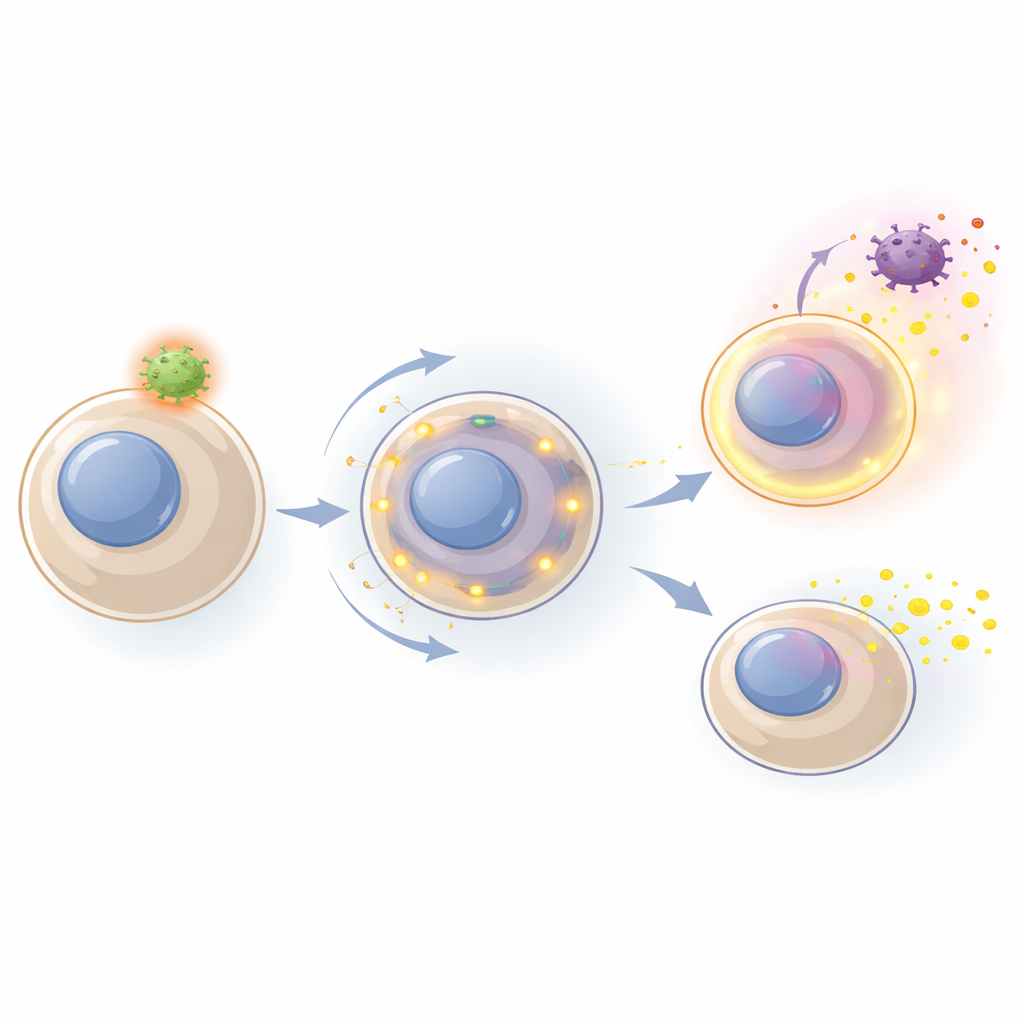
To uncover how cells “remembered” the earlier BCG exposure, the scientists examined a specific histone mark called H3K27ac, which is associated with active switches in the genome. Weeks after vaccination, they found hundreds of regions in monocyte and lung macrophage DNA where this mark was altered in BCG-treated animals compared with controls. In monocytes, many of these changes lay near genes involved in immune regulation and cytokine control, hinting that BCG leaves lasting chemical traces that make certain genes easier to turn on later. Some of the altered regions overlapped with sites identified in human studies, suggesting that parts of this training program are shared across species, while many other regions appeared to be cattle-specific.
What this means for animal and human health
Taken together, the findings show that a standard BCG shot can re-shape the early immune defenses of cattle: their monocytes and lung macrophages become more capable of unleashing strong inflammatory reactions when they encounter new threats. This shift is tied not only to what the cells do—secreting more cytokines and activating more genes—but also to how their genetic material is packaged and marked. For a lay reader, the key idea is that innate immune cells are not as “forgetful” as once thought. Instead, they can carry a biochemical memory of past challenges that helps them respond more vigorously the next time. Understanding and harnessing this kind of trained immunity could lead to smarter vaccine strategies and hardier livestock, and may even inspire new approaches to boosting human resilience against a wide range of infections.
Citation: Samuel, B.E.R., Yang, P., Tuggle, C.K. et al. Integrative profiling of transcriptome and H3K27ac modification reveals changes associated with BCG-induced trained immunity in bovine immune cells. Sci Rep 16, 8216 (2026). https://doi.org/10.1038/s41598-026-39580-7
Keywords: trained immunity, BCG vaccine, cattle health, innate immune cells, epigenetic changes