Clear Sky Science · en
Community-level influenza activity modifies the association between ambient air pollution and acute respiratory emergency visits in six U.S. Cities
Why this matters for your winter health
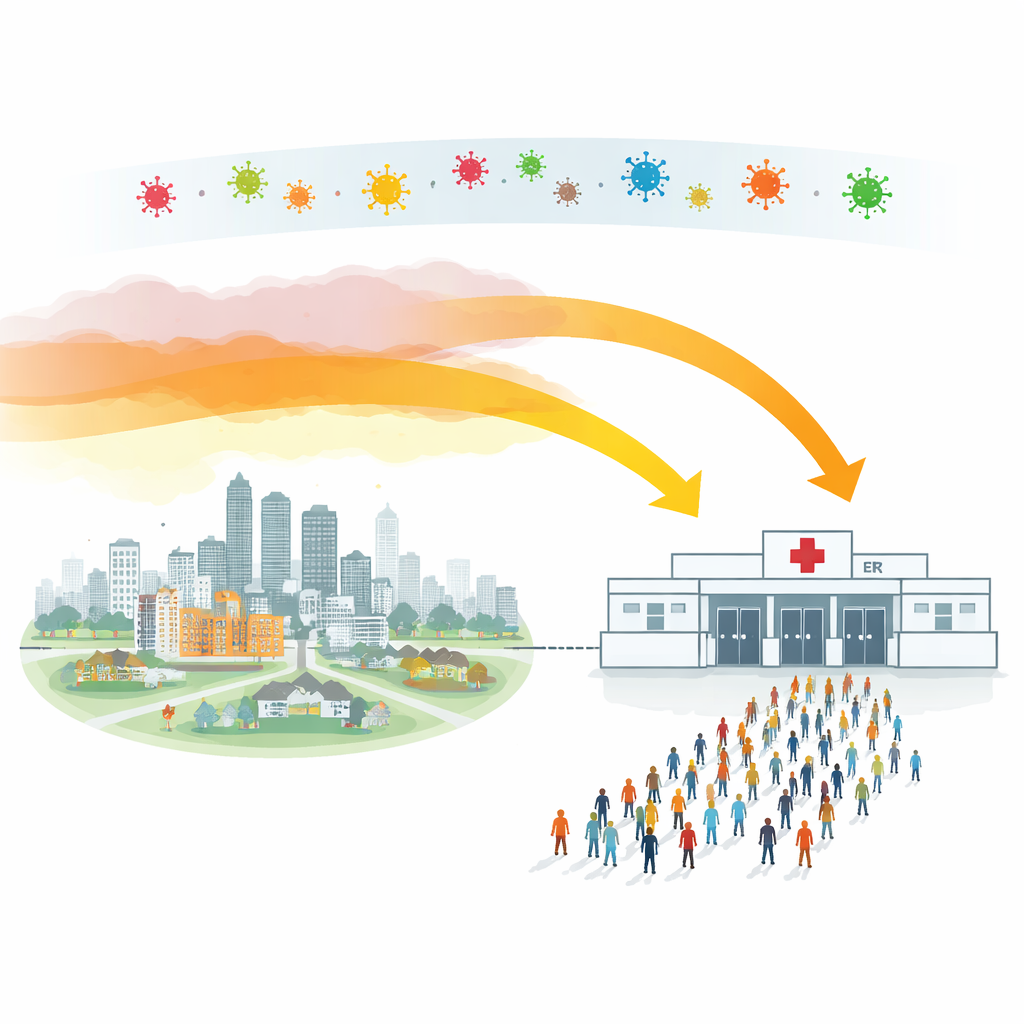
Every winter, two invisible threats often peak at the same time: dirty air and the flu. Each can irritate the lungs and send people to the emergency room. This study asks a crucial question for everyday health and hospital planning: when flu is circulating in a community, does breathing polluted air make it even more likely that people will rush to the emergency department with serious breathing problems?
Tracking real people in real cities
The researchers examined more than 6.6 million emergency department visits for breathing issues over a decade of flu seasons in six U.S. metropolitan areas, including Atlanta, San Francisco, Baltimore, Albany, Rochester and Salt Lake City. They focused on visits for all respiratory illnesses combined, as well as pneumonia, asthma and chronic obstructive pulmonary disease (COPD). For each city and day, they matched hospital records with detailed estimates of fine particle pollution (known as PM2.5) and nitrogen dioxide, a gas closely tied to traffic and combustion. To capture how much flu was actually circulating in each community, they used weekly rates of lab-confirmed influenza hospitalizations from a national surveillance network, rather than relying on less precise symptom codes.
Dirty air raises the risk on its own
Looking first at pollution alone, the study found that short-term increases in fine particles were consistently linked to more breathing-related emergency visits during flu season. Across the six cities, a typical jump in PM2.5 was associated with roughly 1–3 percent more visits for overall respiratory problems, pneumonia, asthma and COPD. Nitrogen dioxide showed smaller and less consistent effects: it clearly increased emergency visits for asthma and COPD in the combined analysis, but its impact varied more from city to city. Importantly, even after the models accounted for how intense the flu season was in a given week, the link between air pollution and emergency visits barely weakened, showing that pollution itself is an independent driver of acute breathing problems.
When flu and bad air collide
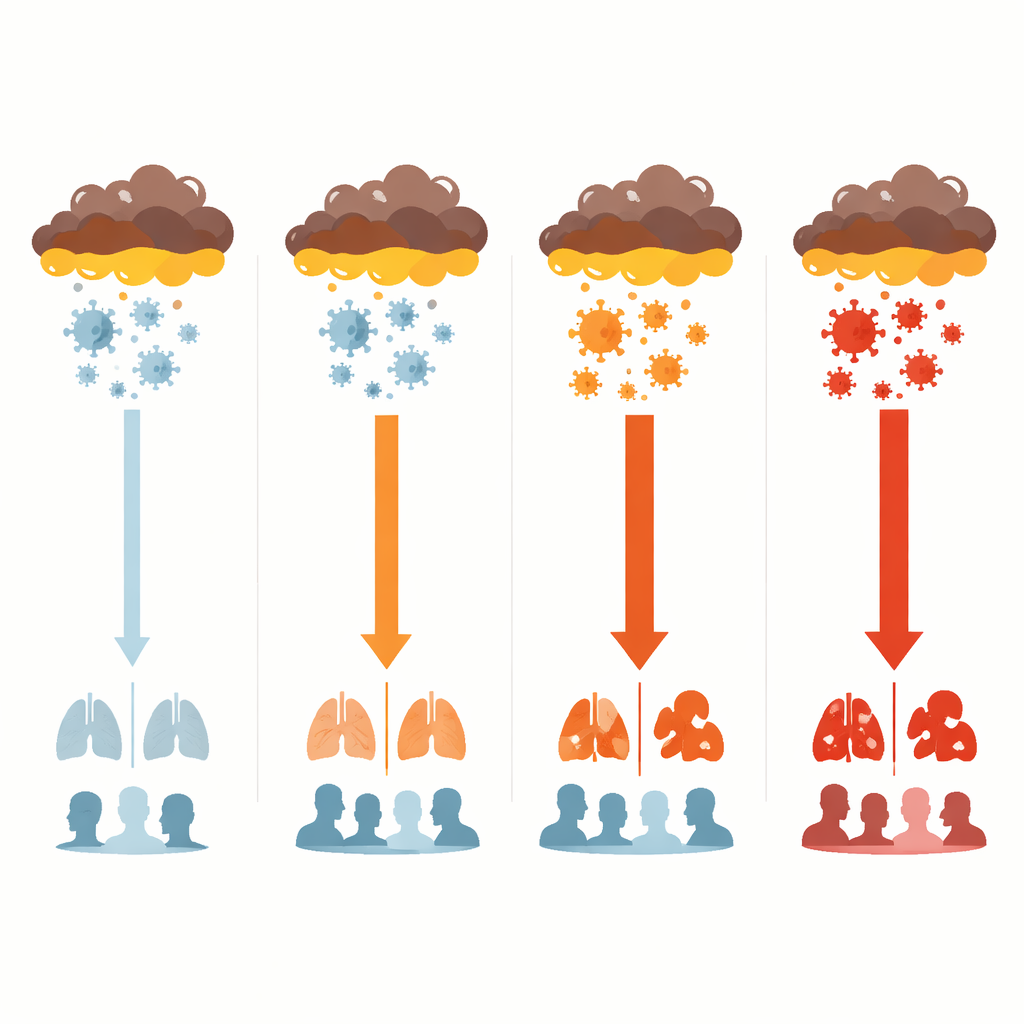
The heart of the study asked whether weeks with more flu activity changed how strongly pollution affected emergency visits. To test this, the team compared pollution effects during weeks with low, moderate and high flu levels. They found that the relationship is not simple: in many cases, pollution had the biggest impact when flu activity was moderate rather than at its very highest. For example, in Atlanta, a typical rise in fine particles barely changed respiratory visits when flu activity was low, but during peak flu weeks the same pollution increase was linked to about a 3–4 percent rise in emergency visits. San Francisco showed a similar amplification pattern. For nitrogen dioxide, the clearest pattern appeared for COPD: in the pooled results, the risk connected to this gas grew steadily as flu activity rose. Overall, the results suggest that even modest levels of circulating flu can “prime” the population so that extra pollution triggers more emergency breathing crises.
Why the patterns differ by place
The strength and shape of these interactions varied across cities, reflecting differences in local pollution sources, weather and population health. In some locations, like Salt Lake City, wintertime pollution is driven by cold-air inversions that trap emissions and favor certain chemical mixtures. In others, such as the San Francisco Bay Area, wood burning, traffic and occasional wildfire smoke play larger roles. These differences mean that the same measured level of particles or nitrogen dioxide can represent very different chemical cocktails. The authors argue that such local contrasts, combined with variations in healthcare use and underlying illness, likely explain why some cities showed strong amplification of pollution effects during high-flu weeks, while places like Albany showed weaker or even reversed patterns.
What this means for protecting people
For the public, the main message is that wintertime air quality and flu activity are not separate problems. Even small day-to-day increases in pollution can translate into more emergency visits for breathing trouble, and these effects often grow when flu is circulating in the community. For health officials and planners, the findings support integrated strategies: pairing air quality alerts, traffic or wood-burning controls, and indoor air cleaning with strong vaccination campaigns and flu surveillance. By reducing either pollution or flu transmission—especially during weeks when both are elevated—communities could meaningfully ease the seasonal strain on emergency departments and better protect people with vulnerable lungs.
Citation: Huang, X.F., Zhu, Q., Zhang, R. et al. Community-level influenza activity modifies the association between ambient air pollution and acute respiratory emergency visits in six U.S. Cities. Sci Rep 16, 9873 (2026). https://doi.org/10.1038/s41598-026-39576-3
Keywords: air pollution, seasonal influenza, respiratory emergencies, PM2.5 and NO2, public health surveillance