Clear Sky Science · en
Effect of thermal and gold nanoparticles on the optoelectronic properties of graphene oxide
Light Sensors Built from Ultra-Thin Carbon Sheets
From smartphone cameras to fiber‑optic networks, modern life depends on devices that can turn light into electrical signals. Researchers are racing to make these “eyes of electronics” cheaper, thinner, and more flexible. This study explores how a carbon‑based material called graphene oxide, gently heated and sprinkled with tiny gold particles, behaves as a light sensor—and what trade‑offs appear when you try to squeeze both high sensitivity and long‑term stability out of an atom‑thin film.
From Rusty Graphene to Repaired Carbon Sheets
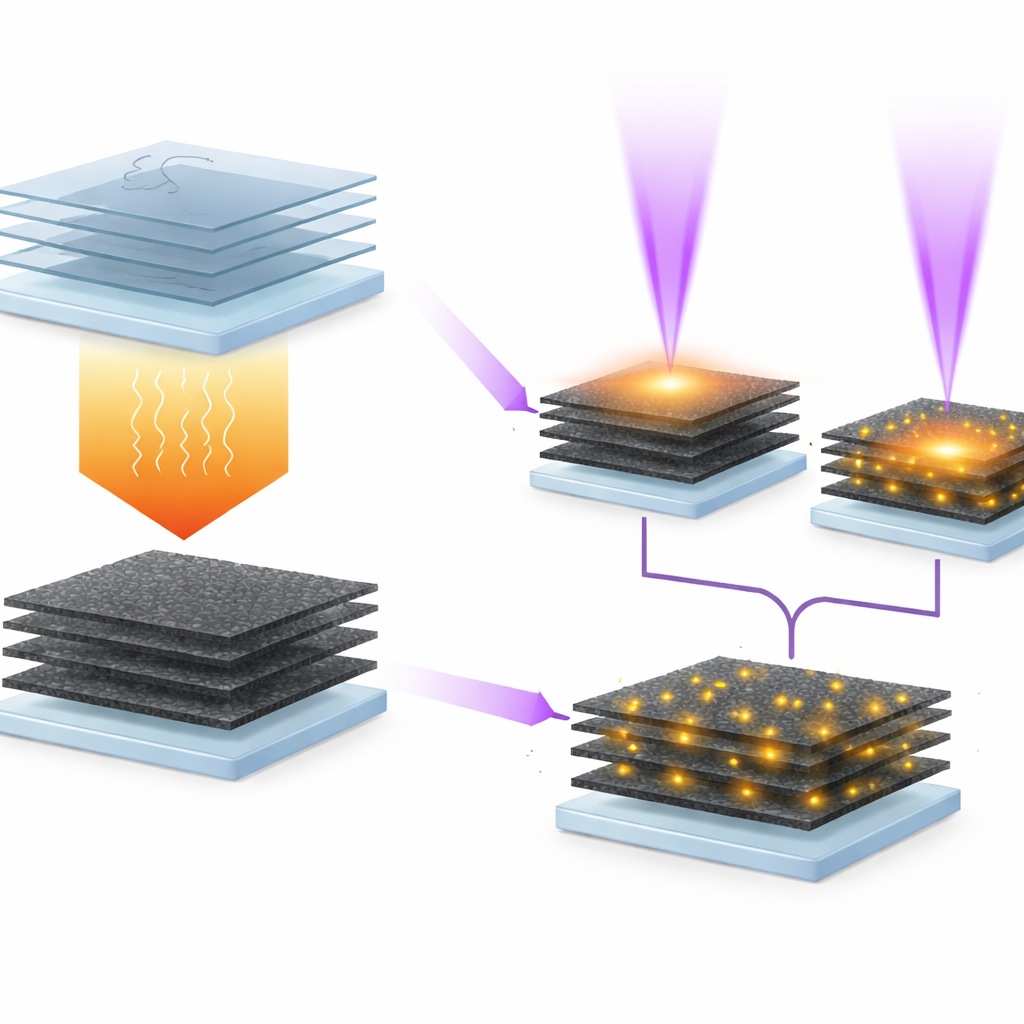
Graphene is a single layer of carbon atoms known for its remarkable electrical conductivity. Graphene oxide is often described as a “rusted” version of graphene: oxygen‑containing groups cling to the carbon sheet, breaking up its smooth network for carrying charge and turning it into a poor conductor. The authors began with thin films of graphene oxide on glass and then gently heated them to about 150 °C. This mild baking step stripped away part of the unwanted oxygen, partially “repairing” the carbon network and converting graphene oxide into what is called reduced graphene oxide. That repair job, though incomplete, boosted the material’s ability to carry current by several orders of magnitude, laying the groundwork for a functional light detector.
Sprinkling in Gold: Help and Hindrance
To further tune the films, the team added gold nanoparticles—tiny clusters of gold only about 25 nanometers across—to the graphene oxide solution before coating the glass. During heating, these particles nestled between or on top of the carbon sheets. Microscopy and X‑ray measurements confirmed that gold was not just loosely mixed in, but integrated into the layered structure, changing the spacing and ordering of the sheets. In principle, metal nanoparticles can enhance how a material interacts with light and sometimes even create new paths for charge to move. But they can also clump together, forming roadblocks that scatter electrons instead of guiding them.
How the Films Behave under Violet Light
The researchers then tested how the different films responded to a violet laser similar in color to the edge of visible light. Pure graphene oxide and gold‑decorated graphene oxide without heating barely reacted: their currents under illumination were nearly indistinguishable from their dark values. After thermal treatment, the picture changed dramatically. The reduced graphene oxide film generated a much larger photocurrent—about 33 microamperes under the chosen conditions—and a higher “responsivity,” meaning more electrical signal per unit of incoming light. When the gold nanoparticles were present in the reduced film, the photocurrent dropped to roughly one‑third of that value, indicating that gold, in the specific amount and distribution used here, actually limited how much extra current the light could drive.
Speed, Memory, and Stability of the Light Signal
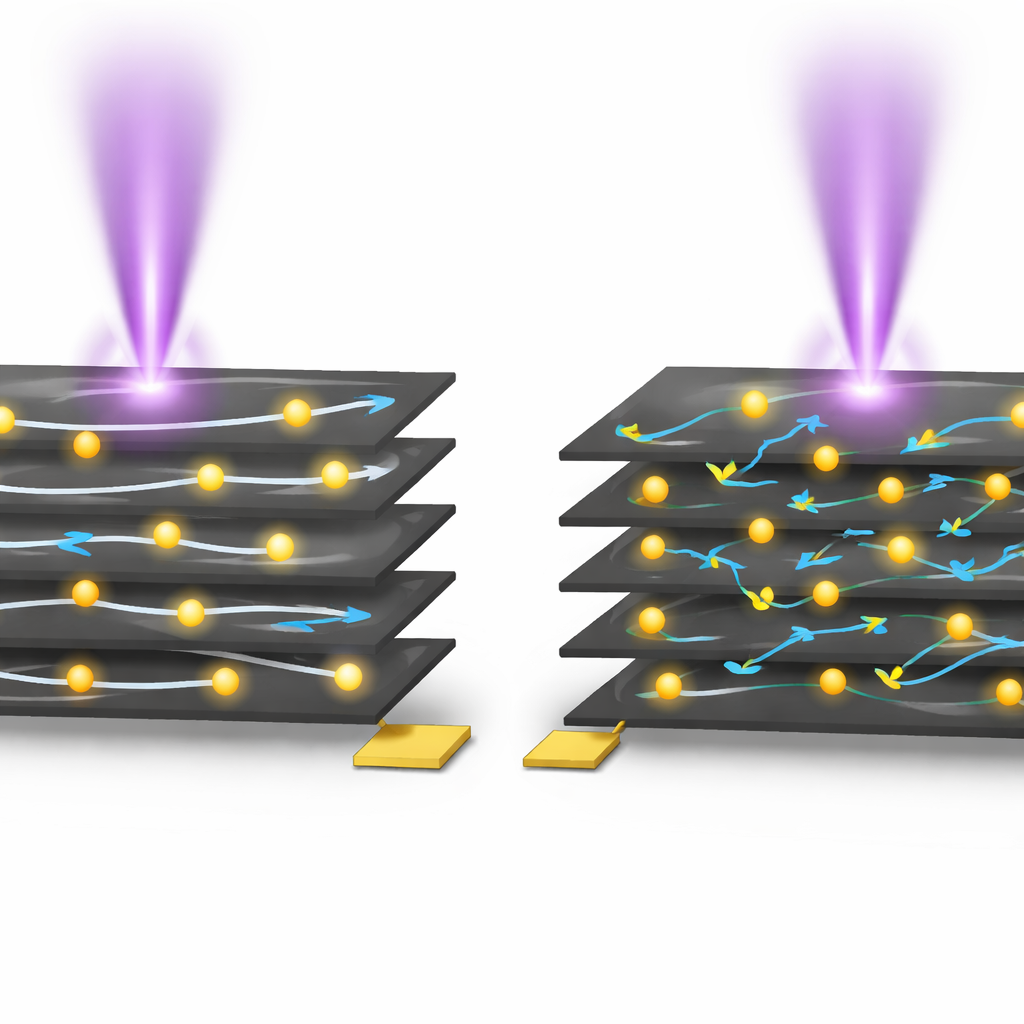
Performance, however, is not only about strength of signal; it is also about how cleanly and quickly the device turns on and off. When the laser was switched off, the reduced graphene oxide film’s current took several tens of seconds to relax and never quite returned to its original “dark” level. This lingering current suggests that defects and leftover oxygen groups in the film trap charge, giving the material a kind of short‑term memory of past illumination. In contrast, the reduced graphene oxide with gold snapped back almost perfectly to its starting current after each light pulse, even though its signal was weaker. Its rise in photocurrent was slightly faster as well. The gold particles appear to reshape the local electrical landscape, encouraging charge to recombine or escape more cleanly once the light is gone, which improves reversibility but at the cost of peak sensitivity.
Balancing Brightness and Reliability
In everyday terms, the study shows that gentle heating is the main ingredient that turns graphene oxide films into working light sensors, dramatically brightening their electrical response. Adding gold nanoparticles, at least in the way done here, dims that response but makes the sensor’s behavior more repeatable and stable over many on–off cycles. To build practical graphene‑based photodetectors—devices that might one day be printed onto flexible plastic or woven into textiles—engineers will need to fine‑tune how much gold they add and how uniformly it spreads. The sweet spot will be a design that keeps most of the strong signal provided by reduced graphene oxide while borrowing the steadiness and quick reset that gold nanoparticles can offer.
Citation: Taheri, M., Feizabadi, Z. Effect of thermal and gold nanoparticles on the optoelectronic properties of graphene oxide. Sci Rep 16, 9180 (2026). https://doi.org/10.1038/s41598-026-39573-6
Keywords: graphene photodetector, reduced graphene oxide, gold nanoparticles, thin film sensors, optoelectronic materials